

On this page
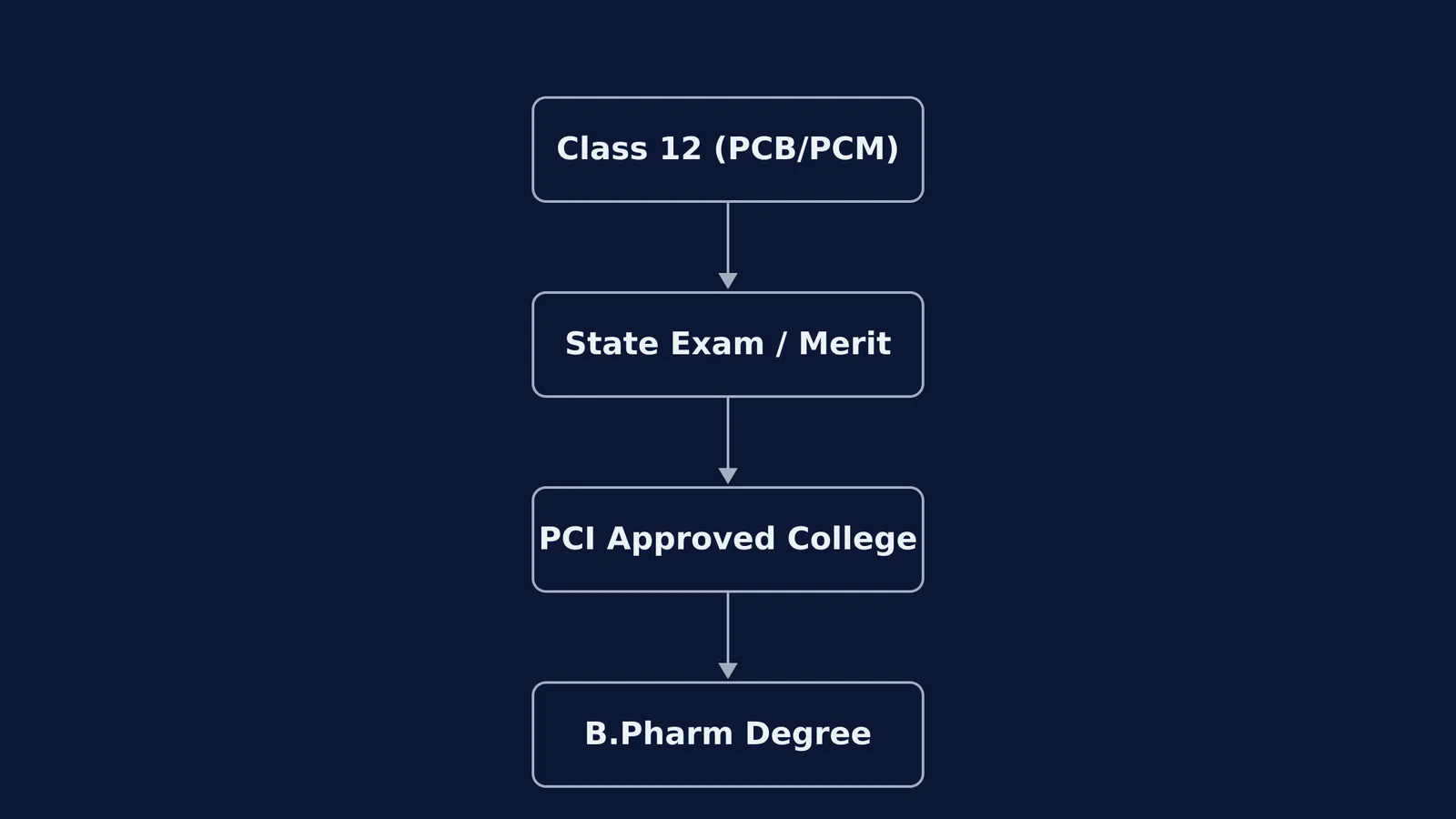
The Bachelor of Pharmacy (B.Pharm) is a four-year undergraduate professional degree divided into eight semesters, bridging chemical sciences with healthcare delivery. For students completing Class 12, pharmacy offers versatile opportunities across clinical formulation, drug discovery, quality assurance, and regulatory affairs. Navigating admissions successfully requires understanding state entrance exams, merit-based counselling systems, and essential regulatory safeguards.
Who is eligible for B Pharm admission after 12th?
Eligibility for the B.Pharm programme is governed nationally by the Pharmacy Council of India (PCI). Candidates must pass the 10+2 examination with English, Physics, and Chemistry, alongside either Mathematics or Biology. Both PCM and PCB students are eligible to enroll, provided they meet the academic requirements under the PCI B.Pharm Regulations.
Candidates must reach at least 17 years of age on or before December 31st of the admission year. While the PCI only requires passing marks, state exams like West Bengal's WBJEE mandate a minimum of 45% aggregate in core science subjects for General category candidates, and 40% for reserved categories. For students building foundational clarity across physical chemistry and biology before entrance tests, the Fermi Concept Library covers every concept in physics, chemistry, biology, mathematics and computing, each with its own lesson and its place in the map.
Which entrance exams lead to B Pharm admission?
Unlike medical education, there is no single mandatory national exam like NEET-UG that governs every pharmacy seat across India. Instead, admissions are distributed across state-level entrance tests, national university examinations, and institutional assessments.
In Maharashtra, the State Common Entrance Test Cell administers MHT CET for its Centralized Admission Process (CAP), with All India seats accepting either MHT CET or NEET-UG scores. In West Bengal, WBJEE generates a dedicated Pharmacy Merit Rank (PMR), while private colleges allocate 10% of their intake to JEE Main rank holders. Karnataka allocates government quota seats via KCET, while central universities admit through the Common University Entrance Test (CUET-UG).
Comparing these varied entrance formats is a valuable exercise when evaluating alternative healthcare careers alongside traditional clinical routes. Mastering multi-step calculations in physical chemistry and reaction kinetics requires structured practice; the Fermi Problem Library provides worked problems with a step-by-step solver that explains the reasoning rather than printing an answer.
How does merit-based direct admission work?
Not every state requires candidates to write a competitive entrance exam. Several systems operate counselling based strictly on Class 12 board examination marks.
Private universities and colleges offering management quota seats also accept applications based on 10+2 marks. The operational dynamics of document verification and choice filling in these systems closely mirror state quota counselling procedures.
How do you verify if a pharmacy college is PCI approved?
Institutional accreditation is the single most critical factor in pharmacy admissions. On March 5, 2020, the Supreme Court of India ruled in PCI v. Dr. S.K. Toshniwal Educational Trusts that the Pharmacy Act, 1948 is the supreme special statute governing pharmacy education in India, taking precedence over general technical education councils.
Under Section 12 of the Pharmacy Act, 1948, colleges must hold explicit PCI approval. To verify an institution, follow these steps on the official PCI portal:
Visit the official portal at pci.gov.in and open the "Approved Institutions" directory.
Select the approved degree institutions section to inspect B.Pharm approvals.
Locate the institution by state, checking its unique PCI ID and full legal name.
Verify that the approved intake capacity covers the current academic session.
Distinguish between full Section 12 approval and provisional permission known as "Conduct of Course."
What should you check before paying fees?
Before confirming admission or transferring non-refundable deposits, parents and students should run through a practical five-point checklist:
Verify the college's exact PCI identification number and sanctioned intake on the official council portal.
Confirm that the college is affiliated with a recognized state health university or government technical university, not an unaccredited autonomous entity.
Check that tuition matches the official fee structure set by the state fee regulatory committee, avoiding hidden development charges.
Inspect physical facilities to confirm active, equipped laboratories for pharmaceutics, pharmacology, pharmacognosy, and pharmaceutical chemistry.
Clarify structured hospital training agreements and industry internship networks needed to complete mandatory practical training hours.
Pharmacy offers extensive scope for students seeking STEM careers beyond engineering and medicine. When planning your study routine across Class 12 board preparations and upcoming entrance tests, Fermi's AI tutor can work out what you already know and build a plan for the session, keeping daily revision structured and efficient.


