

On this page
Every counselling season, new branch names appear on choice-filling lists: CSE (Cyber Security), CSE (IoT), CSE (IoT and Cyber Security including Blockchain Technology). They sound more job-ready than plain CSE. Before you rank one above the other, it helps to see what actually changes inside the four years.
We took two real syllabi from the same university and compared them line by line. The short version: in this example, the specialised branch is not CSE plus extra. It is CSE with some core subjects swapped out to make room.
What is the difference between CSE and CSE with a specialisation?
A specialised CSE branch is usually a separate branch you are admitted to, not an add-on you pick later. Pondicherry University's 2023-24 regulations list CSE (Internet of Things and Cyber Security including Blockchain Technology) as Branch XIII, separate from Branch IV, Computer Science and Engineering, and say branches are ordinarily allocated at admission.
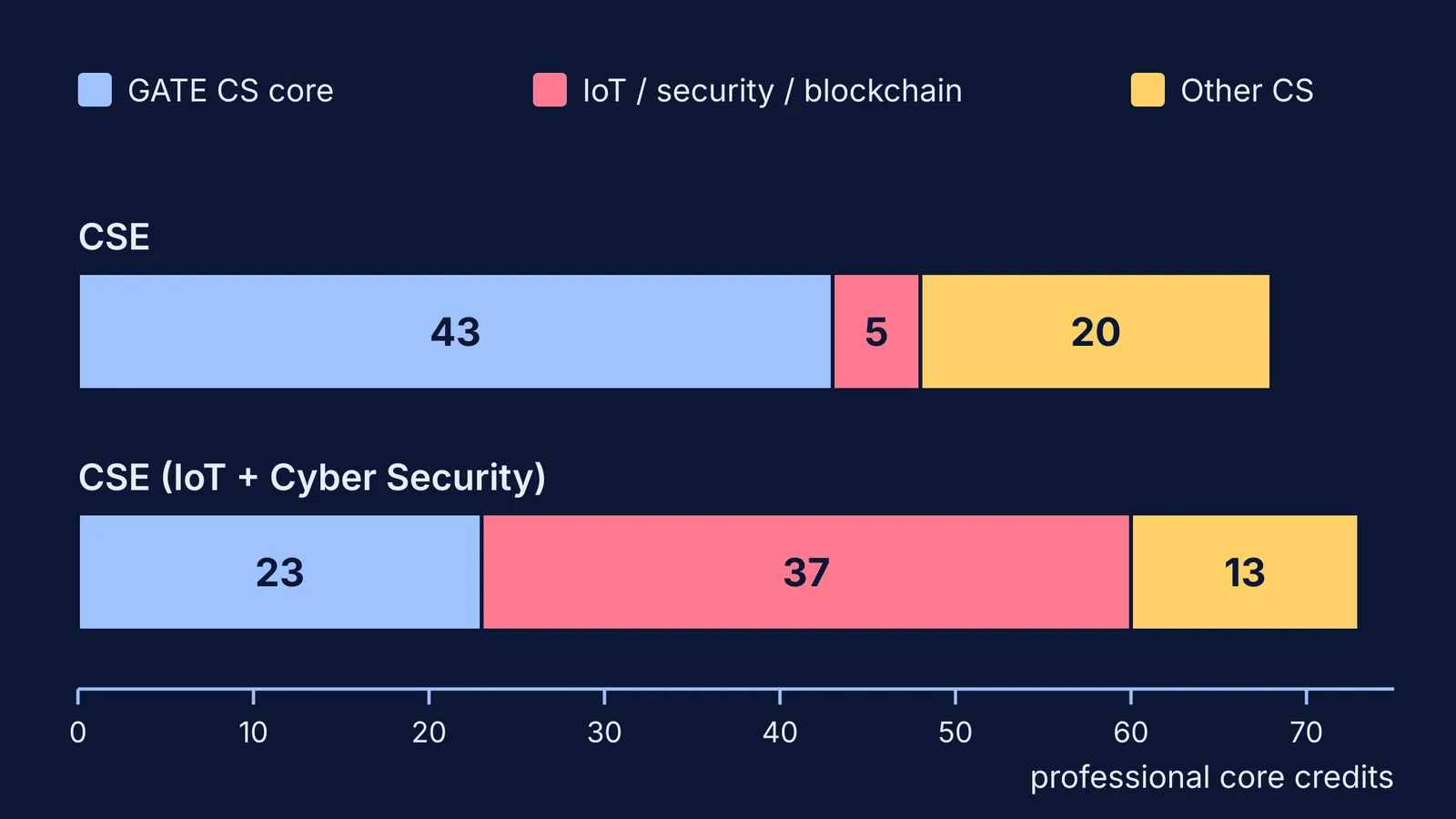
The total workload is about the same. The plain CSE curriculum is 169 credits; the IoT and cyber security curriculum is 165. The difference is in the professional core, the compulsory courses of your branch:
Plain CSE: 68 core credits, of which 43 go to subjects in the GATE CS syllabus, such as data structures, algorithms, computer organisation, operating systems, databases, networks, theory of computation, compilers and discrete maths. It also has a compulsory Cyber Security course and lab.
CSE (IoT and Cyber Security): 73 core credits, of which 23 go to those subjects and 37 go to IoT, embedded systems, cryptography, blockchain, ethical hacking, wireless and digital forensics.
These counts are our own tally of course titles and credits in the two official PDFs. Electives can change the picture, so treat this as one worked example, not a rule for every college.
What does a CSE cybersecurity or IoT branch drop?
In this example, the specialised branch keeps data structures, databases, networks, operating systems and theory of computation. Its compulsory list has no course titled Compiler Design, Computer Organisation and Architecture, Design and Analysis of Algorithms, Discrete Mathematics or Digital Electronics, all of which plain CSE requires (CSE syllabus, IoT and cyber security syllabus). It does have Microprocessor and Microcontroller (as does plain CSE), which covers some of the hardware ground.
Why do core subjects matter more than the label?
The core is what other people test you on. The GATE 2027 CS syllabus has engineering maths plus nine computer science subjects: digital logic, computer organisation, programming and data structures, algorithms, theory of computation, compiler design, operating systems, databases and computer networks. IoT and cyber security are not separate sections.
That matters because IIT Madras, which organises GATE 2027, says GATE scores are used for admission to postgraduate programmes and that several public sector undertakings use them for recruitment. Each paper carries 85 marks for the subject and 15 for general aptitude, according to the GATE 2027 papers page.
Specialisations also sit on top of the core. Security work starts from how operating systems and networks behave. IoT devices are small computers, so they lean on computer organisation and digital logic. Skip those, and you learn the vocabulary of IoT without the machinery underneath.
Is CSE with cybersecurity or IoT worth it for you?
It can be, if the college is good and the syllabus keeps the core. Use this five-step check before you fill choices:
Download the branch syllabus from the university or college website. If you cannot find one, treat that as a warning.
Find the professional core list and mark these nine: data structures, algorithms, discrete maths, computer organisation, operating systems, databases, networks, theory of computation, compilers.
Count how many are compulsory, and note which are missing.
Ask whether the missing subjects are offered as electives in your branch, and in which semester.
Compare colleges, not labels. A strong college's specialised branch with most of the core intact can beat a weaker college's plain CSE.
At a counselling help desk or on a college visit, you can say: Can you share the semester-wise syllabus for this branch? Are Compiler Design and Computer Organisation compulsory or electives? Can students in this branch take CSE electives?
If you already have a seat in a specialised branch, you are not stuck. Plan to cover the missing subjects yourself in your second and third years, one per semester, using the GATE list as your checklist. The Fermi Concept Library has a lesson for every concept in computing and mathematics, so you can fill a gap such as automata or recurrence relations topic by topic. If you do not know where to start, Fermi's AI tutor can work out what you already know and build a plan for the session.
What should you read next?
The same check works for other new branch names; our guide on whether a B.Tech in AI and ML is worth it walks through it. If you are torn between two close branches, see how CSE and IT differ. For the bigger trade-off, read how to choose between a better college and a better branch.
Pick the branch whose syllabus you have actually read.


