

On this page
Choosing between a prestigious institution and your preferred field of study is one of the most stressful parts of engineering counselling. You might find yourself staring at an allotment list, wondering whether a lower branch at an old IIT or top NIT is worth giving up Computer Science elsewhere.
There is no single correct answer, but understanding what you want from your career makes the choice clearer. A 2024 study on post-college earnings found that for STEM students, the specific discipline (major) is more consequential for future earnings than the college attended. However, that does not mean the college brand is useless—it depends entirely on what you plan to do after your four years.
When should you prioritize the college?
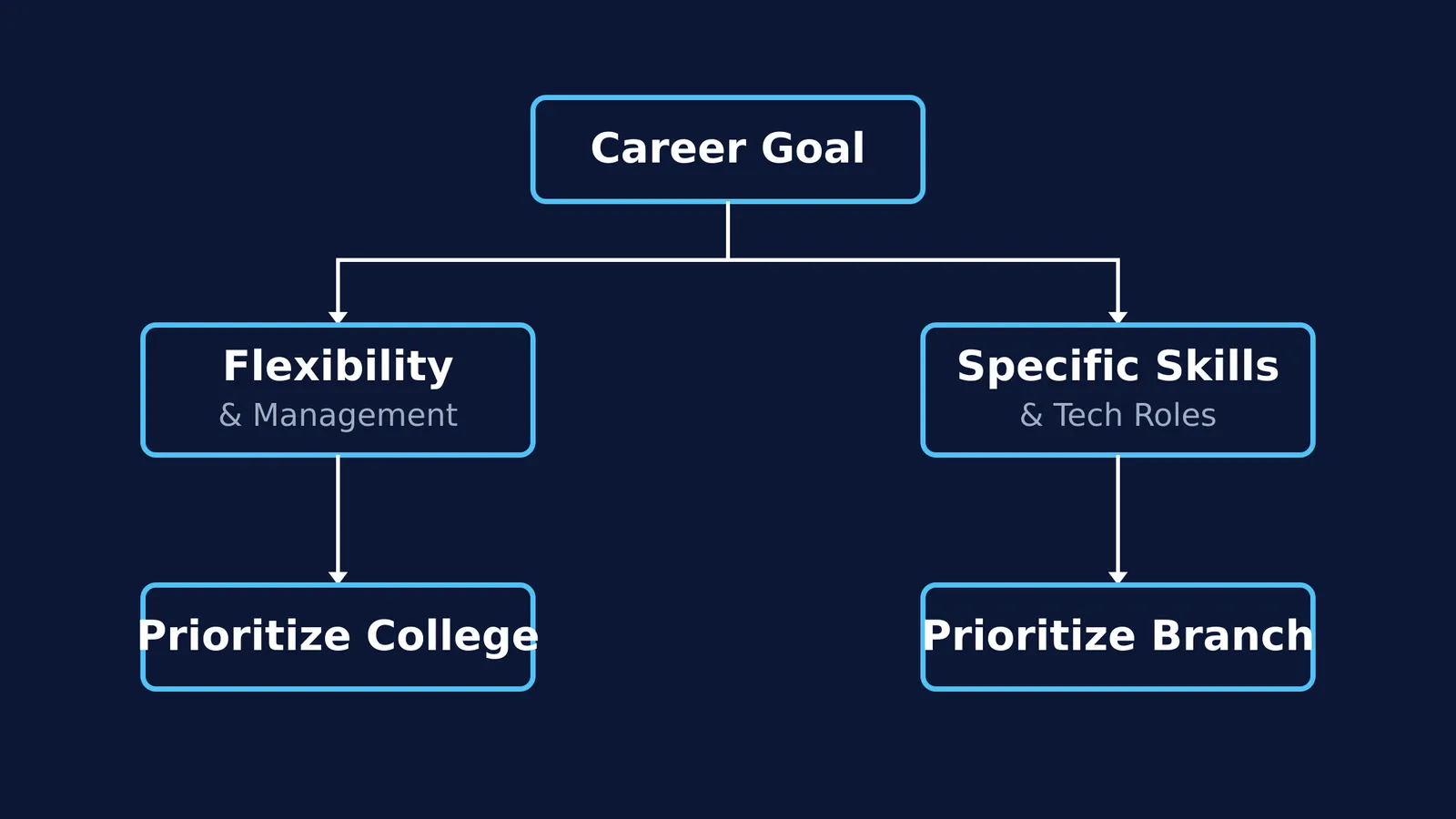
Choosing a top-tier college (like an older IIT, a top NIT, or BITS Pilani) over your preferred branch is often the better move if you value career flexibility.
You want a strong brand name: A top-tier college on your resume carries significant weight for MBA admissions, MS applications abroad, and civil services.
You are undecided about your career: Top colleges offer a diverse environment with numerous clubs, hackathons, and networking opportunities. This exposure helps you explore fields like finance, consulting, or entrepreneurship, which are often open to students from any branch.
You want to change branches later: Many top colleges allow a branch change after the first year based on your CGPA. If you are confident in your academic abilities, you can enter with a lower branch and upgrade.
No matter which branch you start in, you will face demanding foundation courses in your first year. The Fermi Concept Library contains every concept in physics, chemistry, biology, mathematics and computing, each with its own lesson and its place in the map, helping you build the strong base needed to maintain a high CGPA and keep your branch-change options open.
When should you prioritize the branch?
Choosing a specific branch (like Computer Science or Electronics) at a mid-tier college is usually the better choice if you want to master a specific skill set.
You have a specific passion: If you have been coding since childhood or are obsessed with robotics, forcing yourself to study a branch like Chemical or Civil Engineering can lead to burnout.
You want a direct tech job: If your primary goal is a high-paying software job, the branch matters most. Many tech companies only allow students from CSE, IT, and ECE to sit for their placement drives.
You plan for technical higher studies: If you want to pursue an M.Tech or PhD in a specific field, your undergraduate branch will determine your eligibility and foundational knowledge.
College or branch: which is more important in counselling?
A common strategy used during JoSAA or state counselling is to base your decision on the tier of the colleges you are comparing. For the very top institutions, the brand and ecosystem often outweigh branch limitations. For middle-tier colleges, it is best to maintain a balance by comparing branch-wise placement records. For lower-tier or local private colleges, the brand name carries less weight, so securing a high-demand branch like Computer Science is your best bet for employment.
To help make your decision objective, you can use a simple scoring sheet to weigh your options.
How to score your counselling options?
When you are stuck between two options, rate each on a scale of 1 to 5 (where 5 is the best). The option with the higher total score is likely the better fit for your goals.
Brand Value: How widely recognized is the college name for MBA or higher studies?
Career Alignment: How closely does this specific branch match the job you actually want to do?
Placement Record: What is the median salary for this specific branch at this college?
Peer Group: How competitive and diverse are the students on this campus?
Location and Costs: Is the campus located in a tech hub? Do the fees justify the expected starting salary?
If you are still exploring what options exist, you can read about talking about STEM careers beyond engineering and medicine, or prepare for what happens next by learning about your first semester at science or engineering college.
Ultimately, never choose a branch you absolutely dislike just for a college name. You will have to study those subjects for four years, and doing poorly in a "good" college can be a difficult hurdle to overcome.


