

On this page
What is the core academic difference between CSE and IT?
When engineering seat allotments begin, students and parents often face a stressful question: should you accept Information Technology (IT) if your rank misses Computer Science and Engineering (CSE)? The confusion usually stems from assuming the two branches lead to different careers. In academic reality, the difference is about orientation rather than division.
The global benchmark for computing curricula, published jointly by the ACM and IEEE Computer Society (CC2020 Task Force, DOI: 10.1145/3467967), describes computing as a spectrum between theoretical construction and organizational application. Computer Science focuses on mathematical foundations, computational complexity, and system architecture. Its primary objective is creating technology—designing algorithms, developing programming languages, and studying the limits of computation.
Information Technology focuses on deployment, integration, and user needs. Under the CC2020 framework, IT equips graduates to select, configure, secure, and maintain computing infrastructure for organizations. While a computer scientist builds database engines or compiler runtimes, an information technologist integrates those systems into enterprise workflows, manages network security, and maintains infrastructure.
How much do the CSE and IT syllabi actually overlap?
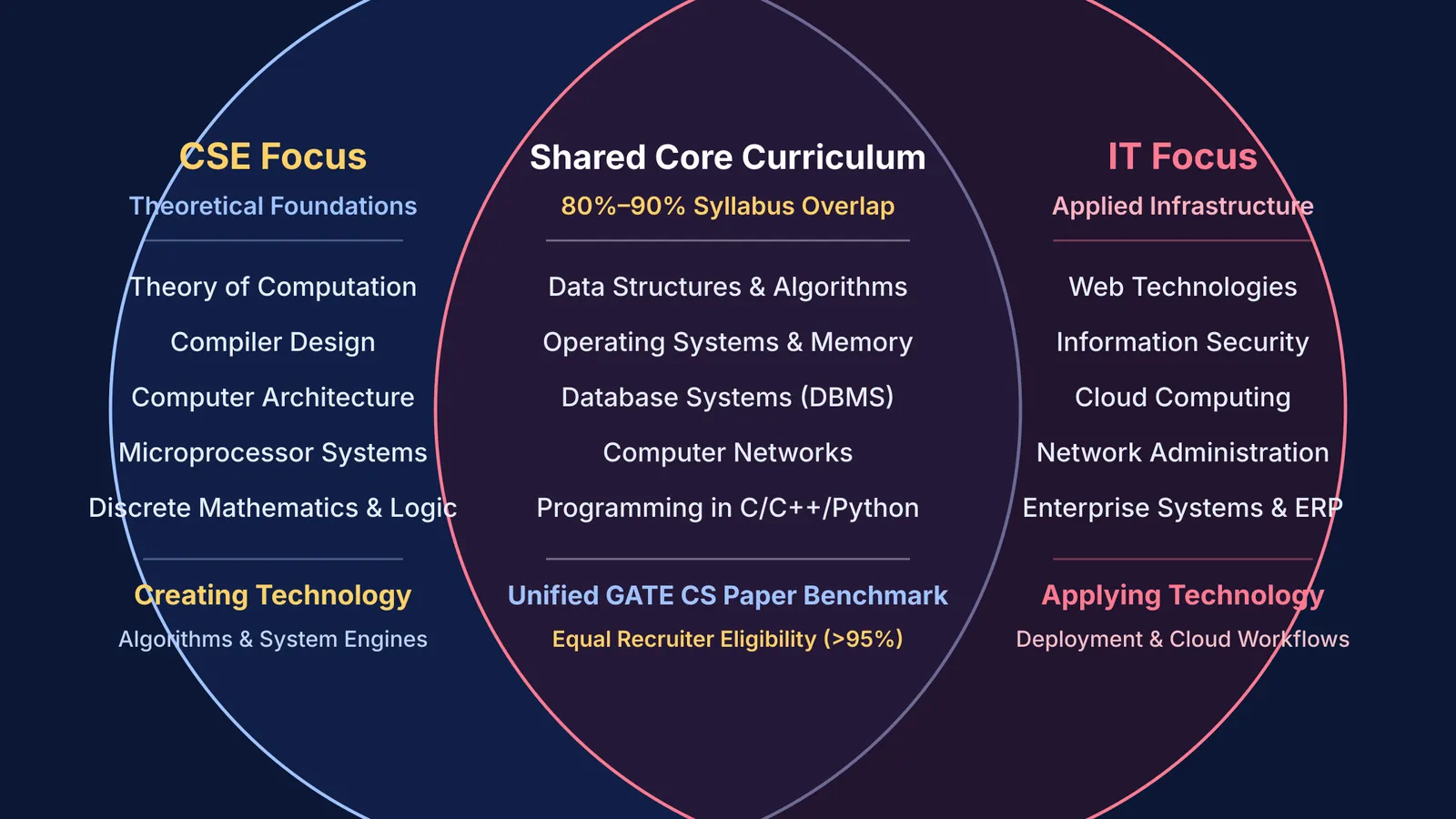
In Indian engineering institutes, syllabus divergence is remarkably small. Across undergraduate programmes at universities like the National Institute of Technology Karnataka (NITK), the CSE and IT curricula share between 80% and 90% common coursework.
During the first two years, both branches complete identical foundational subjects:
Programming in C, C++, and Python
Data Structures and Algorithms (DSA)
Operating Systems (OS) and memory management
Database Management Systems (DBMS) and SQL
Computer Networks and standard communication protocols
The divergence occurs in the final three semesters:
CSE emphasizes theoretical computing: Students take Theory of Computation, Compiler Design, Advanced Computer Architecture, and Microprocessor Systems.
IT emphasizes applied infrastructure: Students study Web Technologies, Information Security, Cloud Systems, and Enterprise Software.
The national exam structure confirms this common foundation. In the Graduate Aptitude Test in Engineering (GATE), authorities discontinued the separate IT paper in 2009 and merged both disciplines under paper code CS ("Computer Science and Information Technology"). Every candidate from both branches sits for the same paper, tested on identical mathematics and systems fundamentals.
If you are preparing for your first year of computing courses, the Fermi Concept Library covers every concept in physics, chemistry, biology, mathematics and computing, each with its own lesson and its place in the map.
Do campus placements and tech recruiters treat IT differently from CSE?
For students and parents, the foremost question is hiring. Across campus placement drives documented at institutes like the National Institute of Technology Karnataka, more than 95% of software and technology recruiters treat CSE and IT candidates as completely equivalent.
Whether a company is a product firm (such as Google or Microsoft) or a tech consultancy (such as Infosys or TCS), recruitment notices list CSE and IT together. Both groups take the same coding assessments and interview rounds. Technical interviewers evaluate candidates on Data Structures and Algorithms, system design, and coding projects—not the branch name on their degree.
The main difference is the closing rank during admissions. Because of popular preference, CSE cut-offs close higher. In national seat allocation through JoSAA counselling, the 2024 Other State open closing rank at NIT Surathkal was 1,615 for CSE and 4,800 for IT. Yet on campus, both batches share the same placement drives and report similar salary packages.
Several premier institutes focus entirely on IT. The Indian Institute of Information Technology (IIIT) Allahabad does not offer a traditional CSE branch; its flagship B.Tech in Information Technology consistently achieves top coding and placement outcomes nationwide.
Families navigating choice filling can consult our guide to JoSAA counselling for parents, review options in CSAB special rounds, or explore state routes in TNEA engineering admission.
How should you choose between CSE and IT during engineering counselling?
When completing your choice list, use this three-step decision framework:
Prioritise institute reputation over branch name: IT at a top NIT or IIIT provides stronger coding peers, alumni networks, and recruiter footfall than CSE at a lower-ranked private college.
Match your interest to theory or application: Choose CSE if you enjoy abstract mathematics, compiler construction, and system internals. Choose IT if you prefer building web platforms, cloud networks, and cybersecurity applications.
Keep postgraduate options open: For master's programmes (MS or M.Tech) in computer science, admissions committees require core prerequisites in algorithms, operating systems, and mathematics—areas both branches cover fully.
When learning algorithmic problem-solving and discrete mathematics, the Fermi Problem Library offers worked problems with a step-by-step solver that explains the reasoning rather than printing an answer. Building strong reasoning habits early gives you lasting confidence in whichever computing branch you choose.


