

On this page
Choosing between a core Computer Science and Engineering (CSE) degree and a specialised B.Tech in Artificial Intelligence and Machine Learning is one of the most common dilemmas for engineering aspirants today. With the All India Council for Technical Education (AICTE) reporting a 16% rise in approved B.Tech seats—driven largely by a 50% surge in these specialised computing streams—the landscape is shifting fast.
Is the AI and ML branch a safe bet, or are you better off keeping your options open with core CSE? The answer lies in the subjects you will actually study, and how they align with what employers look for in a rapidly changing tech industry.
B.Tech AI and ML vs CSE: What is the difference?
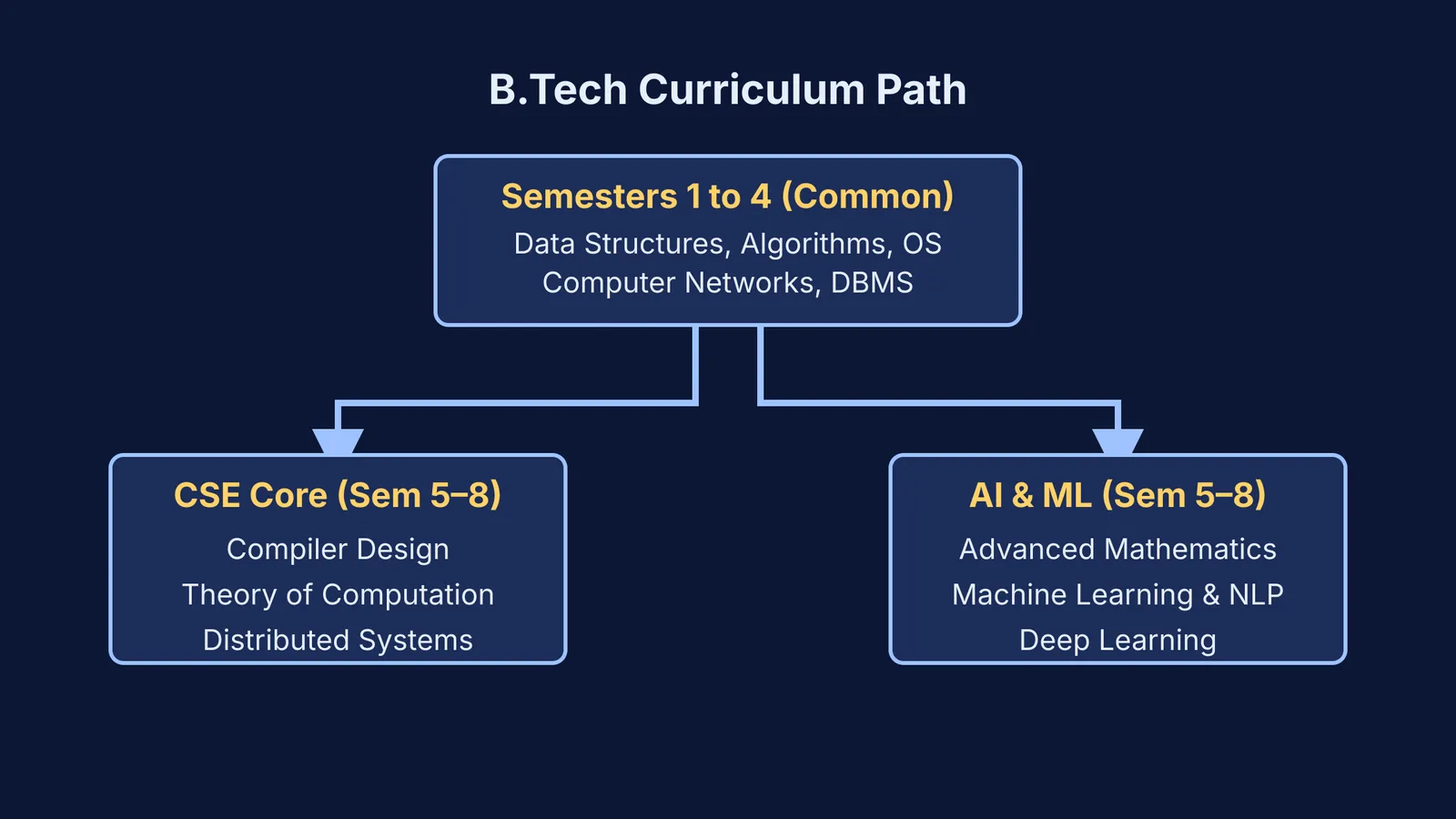
Both degrees are built on the same foundation. For the first two years (semesters one to four), your timetable will look identical regardless of the branch. You will learn the essentials of computing: programming in C and Java, Data Structures and Algorithms (DSA), Operating Systems, Database Management Systems, and Computer Networks.
These foundational semesters ensure that every engineering graduate knows how to write efficient code and understand how software interacts with hardware.
The divergence begins in the fifth semester. A core CSE degree maintains a broad focus on how computers and large-scale software systems work. The AI and ML specialisation trades some of these general computing subjects for a deep dive into data patterns, predictive modelling, and automation.
The core subjects you will actually study
If you choose core CSE, your third and fourth years will include subjects like Compiler Design, Theory of Computation, and Distributed Systems. These teach you how software languages are built and how to manage large-scale web applications across multiple servers.
If you opt for the AI and ML branch, you skip those broader software engineering topics in favour of:
Advanced Mathematics: You will spend far more time on Linear Algebra, finding patterns like Aⁿ for a matrix, and Probability, tackling complex with and without replacement probability problems.
Machine Learning and NLP: Training algorithms to recognise patterns in data and parsing human language.
Deep Learning: Building and fine-tuning neural networks for image recognition and generative AI tasks.
Because the AI branch is mathematically intense, strong fundamentals in calculus and linear algebra are non-negotiable. If you find yourself struggling with the mathematical theory behind these topics, the Fermi Concept Library has a lesson for every concept in mathematics and computing. If you are not sure where to start your revision, Fermi's AI tutor can work out what you already know and build a plan for the session.
Is B.Tech in AI and ML a good branch?
Yes, if you are certain about your interest in data science and automation. The industry is currently facing a massive talent gap. According to a 2024 NASSCOM report, 58% of employers cite low applicant volume as a key challenge in hiring AI talent, creating a high demand for engineers who understand these systems deeply. Companies are actively searching for professionals who can bridge the gap between traditional software engineering and intelligent data modelling.
However, a specialised degree is not a shortcut to a high-paying job. Employers in the AI field prioritise what you can build over what your degree certificate says. Your success will depend more on your GitHub portfolio, your ranking in Kaggle competitions, and the hands-on models you have trained rather than the specific name of your degree.
Keeping your options open
Core CSE is often considered the safer choice because it allows you to pivot to any tech role—whether that is web development, cloud architecture, or cybersecurity. It provides a versatile foundation that fits almost any entry-level software engineering job description.
If you are unsure about committing entirely to AI at 18, choose core CSE. You can still enter the AI field by taking electives in your final year, participating in hackathons, or learning the frameworks on your own time. But if you already know that algorithms, mathematics, and data are your calling, the B.Tech in AI and ML offers a two-year head start on the exact skills the industry is scrambling to hire today.


