

On this page
College timetables are lumpy: three lectures and a four-hour lab one day, a free afternoon lost to your phone the next. Plans that need a fixed gym hour often break in week two. A plan made of short pieces tied to things you already do is easier to keep. Here is the target, a weekly plan that reaches it, and a fallback for heavy weeks.
How much exercise do you actually need in college?
The World Health Organization's 2020 guidelines, published in the British Journal of Sports Medicine, set the target for adults aged 18 to 64.
Aerobic activity: 150 to 300 minutes of moderate-intensity activity a week, or 75 to 150 minutes of vigorous activity, or a mix.
Strength: muscle-strengthening activity that works all major muscle groups on 2 or more days a week.
Sitting: replacing sitting time with activity of any intensity, even light, brings health benefits.
Roughly, moderate means you can talk but not sing, like a brisk walk to the next block. Vigorous means you can only say a few words, like a fast game of football.
The WHO physical activity fact sheet estimates that 31% of the world's adults, about 1.8 billion people, were physically inactive in 2022. The same page says any amount of physical activity is better than none, and that all physical activity counts.
Do short bursts of exercise count?
Yes. WHO says all physical activity counts, so a 10-minute walk between classes is not wasted.
A 2022 study in Nature Medicine by Emmanuel Stamatakis and colleagues used wrist-worn activity trackers on 25,241 UK Biobank adults who did no leisure-time exercise. Their average age was about 62. It looked at short bursts of vigorous activity in everyday life, each lasting 1 to 2 minutes. People who did about 3 such bursts a day had a 38% to 40% lower risk of death from any cause or from cancer over about seven years than people who did none. This was an observational study of older UK adults, so it shows a link rather than proof, but it fits the WHO message that small amounts add up.
How do you fit exercise into a packed timetable?
Attach each piece of activity to something already on your timetable. Here is a worked week for a student with morning lectures and two lab afternoons.
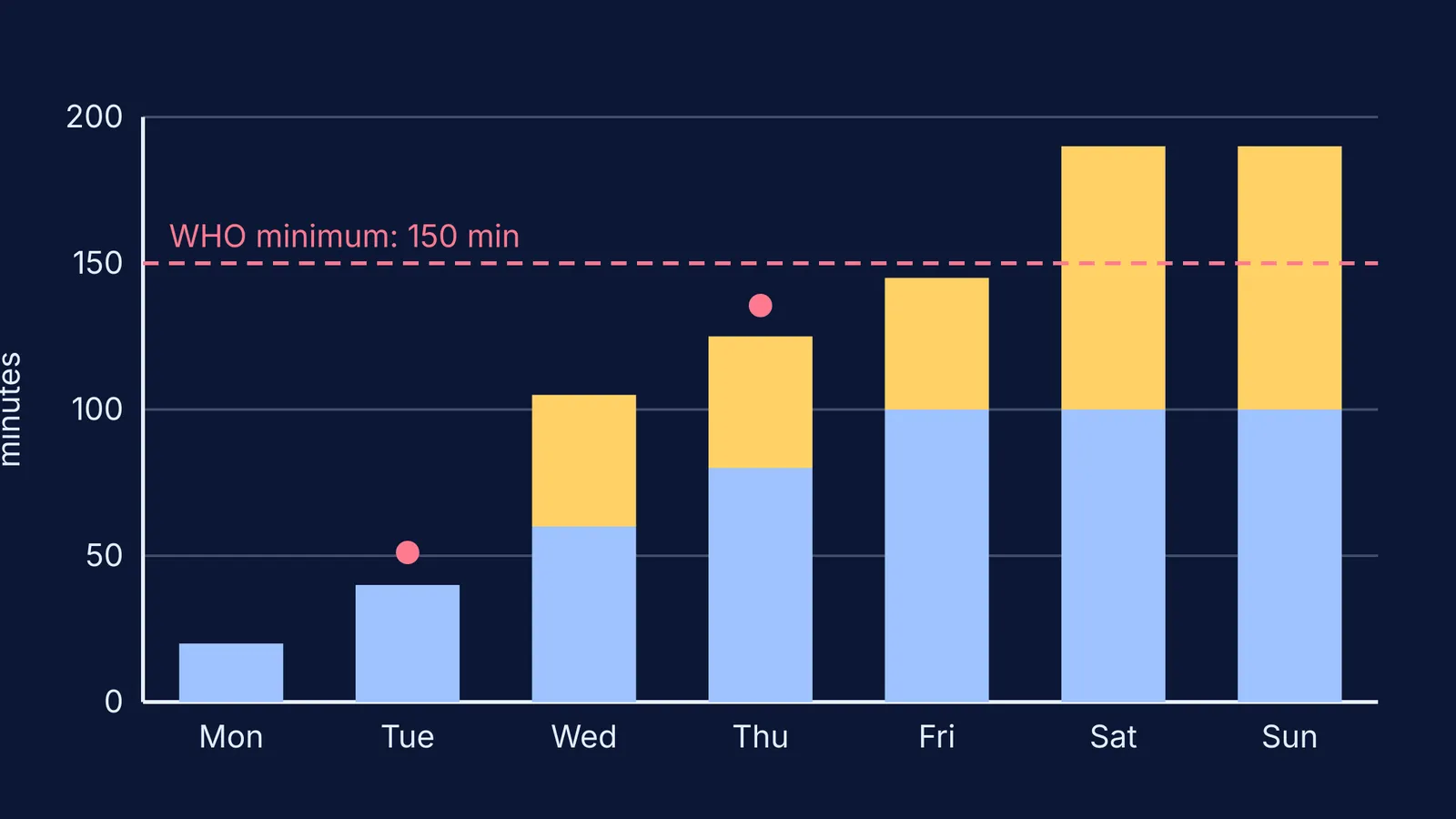
Monday to Friday: walk briskly for 10 minutes on the way to your first class and 10 minutes after lunch. That is 20 minutes a day, or 100 minutes by Friday.
Tuesday and Thursday: 15 minutes of squats, push-ups, lunges and planks in your hostel room before dinner. These are your 2 strength days.
Wednesday and Saturday: 45 minutes of campus sport, such as badminton, football or a run with friends. That adds 90 minutes.
Every day: take the stairs, and walk for a minute between long lab tasks.
Add it up: 100 minutes of walking plus 90 minutes of sport is 190 minutes, inside WHO's 150 to 300 range, with strength on 2 days.
To see these blocks in a full day, our daily routine for engineering college students lays out lectures, labs, meals and self-study hour by hour.
How can campus sports help without eating study time?
Team sport gets you moving and puts the session on a calendar friends expect you to keep. The UGC's guidelines on physical fitness and student well-being say that only 1 or 2% of students in a higher education institution take part in sport or use its sports facilities, even though every student pays sports fees. The same guidelines ask colleges to run weekly intramural tournaments, so ask your sports office what is already on.
Pick one sport, two fixed slots a week, and treat them like a lab you cannot skip. If you want to play for a team, read how to get into a college sports team and balance studies before trials.
Study sessions that drag on are often what eat the evening game. If you sit down without knowing where to start, Fermi's AI tutor can work out what you already know and build a plan for the session, so the slot you kept for sport stays free.
What should you do in exam or lab-heavy weeks?
Shrink the plan, do not drop it. Use this checklist:
Keep the two daily 10-minute walks; they double as a break from revision.
Swap the 45-minute game for one 20-minute brisk walk or jog.
Do one 10-minute strength session instead of two.
Break up long stretches of desk work with a short walk.
Return to the full plan the week after exams, starting at half the sport time.
If you are restarting after a long break, expect some stiffness. Our explainer on why muscles ache a day after exercise covers what is normal. If pain, dizziness or breathlessness worries you, see your campus doctor before you continue.
Start this week with just the two walks, then add the rest one piece at a time.


