

On this page
Getting into a college sports team and keeping your place requires more than just athletic talent. It demands serious time management, especially when your degree involves practical labs.
How much time do college sports take?
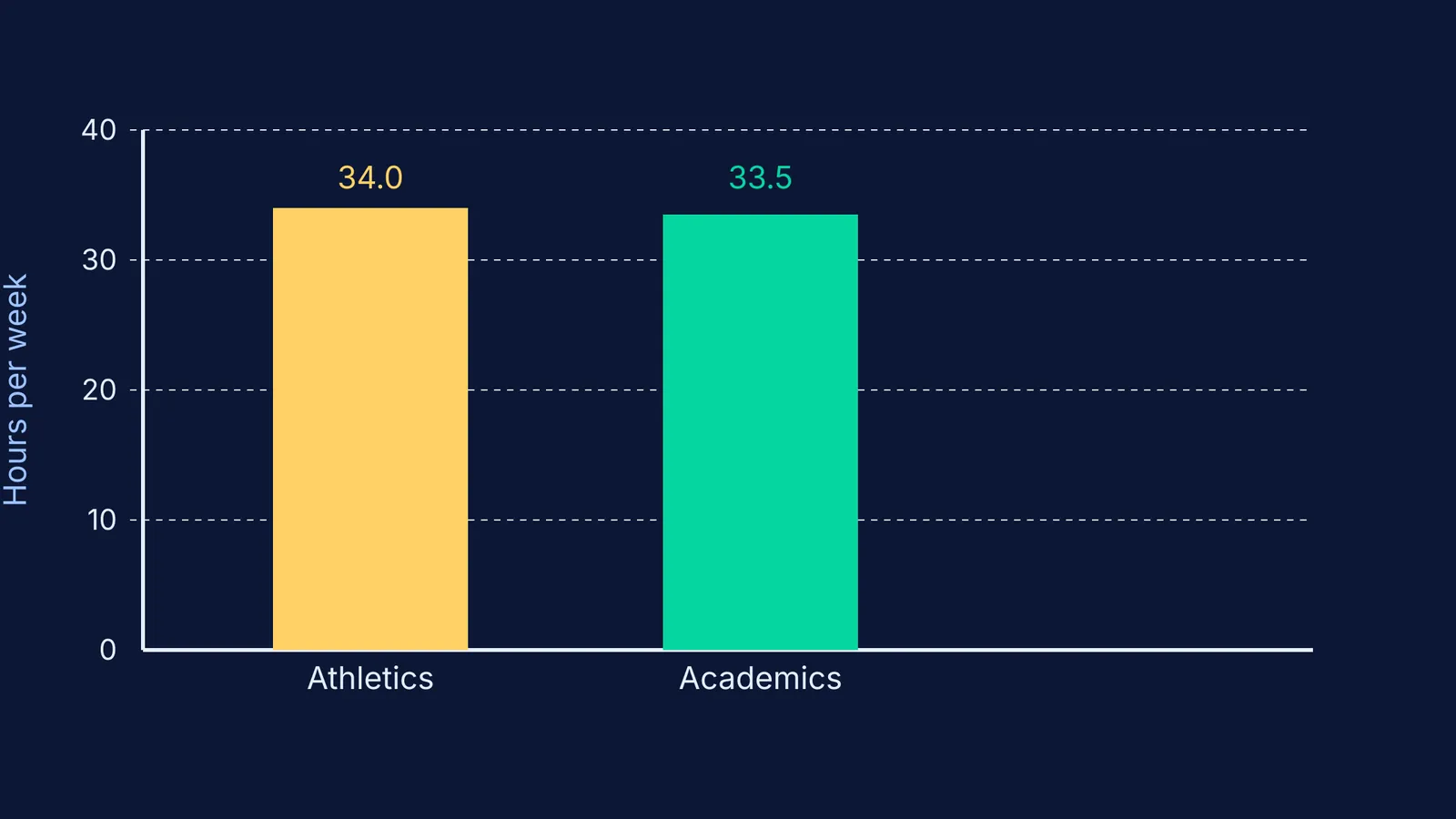
Before you commit to trials, it helps to know what you are signing up for. The 2025 NCAA GOALS study tracks the time commitments of student-athletes across divisions. According to the study, Division I athletes spend a median of 34.0 hours per week on athletic activities during the season.
This includes practice, competition, film study, travel, and medical treatment. At the same time, these students dedicate 33.5 hours per week to academic activities. That is nearly 70 hours a week combined. The study also notes that athletes report averaging under seven hours of sleep per night, leaving little room for error when balancing assignments and training.
How to get into a college sports team?
If you were not heavily recruited out of high school, you can still join a team as an unrecruited "walk-on." This means you must gain admission to the college on your own academic merit and attend an open tryout to earn a roster spot, according to NCSA Sports.
Clear your eligibility: Before you can step on the field or court, you must prove you are academically eligible. This requires a recent physical exam, proof of health insurance, and full-time enrollment (usually at least 12 credit hours).
Contact the coaching staff: Do not wait for an open trial announcement. Email the "Walk-On Coordinator" or an assistant coach early in your first semester with a concise introduction, your academic standing, and any highlight footage you have.
Attend the open tryout: Trials usually occur in the first few weeks of the semester. Expect to be tested on measurable physical traits (such as your vertical jump or agility) and position-specific skills. Coaches look for players who follow instructions perfectly and fit the team's culture.
How to manage missed lectures and labs?
Once you make the team, the real challenge begins. Missing classes for travel and away games is common. In fact, the 2010 NCAA GOALS study found that Division I baseball and basketball players report missing more than two classes per week during their competitive season.
While lectures can sometimes be recorded, science labs are strictly scheduled and require your physical presence. At the start of the semester, take your game schedule to your lab instructor. Many universities allow student-athletes to attend a different lab section during travel weeks if they coordinate it weeks in advance.
To survive the academic load, you must plan your day around school timings and treat your study blocks with the same discipline as your training schedule. Use travel time on buses or flights to read notes or solve problem sets.
What to do when you fall behind?
When you miss a difficult lecture on a complex topic, do not wait until the night before the exam to catch up. Fermi's AI tutor can work out what you already know and build a plan for the session, so you sit down to a clear next step. Rather than just giving you answers, it teaches you the concepts you missed by holding a line of reasoning and checking your understanding as it goes.
If you struggle to stay motivated through two years of preparation or a grueling college semester, remember that the discipline you learn in sports translates directly to academics.
How to handle the off-season?
You might expect a break when the season ends, but the time demands rarely drop. Approximately 67% of Division I athletes report spending as much or more time on their sport during the off-season as they do during the competitive season, according to the NCAA GOALS study.
Use this period to strengthen your academic foundation. If you find theoretical subjects hard to picture, the Fermi Simulation Lab has interactive simulations for the ideas that are easier to see than to read. Getting ahead during the off-season ensures you do not fall behind when heavy travel and matches resume.


