

On this page
If you wrote both the IISER Aptitude Test and JEE (Main), you may hold two offers that lead to different lives: one asking why something is true, one asking how to make it work. The right one depends on what you enjoy doing for hours.
What is the difference between IISER and NIT?
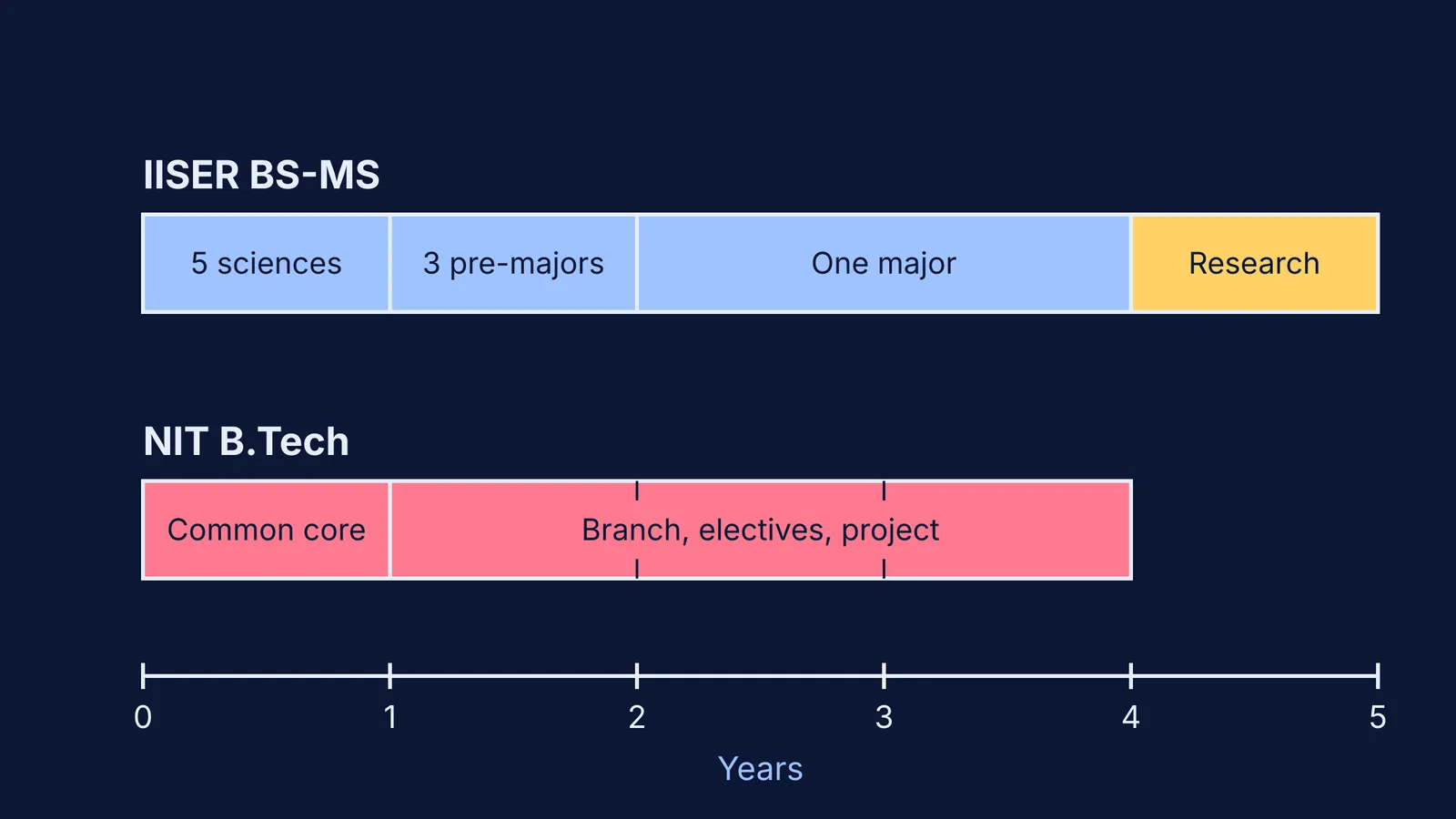
An IISER BS-MS is a five-year dual degree in the natural sciences. At IISER Kolkata, first-year students study biological, chemical, mathematical, physical and earth sciences; in the second year they pick three pre-majors; in the third and fourth years they study one major; and the fifth year is almost completely devoted to full-time research or a technical project, ending in a dissertation.
From 2024 onwards, IISERs admit BS-MS students only through the IISER Aptitude Test (IAT), according to IISER Pune's admissions page. IISER Bhopal lists the eligibility as at least three of biology, chemistry, mathematics and physics in Class 12, with 60% marks (55% for SC, ST and PwD candidates). Bhopal also runs BS and B.Tech programmes through the same test, so check each campus.
An NIT B.Tech is a four-year engineering degree. NIT Tiruchirappalli's B.Tech regulations set the duration at four academic years of two semesters each. The curriculum combines general core courses in mathematics, basic sciences, engineering sciences and humanities with courses in your engineering branch, electives and project work, and the first two semesters are common to all branches.
JoSAA 2026 managed seat allocation for 138 institutes, including 31 NITs, according to the JoSAA portal. The JoSAA 2026 business rules state that seat allocation in the NIT+ system is based on JEE (Main) rank, and that NIT seats are split into a Home State quota and an Other States quota.
Does interest matter as much as the college name?
The research suggests it matters. A 2012 meta-analysis by Christopher Nye, Rong Su, James Rounds and Fritz Drasgow identified 60 studies and about 568 correlations, and found that vocational interests were related to performance and persistence in both work and academic settings (Perspectives on Psychological Science). The fit between a person's interests and their environment predicted performance better than interest scores alone.
In plain terms: interest that fits the work is linked to doing well and sticking with it.
IISER or NIT: which suits you?
Answer these five questions on paper before choice filling.
When an idea in physics or chemistry clicks, do you want to know why it is true (IISER) or what you could build with it (NIT)?
Would a year-long research project, where the experiment might fail and the answer is unknown, excite you (IISER) or frustrate you (NIT)?
Are you happy to study all five sciences in year one, including biology and earth science (IISER), or do you want to focus on maths, physics and engineering from the start (NIT)?
Are you ready for five years and possibly a PhD after that (IISER), or do you want the option of a job after four (NIT)?
Which sounds better on a Saturday: an afternoon in a lab reading a paper (IISER) or an afternoon building a circuit or a robot (NIT)?
Four or five answers on one side is a clear signal. A three-two split means talk to students in each programme first.
How does the test work for a real choice?
Take a hypothetical student, Riya, with an IAT offer and a JEE (Main) rank that gets her civil engineering at an NIT. Her answers: why, excite, five sciences, ready for a PhD, the lab. Five IISER answers, so the NIT's pull is mostly its name. If her answers had been mostly NIT, the next question would be the branch, not the campus.
Unsure whether you love the why? Spend a week going past the syllabus on one topic you liked. The Fermi Concept Library covers every concept in physics, chemistry, biology, mathematics and computing, each with its own lesson, so you can follow a thread and notice whether it keeps pulling you.
What about careers after IISER or NIT?
The BS-MS is built around research, so the natural next step is often a PhD; our guide to building a research career and PhD in India explains what that path looks like. A B.Tech prepares you for engineering work, higher study in engineering, or a switch later. If you want both, read our explainer on the engineering physics branch, which sits between the two.
How do I explain my choice to my parents?
Try this: "IISER is five years with a research year at the end; NIT is four years of engineering. My answers show I enjoy the why more than the how, and research links interest fit to doing well. Can we talk to one current student from each before we decide?" Our piece on explaining IIT vs NIT to your family has more openers.
Write down your five answers tonight, then talk to one current student from each programme this week.


