

On this page
When your child begins preparing for engineering entrance exams, you are suddenly faced with an alphabet soup of institutes. You might hear that IITs are the ultimate goal, but that NITs offer a "home state" advantage, while IIITs are where the best coders go.
Understanding the difference between the Indian Institutes of Technology (IIT), National Institutes of Technology (NIT), and Indian Institutes of Information Technology (IIIT) is essential for making informed decisions during the counselling process. Here is what parents need to know about how these premier institutes differ.
What is the difference between IIT, NIT, and IIIT?
IITs (Indian Institutes of Technology) are the oldest and most prestigious engineering colleges in the country. They focus heavily on research, broad engineering disciplines (like Mechanical, Civil, and Aerospace), and pure sciences. Because of their legacy and global brand recognition, they are generally the top choice for students.
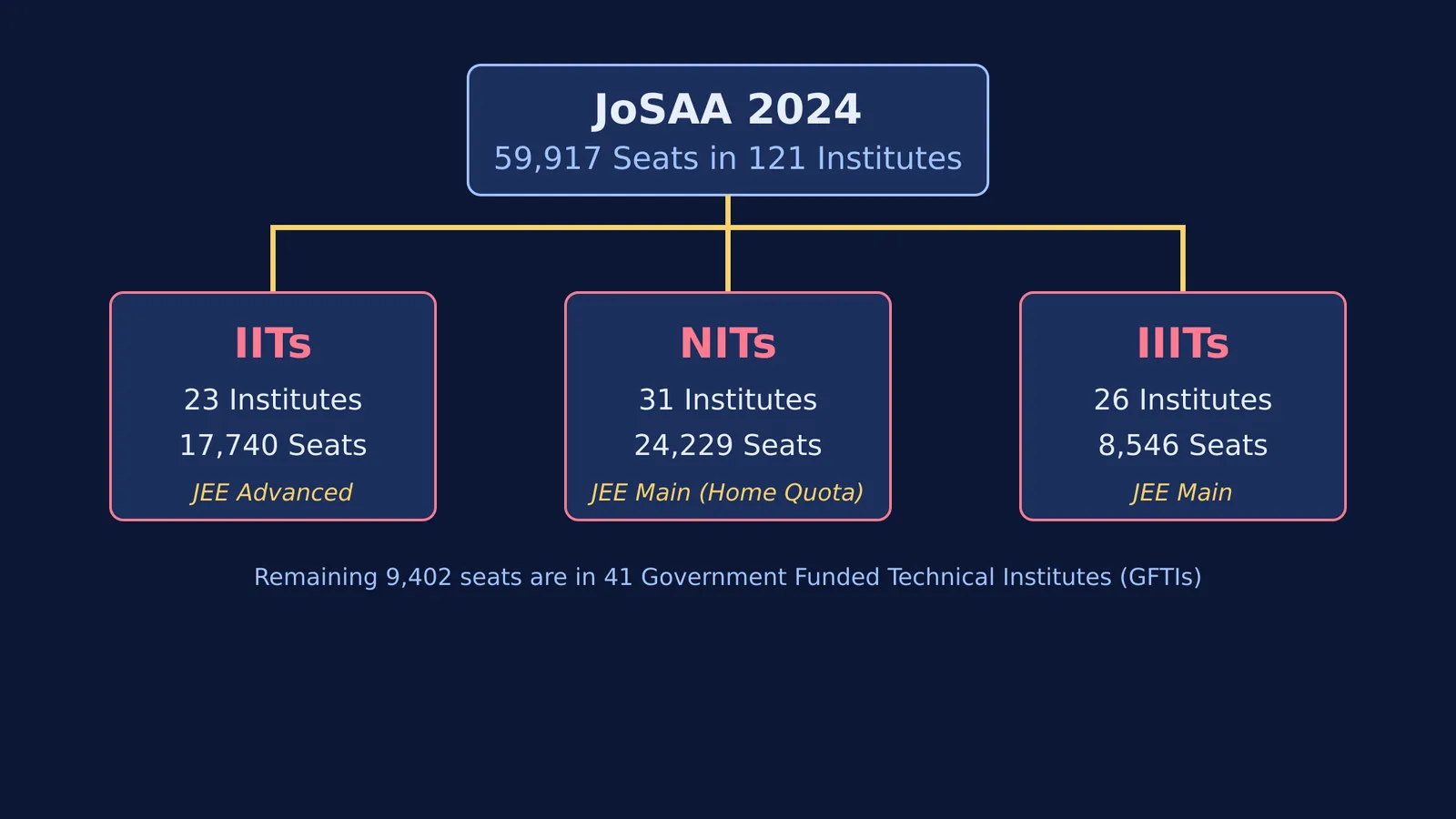
NITs (National Institutes of Technology) form the national tier of engineering colleges. Originally known as Regional Engineering Colleges (RECs), they balance theoretical learning with practical application. There are 31 NITs (India Today), ensuring almost every state has one, which plays a major role in their admission process.
IIITs (Indian Institutes of Information Technology) are specialized institutes. As the name suggests, they focus strictly on Information Technology (IT), Computer Science (CS), and electronics. If your child is certain they want a career in software or data, IIITs are designed to produce industry-ready graduates. According to the Ministry of Education, some of the 26 IIITs are fully government-funded, while others operate on a Public-Private Partnership (PPP) model, which can affect their fee structures.
How do the entrance exams differ?
The most fundamental difference between these institutes lies in which exam determines the seat.
NITs and IIITs admit students based directly on their All India Rank (AIR) in the JEE Main exam.
IITs use a two-step process. A student must first score high enough in the JEE Main (typically in the top 2.5 lakh candidates, according to JEE Advanced) just to qualify for the JEE Advanced. Admission to an IIT is based strictly on the JEE Advanced rank.
If your child is debating whether to focus on qualifying for the Advanced exam or maximising their Main score, a structured study routine is essential. If they do not know where to start their revision, Fermi's AI tutor can work out what they already know and build a plan for the session, so they sit down to a clear next step. You can also read our guide on whether to choose coaching or self-study for JEE to help them plan their preparation.
What is the JoSAA admission process?
Almost all admissions to these three tiers of institutes are handled through a centralized portal called the Joint Seat Allocation Authority (JoSAA).
For the 2024-25 academic year, JoSAA managed admissions for 121 institutes with a total of 59,917 seats, which included 17,740 seats across the 23 IITs (India Today).
During counselling, students submit a preference list of "College + Branch" combinations. The system then runs through multiple rounds of allocation. This process can be stressful, especially if a student's rank is borderline. If you notice your child's mock test scores stalling during this crucial period, our article on why some JEE aspirants plateau explains how they can break through the wall.
How does the home state quota work?
One of the biggest strategic advantages in engineering admissions applies only to the NITs. According to the JoSAA business rules, 50% of the seats in every NIT are reserved for students from the "Home State" (the state where the NIT is located), while the remaining 50% are open to students from all other states.
Crucially, the "Home State" is determined by the state where the student passed their Class 12 board exams, not their permanent address or domicile.
Because competition is restricted to students from a single state, the closing ranks for the home state quota are generally much lower (easier to clear) than the all-India ranks required for the same branch. IITs and IIITs do not have a home state quota; every seat is contested on an all-India basis.
A parent's checklist for counseling
When it is time to fill out the JoSAA preference list, keep these practical steps in mind:
Prioritise branch over a newer brand: A top branch like Computer Science at an established NIT is often a better career launchpad than a lower-demand branch at one of the newest IITs.
Check your local NIT: Look up the previous year's closing ranks for your home state's NIT. The 50% quota makes this a highly realistic fallback option.
Understand the seat options: When offered a seat, your child must choose to "Freeze" (accept it), "Float" (accept it but wait for a better college in the next round), or "Slide" (accept it but wait for a better branch in the same college).
Have documents ready: Ensure all category certificates (OBC-NCL, EWS, SC/ST) are in the exact format specified by JoSAA.


