On this page
If you are in Class 11 or 12 and drones interest you more than any single subject, you are not choosing a hobby over a career. India's drone sector now has its own rules, its own pilot certificate and a growing list of government uses. The useful question is which part of the work you want: building the machine, flying it, or making sense of what it records.
What jobs are there in drone technology?
Most roles fall into three tracks. They overlap, but each has a different entry route.
Design and build: airframe and propulsion design, flight-controller electronics, embedded software, autonomy and testing. This is degree work, usually a B.Tech.
Piloting and operations: flying survey, spraying, inspection or filming missions, planning flights around airspace rules and keeping drones maintained. The entry ticket is a DGCA Remote Pilot Certificate.
Data and analysis: turning aerial photos and videos into maps, 3D models, crop-health readings or progress reports. This leans on GIS, photogrammetry and programming.
The PIB backgrounder on India's drone ecosystem (February 2026) describes the ecosystem as manufacturers, software and component developers, service providers, training institutions, certified pilots, start-ups and research organisations.
Which engineering branches lead to drone design?
A dedicated drone engineering degree is uncommon, so most students enter through a neighbouring branch and specialise through projects.
Aerospace: aerodynamics, propulsion, structures and flight mechanics. Our guide to aerospace engineering careers in India covers the jobs, GATE and MTech route.
Mechanical: frames, materials, vibration and motors.
Electronics (ECE) and electrical (EEE): sensors, power, radio links and the flight controller.
Computer science: control software, computer vision and autonomy.
Mechatronics and robotics: a blend of all of these. Read what mechatronics and robotics engineering involves before you fill choices.
The physics under all of them is Class 11 mechanics: thrust balancing weight, torque, and angular momentum. A quadcopter has two propellers spinning each way for the same reason a helicopter needs a tail rotor: to cancel the twisting reaction on the body. If rotational motion still feels shaky, the Fermi Concept Library gives each concept its own lesson and shows its place in the map of physics.
How do you become a drone pilot in India after 12th?
Under the Drone Rules, 2021, you are eligible to become a remote pilot if you are between 18 and 65, have passed Class 10 or its equivalent from a recognised board, and have completed DGCA-specified training at an authorised remote pilot training organisation, as set out in the PIB backgrounder on the Drone Rules (January 2022).
The older pilot licence was replaced by a Remote Pilot Certificate issued by the DGCA, according to the February 2026 PIB backgrounder. The same document reports 39,890 Remote Pilot Certificates issued and 244 approved training organisations as of February 2026.
You do not need a certificate for everything. The Ministry of Civil Aviation's drone policy booklet says pilot certificates were dropped for drones under 250 grams and for non-commercial drones up to 2 kg. The 2022 backgrounder also lists government-recognised educational institutions among those that need no remote pilot licence for research, development and testing flights. That gives recognised colleges room to build and test drones.
Where is the demand for drone work coming from?
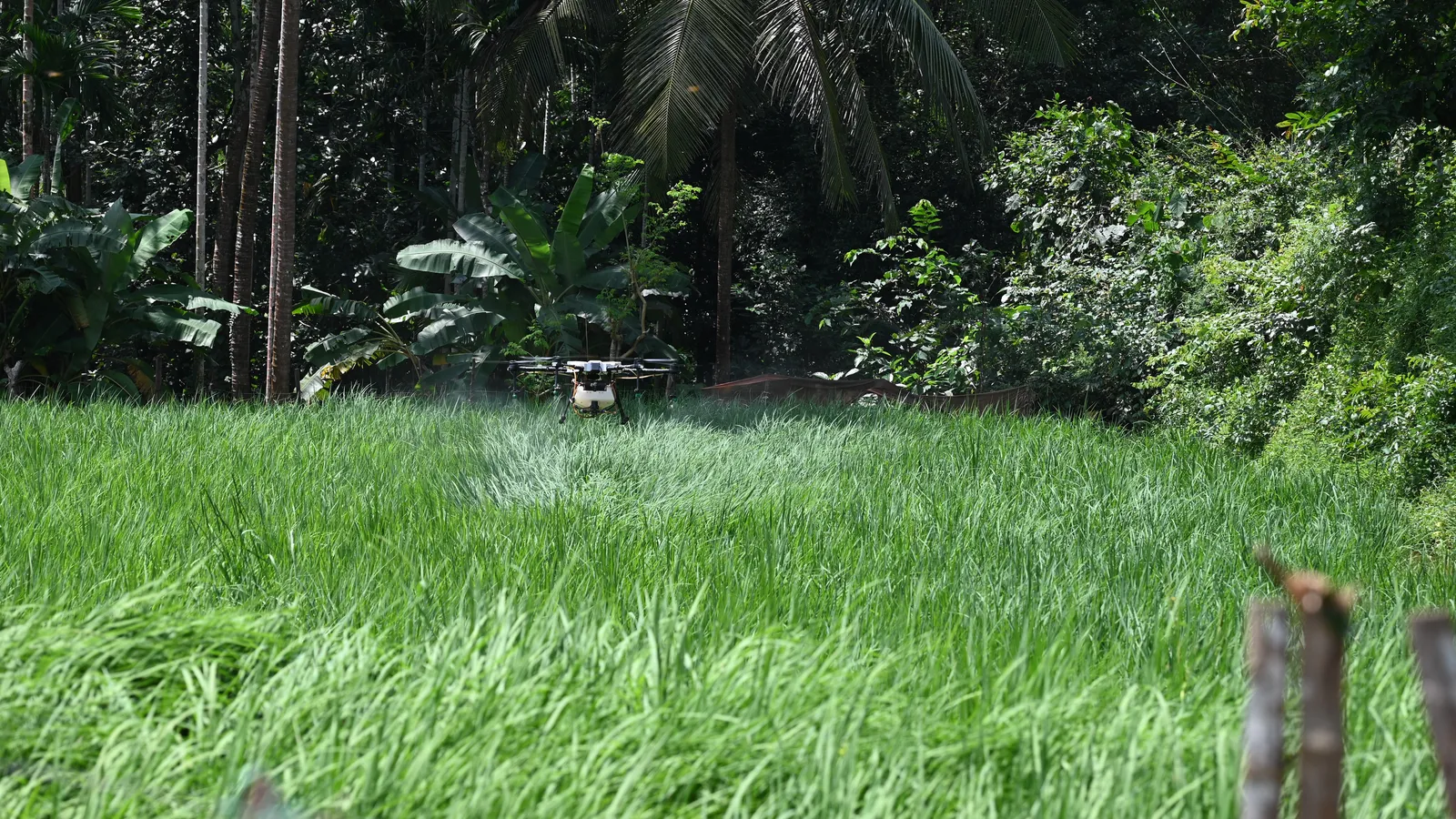
Much of it is public work. The February 2026 PIB backgrounder reports that drone surveys under the SVAMITVA land-records scheme had covered 3.28 lakh villages by December 2025. It also says the National Highways Authority of India mandates monthly drone video for all highway projects, and that 1,094 drones have been distributed to women's self-help groups for farm use. A production-linked incentive scheme for drones and drone components has an approved outlay of ₹120 crore.
Read those as job descriptions: surveys need pilots and map-makers, highway videos need analysts, farm drones need operators and technicians.
What skills should you start building now?
Pick the track you already enjoy, then do one small thing on it this term.
If you like taking things apart: build a small kit drone and log every crash and its cause. Our guide to building a drone as a student project covers parts, rules and the physics.
If you like code: learn Python, then program a microcontroller to read a gyroscope and print tilt angles.
If you like maps: install free GIS software and trace your school or neighbourhood from satellite images.
In all three: get properly comfortable with vectors, Newton's laws and rotational motion; most crashes come back to them.
For the mechanics, the Fermi Problem Library has worked problems with a step-by-step solver that explains the reasoning, so you can compare it with your own working on a torque or thrust calculation.
Start one project this month; a notebook of what you built and fixed will point to your track.