On this page
A homemade telescope is two lenses held the right distance apart. Finding that distance is the whole project, and it teaches focal length better than a page of numericals.
What do you need to make a simple telescope?
A weak convex lens with a long focal length for the front. This is the objective.
A strong convex lens with a short focal length for your eye. This is the eyepiece; a small magnifying glass works.
Two chart-paper or cardboard tubes that slide one inside the other, so you can focus.
Black paper for lining the tubes, tape and a ruler.
For the objective, ask a local optician whether they can sell you one uncut convex spectacle lens of +1 or +2 dioptre. The power of a lens is P = 1/f, with f in metres, according to the NCERT Class 12 Physics chapter on ray optics, which gives the example that a +2.5 D lens has a focal length of 40 cm. So a +2 D lens has a focal length of 50 cm, and a +1 D lens has 100 cm.
How does focal length decide magnification?
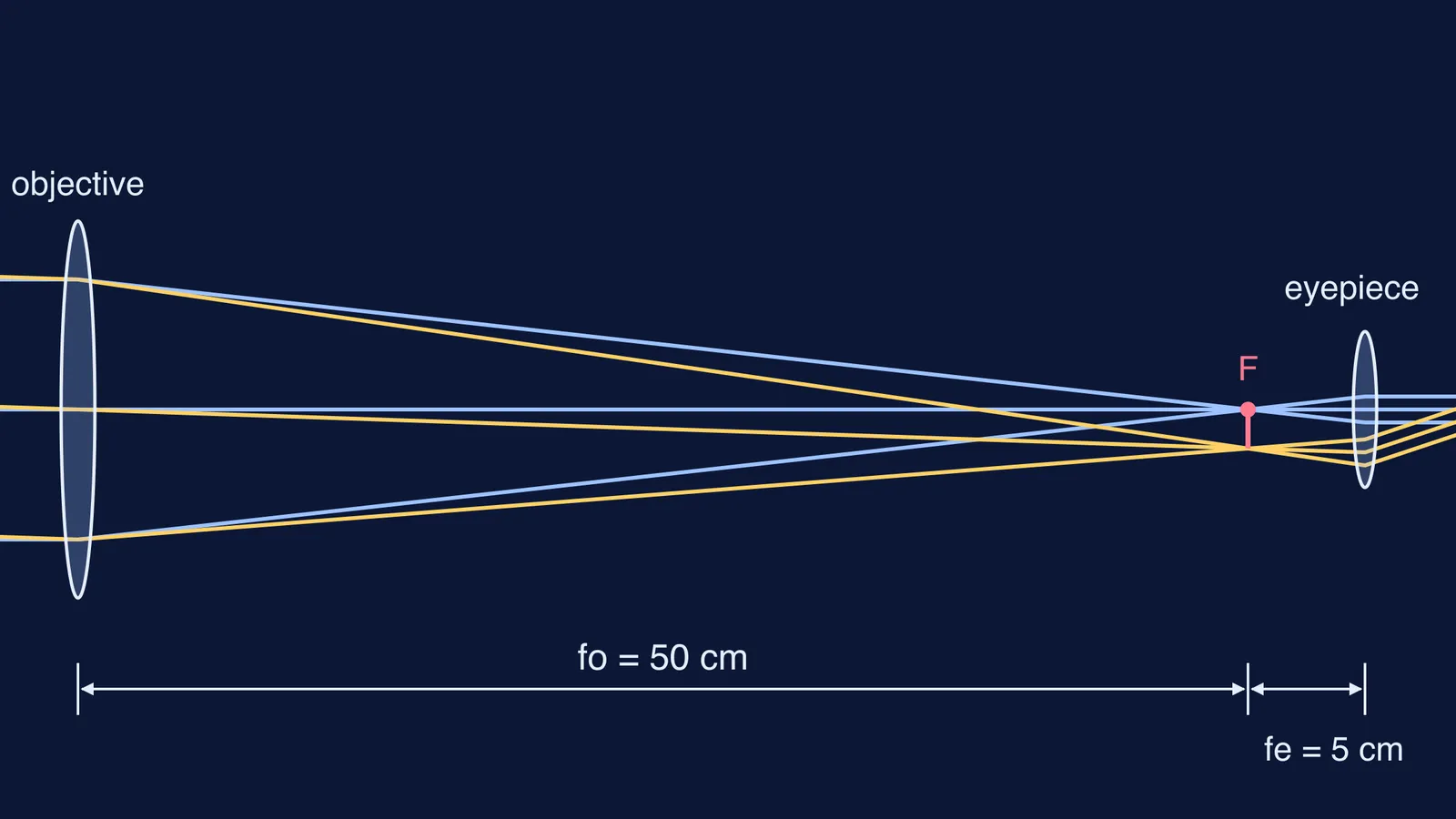
In a refracting telescope, the objective forms a real image of a distant object at its focal point, and the eyepiece magnifies that image, as section 9.7.2 of the NCERT ray optics chapter explains.
The magnifying power of a telescope is m = fo/fe, the objective's focal length divided by the eyepiece's focal length (NCERT, equation 9.46).
When the final image is at infinity (normal adjustment), the length of the telescope tube is fo + fe, according to the same chapter. That is the distance you set when you slide the tubes.
So a longer objective focal length gives more magnification but a longer tube, while a shorter eyepiece focal length gives more magnification without adding much length.
How do you build it, step by step?
Measure each focal length. Hold the lens facing a window from across the room and move a sheet of white paper behind it until you see a sharp, upside-down picture of the buildings outside. The lens-to-paper distance is roughly the focal length.
Work out your target length: fo + fe.
Line the outer tube with black paper, make it a few centimetres shorter than fo, and tape the objective across its front end.
Make the inner tube long enough to slide in and out of the outer one, and fix the eyepiece at its far end.
Set the lens-to-lens distance close to fo + fe, point the telescope at a distant tower or tree, and slide slowly until the view is sharp.
Measure the distance between the lenses at sharp focus and compare it with your prediction. This is where the learning happens.
What magnification will my homemade telescope give?
Here is a worked example using m = fo/fe and length = fo + fe from the NCERT chapter:
+2 D objective (fo = 50 cm) with a 5 cm eyepiece: m = 50/5 = 10, tube about 55 cm.
+2 D objective (fo = 50 cm) with a 2.5 cm eyepiece: m = 20, tube about 52.5 cm.
+1 D objective (fo = 100 cm) with a 5 cm eyepiece: m = 20, tube about 105 cm.
The last two give the same magnification, but the shorter tube is easier to hold steady. Rest it on a wall or a stack of books either way, because shaking is magnified too.
If your focused length comes out a few centimetres away from fo + fe, that is normal: your focal-length measurements were rough.
Is it safe to use a homemade telescope?
It is safe for the Moon, distant buildings and trees. It is not safe for the Sun. NASA's eclipse safety page says that viewing any part of the bright Sun through a camera lens, binoculars or a telescope without a special-purpose solar filter secured over the front will instantly cause severe eye injury. Parents of younger children should keep this rule firm.
What should you notice when you look through it?
The image is upside down. The NCERT chapter notes that this telescope gives a final inverted image, and that terrestrial telescopes add a pair of lenses to make it erect.
Bright edges may show colour fringes, an effect called chromatic aberration. The same chapter notes that it is difficult to make large lenses free of chromatic aberration, one reason modern telescopes use a concave mirror instead.
To see the rays before you build, our Fermi Simulation Lab has interactive simulations for ideas that are easier to see than to read, and we walk through this set-up in how a refracting telescope magnifies, built in a simulation. Thinking about buying one next? Read which telescope to buy for kids, or bring friends in with how to start an astronomy club at school on a small budget.
If the formulas stop matching your tube, the Fermi Concept Library has a lesson for every physics concept, so you can check the idea and go back to the ruler.