

On this page
Should you buy binoculars or a telescope first?
When families decide to explore the night sky, their first impulse is often to buy a telescope. Experienced observers and space agencies frequently advise the opposite. In its skywatching guide, NASA Science notes that binoculars between 7×35 and 10×50 are often the best starter instrument. Binoculars cost less, require zero assembly, and offer an intuitive view using both eyes.
Field of view is decisive for children. A standard pair of 7×50 binoculars covers roughly 6° to 7° of sky—wide enough to fit Orion's belt or the Pleiades in a single glance. In contrast, entry-level telescope eyepieces narrow the view to under 1.5°, so beginners easily lose targets. As education researchers Anthony Lelliott and Marissa Rollnick noted in the International Journal of Science Education, sky familiarity bridges abstract diagrams and physical observation. If a child cannot locate Jupiter or the Big Dipper unaided, a narrow telescope tube frustrates rather than aids the process of encouraging scientific curiosity at home.
Which telescope to buy for kids beginner stargazers?
If your family is ready for a dedicated telescope, the most critical specification is the aperture—the diameter of the front lens or primary mirror. Aperture determines how much light the instrument gathers and how fine a detail it resolves. The NASA Night Sky Network, maintained with the Astronomical Society of the Pacific, advises families to focus on light-gathering area rather than high magnification numbers.
For beginners, two designs offer the best balance of stability and optical clarity:
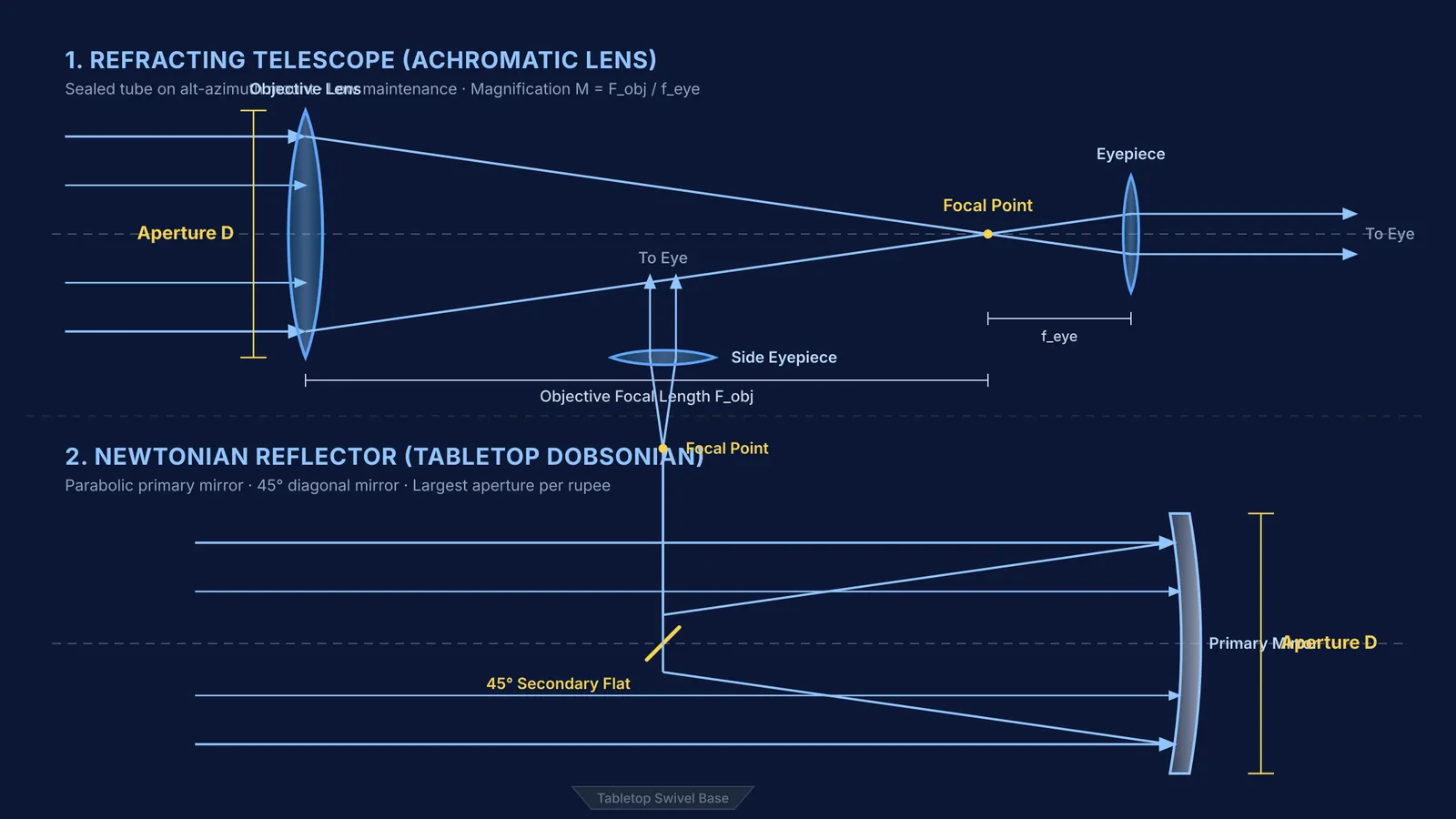
Tabletop Dobsonian reflectors (100 mm to 130 mm): These use a concave mirror mounted on a smooth, rotating wooden base that rests on an outdoor table. They offer the largest aperture per rupee, require no assembly tools, and allow intuitive point-and-look navigation.
Small refractor telescopes (70 mm to 80 mm): These use glass lenses inside a sealed tube on an alt-azimuth tripod. Because the tube is sealed, they need no mirror alignment, withstand travel, and produce sharp, high-contrast planetary views.
Avoid equatorial mounts for younger children; polar alignment and counterweights add needless complexity. A simple alt-azimuth or Dobsonian mount lets a child aim directly at what they see.
Why is magnification the biggest beginner trap?
Astronomers with the NASA Night Sky Network frequently caution against department store telescopes that advertise bold claims like 600× magnification. In practical optics, this is a marketing trap. Magnification equals the focal length of the objective divided by the focal length of the eyepiece (M = F / f). While any small lens can technically reach high numbers with an extreme eyepiece, the resulting image will be unviewable.
Diffraction bounds useful magnification to roughly 1.5× to 2× per millimetre of aperture (50× per inch). A 70 mm refractor has a practical ceiling of 105× to 140× under clear skies; beyond that, images blur without added detail. Light collection scales with aperture area: a 100 mm aperture gathers (100 / 7)² ≈ 204 times more light than a dark-adapted 7 mm pupil. For derivations of angular size, our guide to the magnifying power of telescopes and microscopes explains the ray formulas. To visualize how light refracts through lenses or reflects off mirrors, the Fermi Simulation Lab provides interactive simulations for ideas that are easier to see than to read.
What will your family actually see through the eyepiece?
Realistic expectations prevent disappointment. Children accustomed to processed space photography often expect colourful nebulae. In reality, human rod cells cannot perceive colour in dim light. The Astronomical Society of India, which publishes monthly ASI POEC SkyNews bulletins for skywatchers, outlines planetary positions and celestial events observable through binoculars or small telescopes.
However, our Solar System provides vivid, sharp views:
The Moon: The terminator line dividing lunar day and night reveals crater rims and mountain ridges even in a 70 mm scope.
Jupiter: Even 10×50 binoculars reveal Jupiter's four bright Galilean moons. A 90 mm or 100 mm telescope shows two equatorial cloud belts across its disc.
Saturn: At 25× to 30× magnification, Saturn transforms from a starlike point into an unmistakable disc with rings.
Venus: A small telescope clearly shows the planet's changing crescent and gibbous phases as it orbits the Sun.
How do you choose the right sky-watching gear for your family?
Before purchasing equipment, follow this three-step plan recommended by observational astronomy educators and ASI POEC resources to match gear to your family's routine:
Begin with naked-eye mapping: Spend two or three clear evenings finding the brightest constellations using an open-source sky map. Pairing skywatching with planetarium and science centre visits helps children connect overhead stars with physical scale.
Test with binoculars first: Try an affordable pair of 7×50 or 8×40 Porro-prism binoculars. If your family regularly brings them out to track the Moon and star clusters, the interest is durable.
Choose aperture and stability over gadgets: Prioritize a sturdy mount and an aperture of at least 70 mm in a refractor or 100 mm to 130 mm in a tabletop Dobsonian. When students study reflection and refraction in school physics, the Fermi Concept Library covers every concept across physics and mathematics, each with its own lesson and its place in the map.


