On this page
If you like biology and physics but do not want to spend years chasing an MBBS seat, the BASLP is one of the clinical degrees worth a proper look. It trains you to test hearing, fit hearing aids, and help people who stutter, lose speech after a stroke, or struggle to swallow.
What is a BASLP degree?
BASLP stands for Bachelor in Audiology and Speech-Language Pathology. Audiology deals with hearing, balance and related disorders, and speech-language pathology deals with voice, speech, language and swallowing, as the Manipal College of Health Professions BASLP curriculum defines them.
At the National Institute for Empowerment of Persons with Multiple Disabilities (NIEPMD), the BASLP runs four academic years: six semesters of coursework and two semesters of internship, recognised by the Rehabilitation Council of India (NIEPMD BASLP page). The same page asks for a 10+2 pass and lists physics, chemistry and biology, mathematics, computer science, statistics, electronics or psychology among the subjects. Mark cut-offs, age limits and entrance tests differ between institutes, so read the current prospectus of every college you apply to.
The need is large. About 430 million people, over 5% of the world's population, need rehabilitation for disabling hearing loss, and nearly 2.5 billion are projected to have some degree of hearing loss by 2050, according to the WHO fact sheet on deafness and hearing loss.
What do you study in a BASLP course?
The first semester in the Manipal BASLP syllabus covers communication sciences, anatomy and physiology of speech and hearing, audiology, linguistics and phonetics, electronics and acoustics, and speech-language pathology. Later semesters move to disorders and devices:
voice disorders, speech sound disorders and fluency disorders
diagnostic audiology, amplification devices and implantable hearing devices
language and motor speech disorders, first in children and then in adults
paediatric audiology and aural rehabilitation
Physics turns up more than students expect: frequency, decibels and how sound travels sit under every hearing test. Our hearing range tone test is a quick way to feel what frequency means for your own ears. If waves and sound felt shaky in Class 11, the Fermi Simulation Lab has interactive simulations for ideas that are easier to see than read, and the Fermi Concept Library gives each physics and biology concept its own lesson.
How much clinical training is in a BASLP?
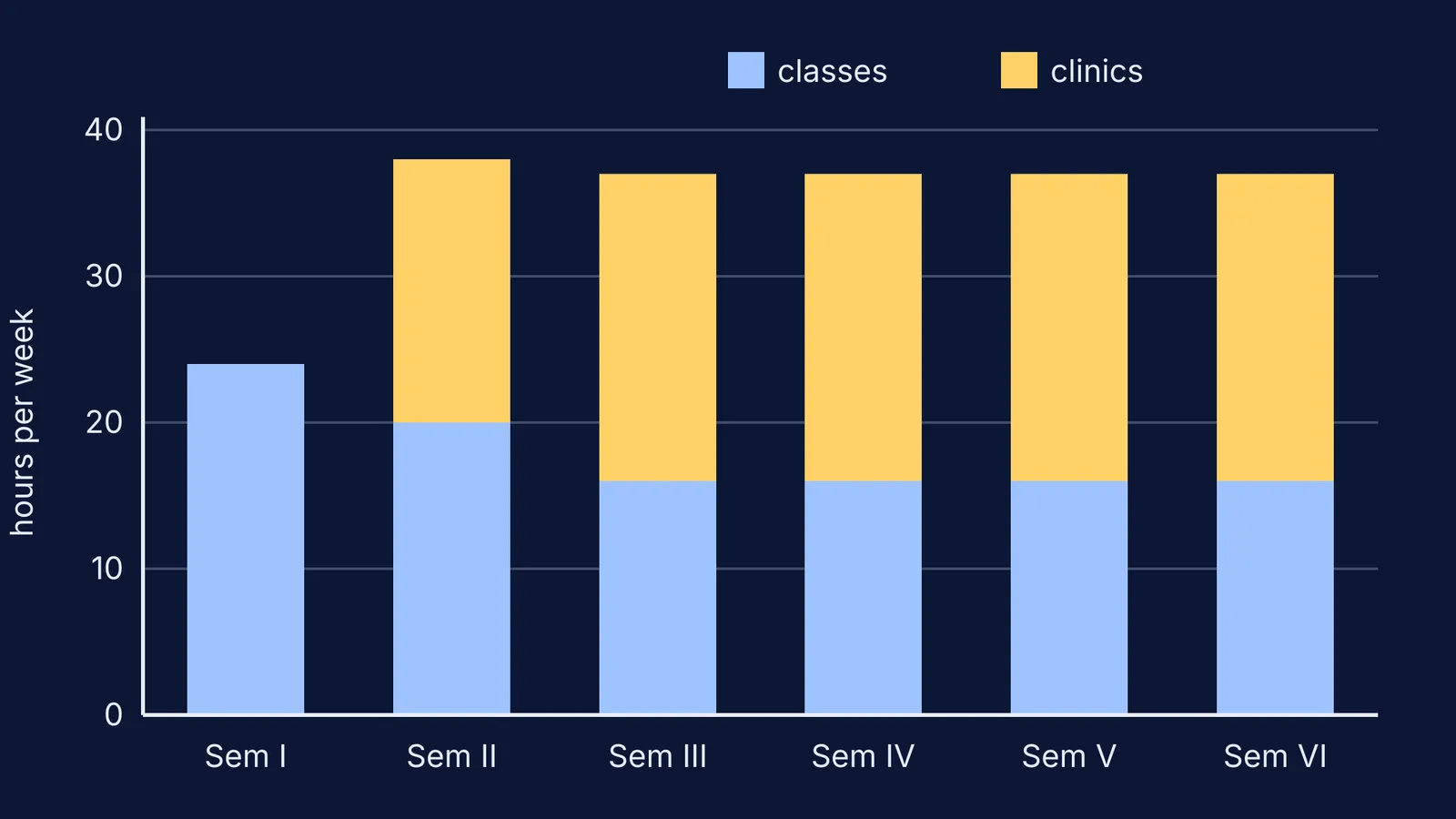
A lot, and it starts early. In the Manipal syllabus, clinics begin in the second semester at 18 hours a week, split between speech-language pathology and audiology. From the third to the sixth semester, clinics take 21 hours a week, more than the 16 hours of lectures and practicals. Each semester runs at least 15 weeks of teaching, and the minimum attendance is 90% for clinics and practicals against 80% for theory.
The final year is a 10-month internship, assessed for 200 marks, and the degree is awarded only after it is complete. Interns receive a certificate listing their clinical postings with hours.
That uses one university's timetable, so ask each college for its own figures.
Where do audiologists and speech-language pathologists work?
The Manipal curriculum lists these settings, in India and overseas:
hospitals and clinics, including ENT, paediatric and neurology clinics
special schools for children with hearing impairment, cerebral palsy, autism or learning disability, and mainstream schools
hearing-aid and cochlear-implant companies
hearing conservation programmes in industry, as an industrial audiologist
universities, as faculty, clinical supervisors and researchers
private practice
NIEPMD adds community settings and national institutes to that list.
To practise, you need RCI registration. Under Section 13 of the RCI Act, only people with a recognised qualification who are enrolled on the Central Rehabilitation Register may practise as rehabilitation professionals, and audiologists and speech therapists are a listed category (RCI norms and guidelines). The same page says to register within 6 months of finishing an approved course; registration is valid for 7 years.
Is the BASLP course right for you?
Answer these five questions before you shortlist colleges:
Would you enjoy spending hours a week with one child or one stroke patient, repeating small steps?
Are you comfortable with physics topics such as sound, frequency and electronics, not just biology?
Do you like talking with families and explaining things patiently?
Could you keep up the 90% clinic attendance that the Manipal syllabus requires, semester after semester?
Are you willing to register with RCI and keep that registration current?
If most answers are yes, take this short script to a college open day: Is this programme recognised by RCI? How many hours a week do students spend in clinics, and from which semester? Where are interns posted? How many clients does the clinic see?
For nearby options, compare this with other allied health science courses after 12th PCB. Parents can read degrees to discuss early with a PCB student not taking NEET.