On this page
If you love working with animals but a five-and-a-half-year degree feels out of reach, a livestock diploma is a real, legally recognised route, and a narrower one than a vet's degree. Here is what the course is, who can apply, and what the job allows.
What is a diploma in animal husbandry?
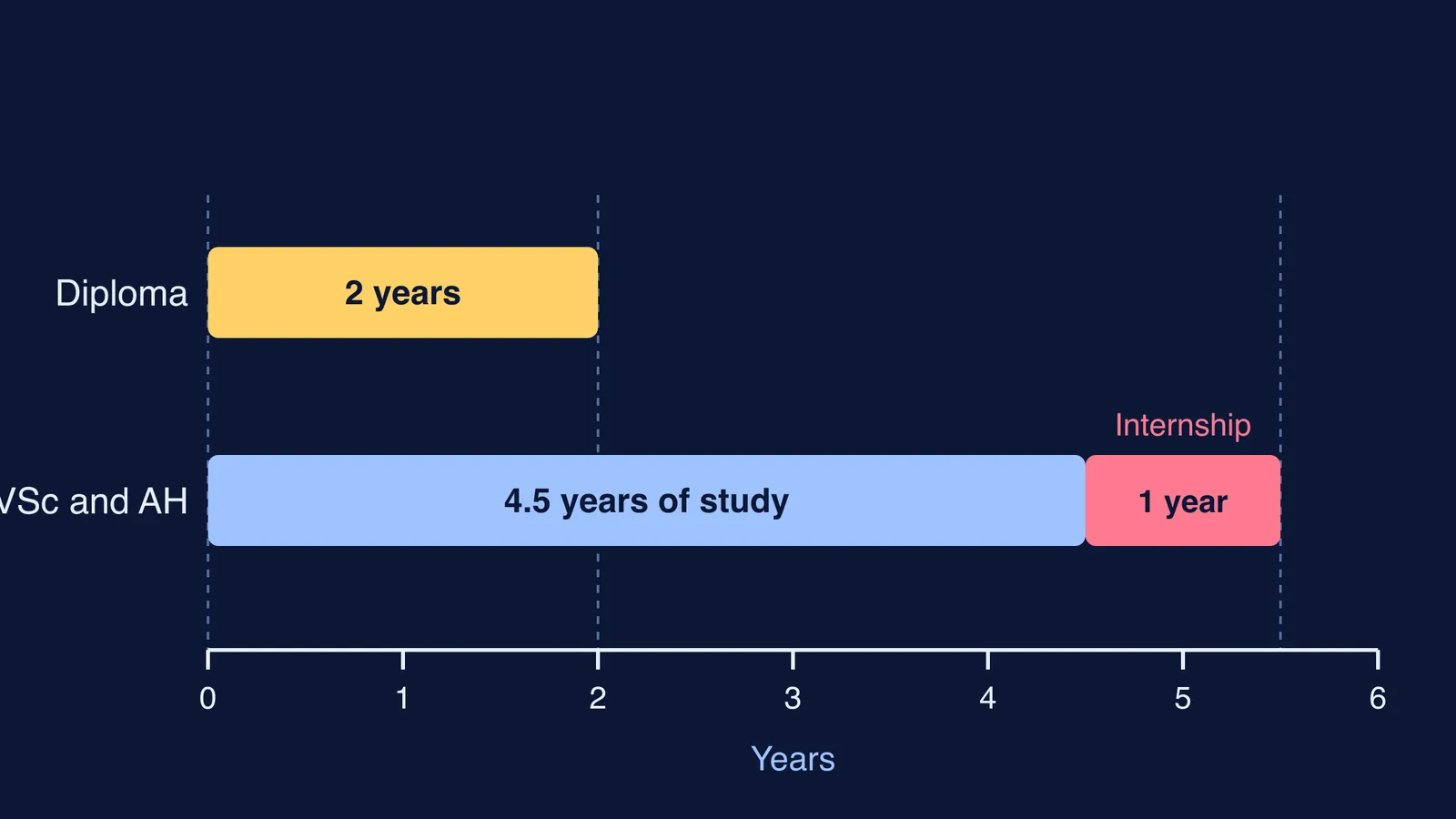
It is a two-year para-veterinary course run by a state veterinary university or its affiliated colleges, and its name changes from state to state.
Lala Lajpat Rai University of Veterinary and Animal Sciences (LUVAS), Hisar, runs a two-year Veterinary and Livestock Development Diploma (VLDD) through its Institute of Para Veterinary Sciences, set up in 2014 "to produce trained Para-Veterinarians to assist the Registered Veterinary Practitioners", according to its 2024-25 diploma prospectus.
Karnataka's veterinary university, KVAFSU, offers a two-year Diploma in Animal Husbandry for students who passed SSLC and studied Classes 1 to 10 in rural areas, with admission on Class 10 merit; its Hassan polytechnic takes 50 students a year.
So "after 12th" is true in some states and not in others. Always read your own state university's current notice.
Who can apply after 12th, and how?
The LUVAS 2024-25 diploma prospectus is a useful worked example of the rules:
Class 12 pass in any stream, plus at least 50% in Class 10 (47.5% for SC/DSC candidates).
At least 17 years old on 31 December of the admission year, with no upper age limit except for in-service candidates.
An entrance test, VLDDET, of 100 multiple-choice questions: 60 on science and 40 on non-science, set at Class 10 standard.
A three-month bridge course for students admitted from a non-science stream.
1,023 VLDD seats in 2024-25 across the university's own institute and 15 affiliated private colleges.
Because the entrance test is set at Class 10 level, revision means going back to basics: cells, nutrition, reproduction and microbes. If those feel hazy, the Fermi Concept Library has a lesson for every concept in biology and chemistry, so you can fix the specific gaps instead of rereading whole textbooks.
What does a livestock assistant actually do?
The law draws the line. Under Section 30 of the Indian Veterinary Council Act, 1984, only a registered veterinary practitioner may practise veterinary medicine, but a state government may permit holders of a diploma or certificate of "veterinary supervisor, stockman or stock assistant" to give minor veterinary services under the supervision and direction of a registered vet.
The Act defines minor veterinary services as preliminary veterinary aid such as vaccination, castration and dressing of wounds, plus other aid the state government notifies.
LUVAS describes para-vets as people who "provide minor veterinary services and assist the Veterinarians for health care and management of livestock", and who also play a role in veterinary extension, taking advice to farmers (LUVAS diploma prospectus). Post names and recruitment differ by state, so check your state animal husbandry department's rules.
How is it different from a BVSc veterinarian?
The Bachelor of Veterinary Science and Animal Husbandry (BVSc & AH) is a degree set by Veterinary Council of India regulations. Under GADVASU's academic rules based on the VCI 2016 regulations, it has four professional years, the last lasting one and a half years, followed by a compulsory rotating internship of twelve calendar months: five and a half years in all.
At LUVAS, BVSc & AH admission is through NEET (UG) conducted by NTA, according to its UG and PG prospectus for 2026-27.
The gap is not only time. Section 30 of the Indian Veterinary Council Act also says only a registered veterinary practitioner may hold office as a veterinary physician or surgeon in government, or sign a veterinary health certificate. A diploma holder works alongside that vet, not instead of them.
Is the diploma the right choice for you?
A quick worked example using the LUVAS 2024-25 rules. If you live in Haryana, passed Class 12 in commerce and scored 55% in Class 10, you meet the VLDD stream and marks conditions; you would still need to be 17 and sit VLDDET, then do the bridge course. If you are in Karnataka and studied in a city school, you would not meet KVAFSU's rural-study condition, so look at other options.
Use this checklist with a parent before you apply:
Read your state university's current prospectus, not a third-party website: Class 10 or Class 12, and which stream?
Check the college is on the university's affiliated list for that year.
Ask your state animal husbandry department which posts the diploma qualifies for and how often they recruit.
Decide what you want in five years. If it is "treat animals on my own", the diploma is a step, not the destination; plan for NEET and a BVSc & AH seat.
Work out fees and support with our guide to scholarships for diploma students.
Weighing the degree route? Read how veterinary and agriculture seats work after NEET, or compare other job-oriented courses after 12th science.