On this page
If NEET-UG did not bring the MBBS seat your family hoped for, or your child has always cared more about animals and farms than hospital wards, two professional degrees sit close by. Veterinary science uses your NEET rank. Agriculture, at the all-India level, uses an exam many NEET students never register for. The rules below are from the 2026-27 bulletins; check the 2027 editions when they come out.
Can you get a veterinary seat with your NEET score?
Yes. The Veterinary Council of India's 2026-27 counselling bulletin says VCI fills 15% of seats in recognised veterinary colleges from the NEET (UG) 2026 merit list, under the All India Quota. That quota is 858 seats for 2026-27, and no merit or weightage other than the NEET rank counts for admission.
The bulletin's eligibility rules:
Class 12 with Physics, Chemistry, Biology or Biotechnology, and English.
At least 50% aggregate in those subjects for General candidates, 47.5% for SC, ST and other special categories.
A minimum age of 17 on 31 December 2026.
Counselling runs online in three stages: Round 1, Round 2 and a stray round. Two rules catch families out. If you are allotted a Round 1 seat and do not report to the college, you cannot join later rounds. And the stray round fee, Rs 50,000 for General, OBC and EWS candidates or Rs 25,000 for SC, ST and PH, is forfeited if you are allotted a seat and do not join. VCI has no role in private college fees, so check them before listing a private college.
The bulletin covers only the 15% quota, so watch your state veterinary university's notices for the rest of the seats.
What does a BVSc & AH course involve?
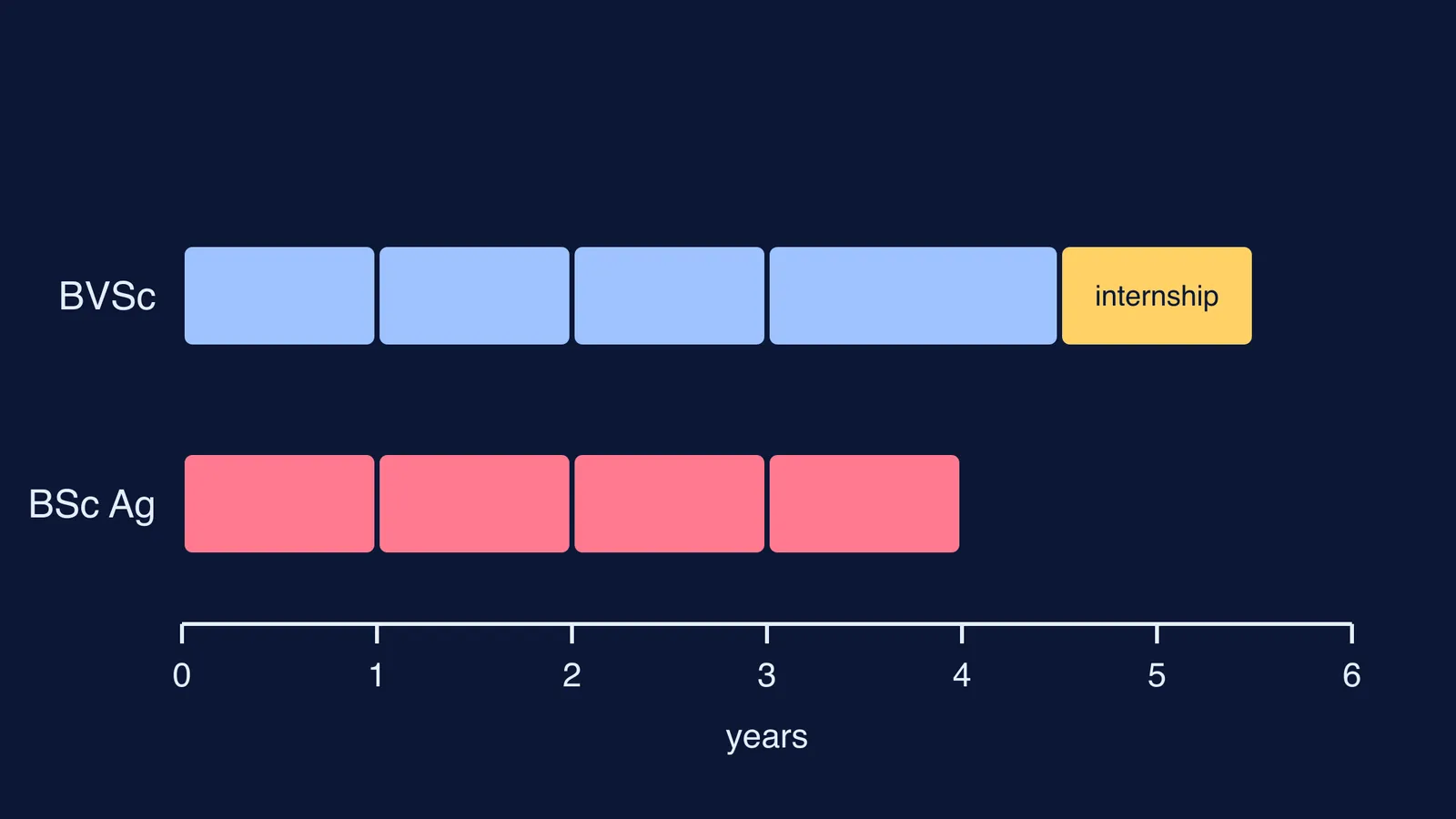
Bachelor of Veterinary Science and Animal Husbandry takes five and a half years, including a compulsory one-year internship, according to the VCI bulletin. A summary of VCI's 2016 minimum standards by the dean of Bihar Veterinary College splits this into three one-year professional years, a fourth of a year and a half, then the internship.
That summary lists 18 subjects, from anatomy, physiology and biochemistry through microbiology, parasitology and pathology to surgery, medicine and obstetrics. Many are about livestock: animal nutrition, genetics and breeding, livestock production management, livestock products technology. This degree is about farm animals and public health as much as pets. Field practicals happen at a Veterinary Clinical Complex and a Livestock Farm Complex, and attendance of 85% is compulsory.
Physiology and biochemistry build on Class 12 science. If a topic such as enzyme action or the nephron never quite made sense, the Fermi Concept Library gives every biology and chemistry concept its own lesson, so you can close the gap before term starts.
Can you get into BSc Agriculture with NEET?
Not through ICAR's all-India seats. The CUET (ICAR-UG) 2026 information bulletin says ICAR fills 20% of seats at agricultural universities (100% at a few central universities and institutes) through CUET (ICAR-UG), and there is no ICAR route into these degrees without qualifying in it.
The bulletin asks for Class 12 with at least three of Physics, Chemistry, Mathematics, Biology and Agriculture; 50% aggregate for General, OBC (NCL) and EWS candidates, 40% for SC, ST and PwBD; and a minimum age of 16 on 31 August 2026. You must take CUET in subjects you passed in Class 12, or you will be rejected at counselling. ICAR's public notice of 11 June 2026 says counselling opens on icarcounseling.com after NTA declares CUET (UG) results.
Other seats follow each university's own rules, so read its prospectus.
What does a BSc (Hons) Agriculture course involve?
The ICAR bulletin lists 13 four-year bachelor's programmes, all declared professional degrees. Besides agriculture they include horticulture, fisheries, forestry, natural farming, agribusiness management, and BTech degrees in agricultural engineering, dairy technology and food technology.
The final year is built around field work. At Amrita Vishwa Vidyapeetham, for example, the eighth-semester Student READY course carries 20 credits and is listed as rural agricultural work experience (RAWE), hands-on training, industrial attachment, project work and internship. Universities arrange this differently, so ask when you compare colleges.
How do you keep both options open?
In Class 12, check your subjects: PCB plus English for veterinary, any three of PCMB and Agriculture for ICAR seats.
Register for NEET-UG and CUET-UG, choosing CUET subjects you are taking in Class 12.
After NEET results, register on the VCI portal and note private college fees before choice filling.
If you hold a Round 1 seat and want to upgrade, report to the college on time and tell its nodal officer you want to join Round 2.
In the stray round, list only colleges you will definitely join.
After CUET results, register for ICAR counselling.
Start with step 1 this week: check your Class 12 subjects against the two bulletins linked above.