On this page
Abacus at eight, swimming at ten, maths tuition after lunch, keyboard at five, and Sunday looks the same. Each class made sense when you signed up. Together they can leave a child with no part of the weekend that belongs to them. Here is how to spot it, win back one free half-day, and let your child decide what stays.
How do you know if your child's weekend is too packed?
Look for a pattern, not one bad Saturday:
Neither day has a block of four hours or more with nothing booked.
Your child asks "what's next?" more often than "can I...?"
They dread a class they once asked for, or keep "forgetting" its kit.
Homework slides to Sunday night because the day had no gap.
Nobody, including you, can say why one class is still on the list.
Sleep is the easiest check. The American Academy of Sleep Medicine recommends 9 to 12 hours per 24 hours for children aged 6 to 12 and 8 to 10 hours for teenagers aged 13 to 18, in its consensus statement on children's sleep. If an early weekend class keeps your child below that, question it first.
Why does unstructured time matter?
Free time is when a child practises running their own day. In a 2014 study in Frontiers in Psychology, parents of 6- and 7-year-olds logged how their child spent the previous week outside school and sleep, in half-hour slots (67 children were analysed). Children who spent more time in less-structured activities did better on a task measuring self-directed executive functioning: working towards a goal without an adult prompting each step. More structured time went with poorer scores, though that link was weaker. It shows a link, not proof of cause, in young children.
The American Academy of Pediatrics warned in a 2007 report on play that free play had been squeezed for some children by hurried lifestyles and more attention to academics and enrichment activities. Article 31 of the UN Convention on the Rights of the Child recognises every child's right to rest, leisure and play.
Free time need not mean screens. The WHO recommends that children aged 5 to 17 get at least 60 minutes of moderate to vigorous physical activity daily, and an unbooked morning of cycling or cricket in the lane counts. For more, read how much free play a child needs each day.
How to find one free half-day: a worked example
Take a Class 6 child with eight weekend classes:
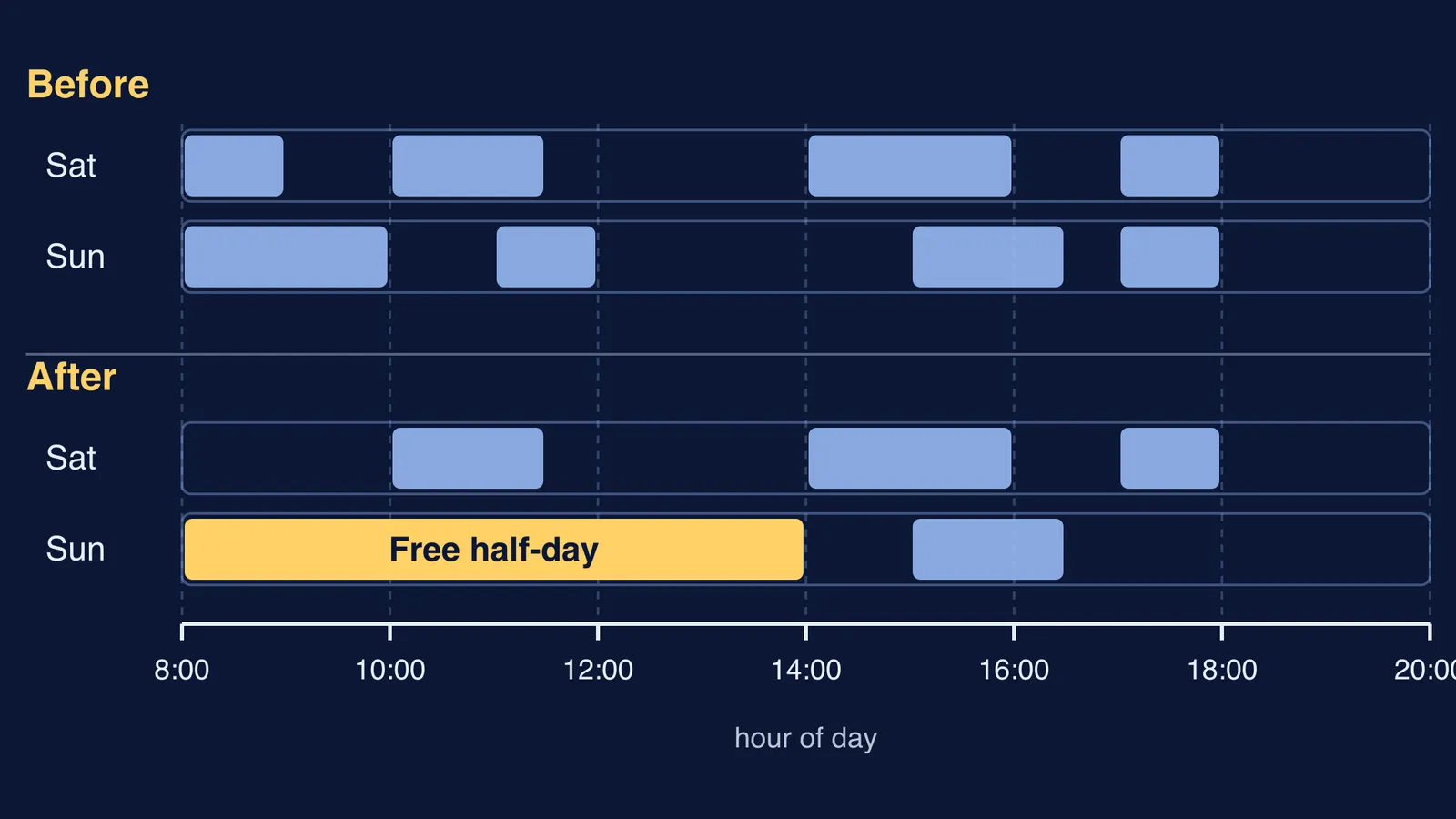
Saturday: abacus 8 to 9, swimming 10 to 11:30, maths tuition 2 to 4, keyboard 5 to 6.
Sunday: olympiad coaching 8 to 10, drawing 11 to 12, cricket 3 to 4:30, spoken English 5 to 6.
That is 11 hours of classes before travel, and no free gap longer than three hours between 8 a.m. and 8 p.m. Sort it in four steps:
List every class with its hours, cost and travel time.
Mark who chose it: your child, you, or "everyone in our building does it".
Ask what it gives that nothing else does. Drawing can happen at home; spoken English overlaps with school.
Clear one half-day first, then fit the rest around it. Here, Sunday 8 a.m. to 2 p.m.
After the sort: swimming, maths tuition and keyboard on Saturday, cricket on Sunday afternoon. That is 6 hours of classes and a free Sunday morning. Abacus and drawing stop; olympiad coaching pauses until exams are over. The diagram above shows both weekends to scale.
If you drop a tuition that mostly re-taught the school chapter, Fermi's AI tutor can work out what your child already knows and build a plan for the session, so a short sitting at home can cover the gap without the travel. For weekdays, try our weekly time audit for after-school activities.
How do you ask your child which classes to keep?
Sit down with the list on paper, away from class times, and try:
"Put a star next to the two classes you would miss most."
"Which one feels like a chore every single week?"
"If Sunday morning were completely free, what would you do?"
"Maths tuition stays until the exams. Of the rest, you choose two."
Be honest about what is fixed, and give real choice over the rest. If your child wants to drop something they only just started, our guide on whether to let your child quit music or sports class helps you agree a fair finishing point.
If your child seems low, anxious or withdrawn for weeks even after the schedule eases, talk to their school counsellor or a doctor. Tele MANAS, the free 24x7 national mental-health helpline, is on 14416.
Try one free half-day for a month, then ask your child how it went.