

On this page
"I'm bored" can sound like a request for you to fix something. It can also be the start of something good. Here is what research says about free play and boredom, and a plan for keeping unscheduled time in a busy week of school, tuition and classes.
How much free play does my child need every day?
We could not find an official daily minimum for free play, so be wary of precise numbers you see online. The closest official benchmark is about movement. The WHO 2020 guidelines on physical activity and sedentary behaviour say that for children and adolescents, an average of 60 minutes a day of moderate-to-vigorous aerobic activity across the week provides health benefits. Running games, cycling, cricket in the lane and chasing a sibling can all count.
Many young people do not get even that. According to the WHO physical activity fact sheet, 81% of adolescents aged 11-17 worldwide were physically inactive.
A practical target for a school-age child: an hour of active play on most days, plus a stretch of time with nothing planned and no screen. The second part is our suggestion, not an official rule.
Why does unstructured play matter for school-age children?
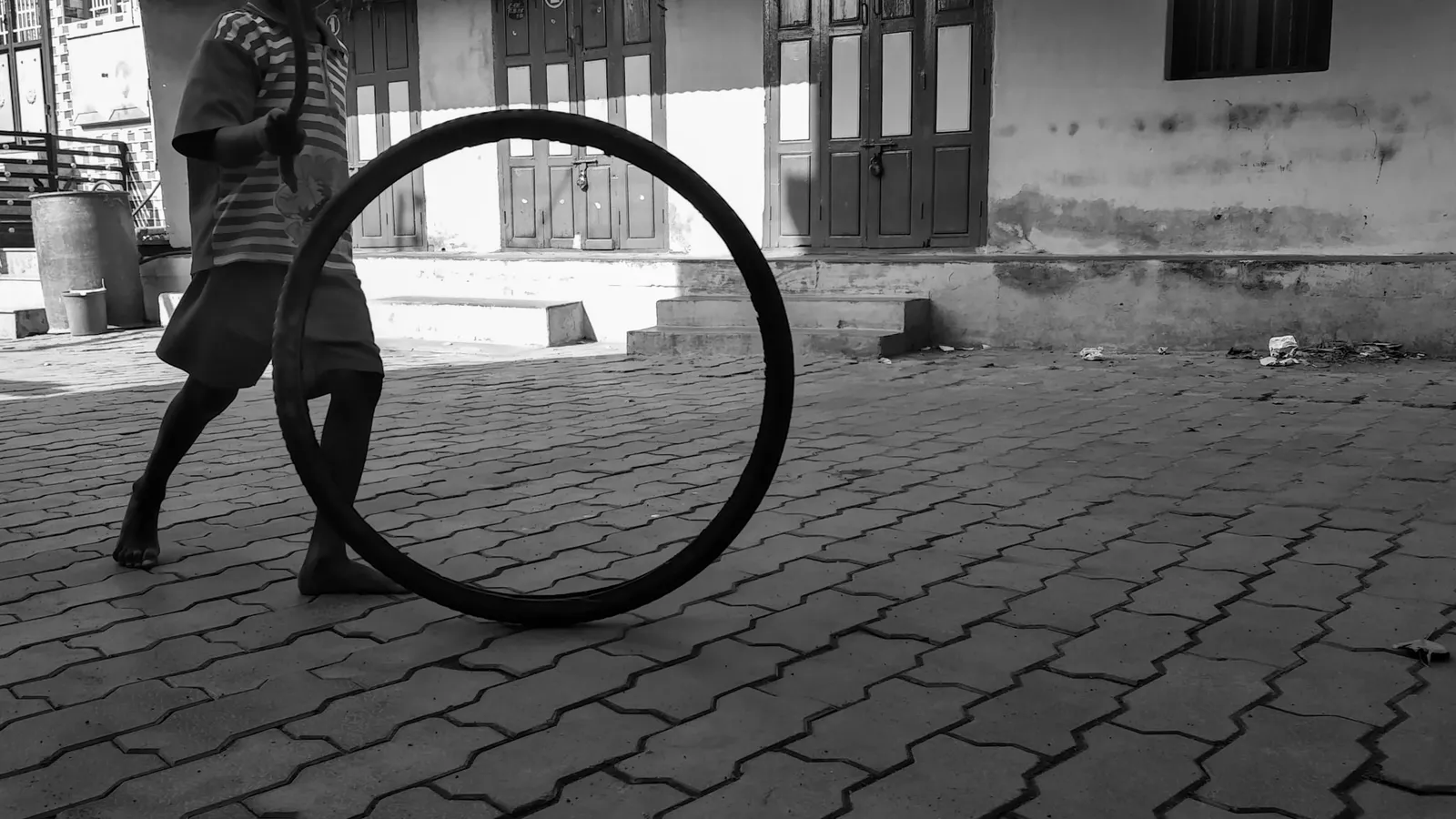
Free play is time the child directs: they choose what to do, how to do it and when to stop. A cricket coaching session or an abacus class can be valuable, but adults run it.
The American Academy of Pediatrics argued for play in a 2007 clinical report that said time for free play "has been markedly reduced for some children", and named a hurried lifestyle and "increased attention to academics and enrichment activities at the expense of recess or free child-centered play" among the causes. Its 2018 report, The Power of Play, which focuses on young children, says play "is not frivolous" and promotes executive function, the skills that let us pursue goals and ignore distractions.
A study of 67 children aged 6-7 by Jane Barker, Yuko Munakata and colleagues, published in Frontiers in Psychology in 2014, asked parents to record how their children spent the previous week. The more time children spent in less-structured activities, the better they did on a task measuring self-directed executive function: deciding for themselves what to do next. More structured time went with poorer scores. The study is correlational, and the authors say experiments are needed to show whether free time causes the difference.
Is it okay for my child to be bored?
Mostly, yes. Boredom is uncomfortable, and that discomfort can push children to invent something. In two experiments with 170 adults, reported in the Creativity Research Journal, psychologists Sandi Mann and Rebekah Cadman found that people who first did a boring task, copying or reading numbers from a phone book, then gave more creative answers than a control group. The participants were adults, so treat this as a hint for children rather than proof.
What to say when your child says "I'm bored":
"That's okay. Boredom often comes just before a good idea."
"I'm not going to plan it for you, but the cardboard box and the chalk are on the shelf."
"Tell me what you came up with at dinner."
Then step away, so boredom does not become your job to fix.
How do I protect free time in a busy week?
Try this four-step plan on a Sunday evening.
Map the week. Write down each day's school, tuition, classes, homework and screen time. Look at what is left.
Find one cut. If every weekday is full, drop or move one activity. Our post on whether extracurriculars hurt marks can help you decide which ones earn their place.
Block the gap. Give an hour on most days a name, such as "outside time", and treat it like a class you would not cancel.
Keep screens out of it. Our guide to screen time and homework rules has ways to set limits without a daily argument.
Here is an illustrative example. Riya is in Class 6. School ends at 2:30, tuition runs from 4 to 5:30 on three days, and dance is on Saturday. Her parents mapped the week and found that on tuition days her only free time came after 8 pm, when she was tired. They moved homework to straight after school, kept 5:30 to 6:30 for playing downstairs with friends, and left Sunday afternoon unplanned. The homework did not shrink, but it stopped spreading across the whole evening.
Homework is often what squeezes play out, so it is worth checking how much homework is reasonable for your child's age. If the problem is that your child sits stuck and does not know where to start, Fermi's AI tutor can work out what they already know and build a plan for the session, so they sit down to a clear next step instead of a blank page.
This week, pick one afternoon and leave it empty. Then watch what your child does with it.


