On this page
On Friday night, bedtime slides. On Saturday and Sunday your child sleeps till ten. Then Monday morning is a fight. This is usually not laziness. A routine that swings hard between weekdays and weekends works a bit like flying across time zones every week.
Why does a very different weekend routine make Monday hard?
Researchers call it social jetlag: the gap between the sleep times set by school or work and the times your body clock prefers, seen in how differently people sleep on work days and free days (Wittmann and colleagues, Chronobiology International, 2006). In that study, the links between body-clock type, wellbeing and stimulant use were strongest in teenagers and young adults up to age 25.
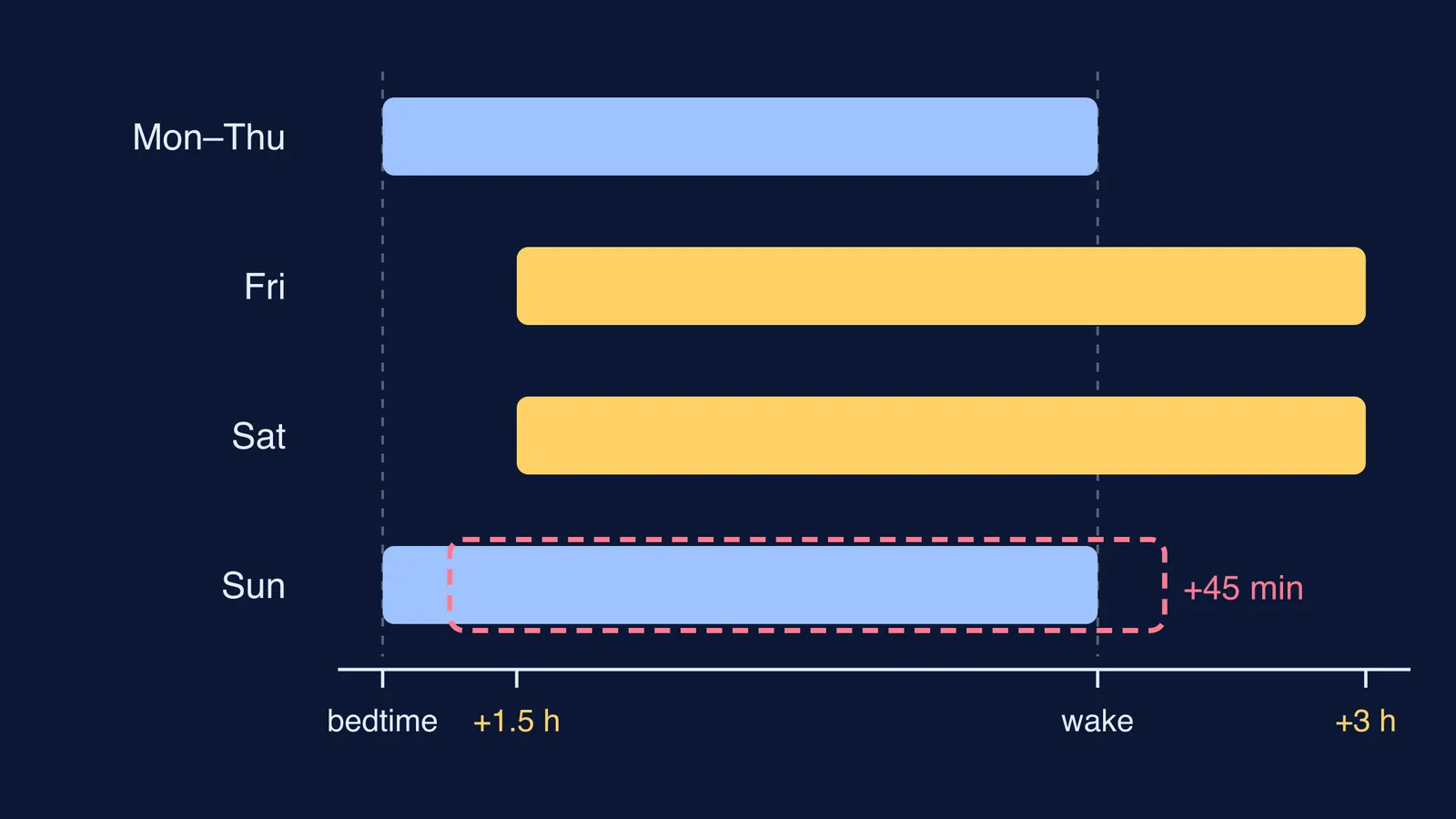
The clearest picture of the Monday problem comes from sleep researchers Crowley and Carskadon. In their 2010 study of 15- to 17-year-olds who slept at home, a typical weekend (bed 1.5 hours later and up 3 hours later than on school nights) pushed the body clock about 45 minutes later between Friday and Sunday (Crowley and Carskadon, 2010). They measured the body clock in a lab, using the evening rise of the sleep hormone melatonin.
So by Sunday night your child's body may be set for a later bedtime than school allows. They can lie awake, sleep less, and Monday's alarm feels far too early. In the same study, neither a two-hour afternoon nap with a smaller lie-in nor an hour of blue light on waking stopped the shift. The two experiments were small (12 and 33 teens), so read it as a warning, not the final word.
The pattern also shows up in school results. In a survey of 796 adolescents aged 12 to 16, more social jetlag went with lower grades and lower scores on most thinking-skills tests (Díaz-Morales and Escribano, 2015). That is a link, not proof of cause.
How much later can a child wake up on weekends?
Start with how much sleep they need. The American Academy of Sleep Medicine recommends 9 to 12 hours per 24 hours for children aged 6 to 12, and 8 to 10 hours for teenagers aged 13 to 18 (Paruthi and colleagues, Journal of Clinical Sleep Medicine, 2016).
Then set a limit on the lie-in. Guidance for teens from SickKids, the Toronto children's hospital, says the weekend schedule should have them up no more than two hours later than their normal weekday wake time (AboutKidsHealth, SickKids).
If your child needs a long lie-in every weekend, weekday sleep is probably too short. Our guide on how much sleep teenagers need and how parents can help covers that, and whether bedtime should change on weekends looks at bedtime itself.
What does a two-hour limit look like for a Class 10 student?
One week inside both limits:
School days: lights out at 9:30 pm, alarm at 6:00 am (8.5 hours, inside the 8 to 10 hour range).
Friday and Saturday: lights out by 10:30 pm, up by 8:00 am (9.5 hours, and a two-hour lie-in, not four).
Sunday: up by 8:00 am, lights out at 9:30 pm again.
The gap is smaller than the three-hour lie-in in the Crowley study, but it has not gone. In that study even a one-hour lie-in plus a nap still shifted the body clock, so expect Monday to be easier, not effortless.
What should a calm Sunday evening look like?
A fixed, boring plan helps with both sleep and the week ahead.
5:00 pm: bag check. Timetable, uniform, books and finished homework. If homework is what keeps Sunday night running late, our Saturday plan for children who leave homework till Sunday night moves it earlier.
7:00 pm: a 15-minute Monday look-ahead. What is the first period, is there a test, and which one topic needs a quick revision?
8:00 pm: dinner at the usual weekday time.
9:00 pm: screens off and phones charging outside the bedroom.
9:30 pm: lights out at the school-night time.
If the look-ahead stalls because your child doesn't know where to start on a chapter, Fermi's AI tutor can work out what they already know and build a plan for the session, so Sunday evening ends with a clear next step instead of a worry.
If your teenager hates the idea, try this: "I'm not asking you to get up at six on Sunday. I'm asking for eight at the latest, so Monday doesn't feel like jet lag. What you do with the morning is your choice." If weekends now run four hours late, move the alarm earlier in steps over a few weeks.
When is it more than a routine problem?
If your child still can't fall asleep for a long time on a steady schedule, snores loudly, or is very sleepy in class despite enough hours in bed, talk to your paediatrician. If Sunday nights come with dread, low mood or anxiety that won't lift, talk to a doctor or counsellor, or call Tele MANAS on 14416, the government's toll-free mental health helpline (PIB, 2024).
This weekend, pick one change: set the Saturday alarm two hours after the school one, and see how next Monday goes.