On this page
You yawn in a warm classroom, in the middle of a long chapter, or just because the person next to you did. Everyone does it, and yet scientists still argue about what a yawn is for. Here is what the experiments actually show, where the evidence stops, and how to test it yourself.
What are the main ideas about why we yawn?
There are three ideas you will meet most often:
The oxygen idea: you yawn because your blood is low on oxygen or high in carbon dioxide. This is the explanation you will hear most often.
The brain-cooling idea: a deep yawn pulls in air and boosts blood flow through the head, which helps bring the brain's temperature down.
The arousal idea: a yawn helps your brain switch state, for example from drowsy to alert, which would fit yawns that come around waking up, going to sleep and boredom.
The last two are not rivals: researchers describe yawning as promoting "cortical arousal and state change through enhanced intracranial circulation and brain cooling" (Gallup, Church and Pelegrino, Biology Letters, 2016).
The oxygen idea is the one that has been tested directly, and it failed. In 1987, Robert Provine and colleagues had college-age volunteers breathe 100% oxygen or air with 3% or 5% carbon dioxide; neither changed how often they yawned, even though both raised their breathing rate (Provine, Tate and Geldmacher, Behavioral and Neural Biology, 1987). A second study in the same paper found that exercise that doubled breathing rate had no effect on yawning either.
Does yawning cool the brain?
The best evidence for cooling comes from Andrew Gallup and Gordon Gallup Jr. (Evolutionary Psychology, 2007). They showed people videos of others yawning and changed how the brain could shed heat.
People told to breathe only through the nose did not yawn contagiously at all, against about 48% of those breathing normally or through the mouth.
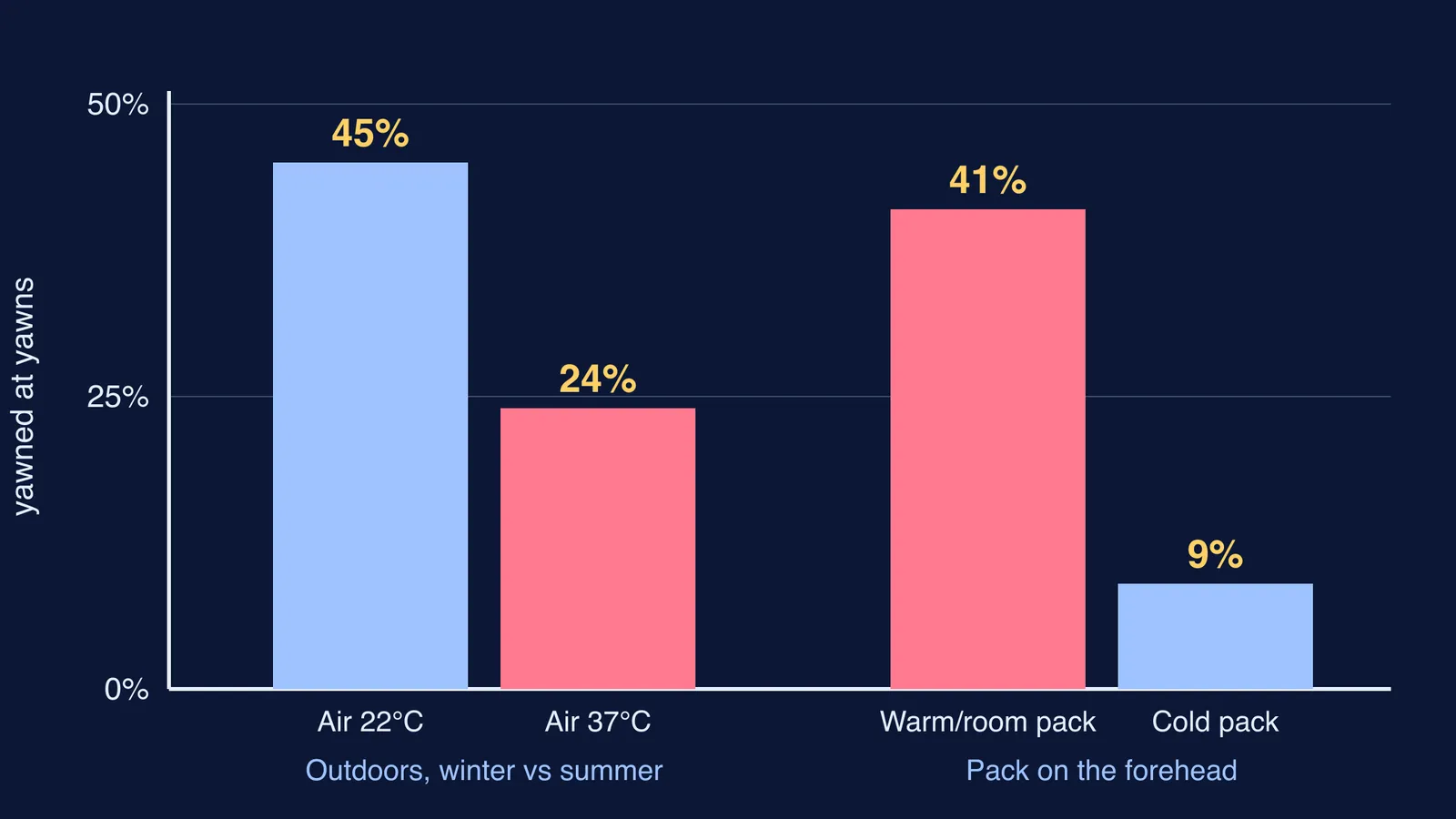
People holding a warm (46°C) or room-temperature pack to the forehead yawned 41% of the time; with a cold (4°C) pack, it fell to 9%.
The weather matters too. In Tucson, Arizona, 45% of pedestrians yawned at pictures of yawns in winter (22°C), against 24% in early summer (37°C), when the outside air was close to body temperature (Gallup and Eldakar, Frontiers in Evolutionary Neuroscience, 2011).
Across mammal species, longer yawns go with heavier brains and more cortical neurons, with correlations above 0.9 (Gallup, Church and Pelegrino, 2016). That fits the idea that a bigger brain needs a bigger yawn, but a correlation is not proof.
If temperature regulation in the body is a gap for you, the Fermi Concept Library covers every concept in biology and physics, each with its own lesson and its place in the map.
Why are yawns contagious?
Watching someone yawn can set off a yawn of your own. One popular explanation is empathy. Ivan Norscia and Elisabetta Palagi watched 109 adults over a year and found yawns spread most between relatives, then friends, then acquaintances, and least between strangers (PLoS ONE, 2011).
Other studies push back. In a test of 328 people, empathy, time of day and intelligence did not predict who caught yawns once age was accounted for, and age itself explained only 8% of the difference between people (Bartholomew and Cirulli, PLoS ONE, 2014). A 2017 review found a pattern of "inconsistent and inconclusive evidence" linking contagious yawning to empathy (Massen and Gallup, Neuroscience and Biobehavioral Reviews).
The brain's motor system may matter more. In a University of Nottingham study of 36 adults, measures of how excitable the motor cortex was, and how strongly it was held in check, explained about half of the variation in contagious yawning; being told to resist yawning only increased the urge (Brown and colleagues, Current Biology, 2017).
What remains unproven about yawning?
Whether cooling is the main purpose of a yawn, or a side effect of something else.
Why some people almost never catch yawns; most of that difference is still unexplained.
Whether contagious yawning has anything to do with empathy at all.
Try it: a 10-minute yawn experiment
Run a small version of the 2007 study with family or friends. It proves nothing, but it shows how scientists test a claim.
Find a 3-minute video of people yawning.
Split volunteers into two groups. Group A watches normally; group B breathes only through the nose while watching.
Each person notes whether they yawned and how many times.
Compare the share of each group that yawned. How many people would you need before you trusted the difference?
Swap the groups next day and repeat.
Next time someone yawns in class, the honest answer is: probably temperature and switching state, and still an open question.