

On this page
When a child leaves their weekend homework until Sunday night, it creates a predictable cycle. The weekend starts with good intentions, but the work is pushed back until Sunday evening becomes a frantic, stressful rush. This habit not only ruins the end of the weekend but also works against the way the human brain actually learns.
Why do students leave homework until Sunday night?
Procrastination is rarely about laziness. To a student, a large pile of weekend homework looks like an insurmountable wall. When a student feels overwhelmed and does not know where to start, they are more likely to put the task off. Without a clear structure, the sheer volume of work creates anxiety, causing them to seek immediate relief by playing a game or watching a video.
This is why procrastination is about feelings, not laziness. They delay the work to protect their weekend peace, only to face a much worse stress on Sunday night. By avoiding the initial discomfort of starting, they inadvertently create a high-pressure environment that makes the homework even harder to complete.
How does the Sunday rush hurt learning?
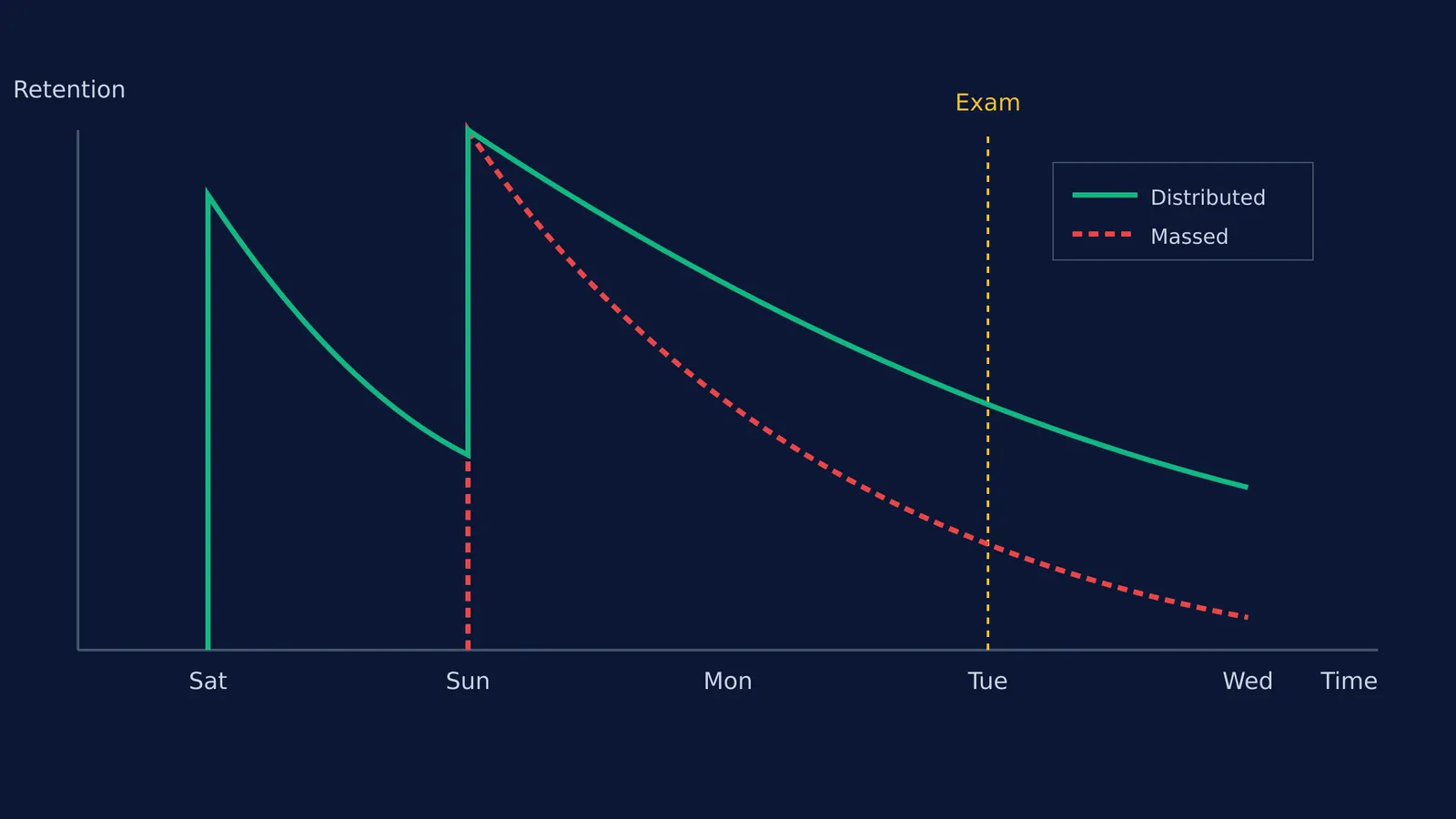
When a child crams all their work into a single Sunday night session, they are relying on "massed practice." While cramming might help them complete an assignment for Monday morning, it is highly ineffective for long-term memory. The brain is not designed to absorb and retain large amounts of complex information in one sitting.
The opposite approach is "distributed practice," or the spacing effect. Research shows that learning is much more effective when study sessions are spaced apart, allowing the brain time to consolidate new information. A landmark study by Cepeda et al. (2008) found that for long-term retention, the optimal gap between study sessions is between 5% and 40% of the retention interval (the time until the final test), depending on how far away the test is. For example, if an exam is in a week, reviewing the material after a gap of a few days is ideal.
When a student does all their homework on Sunday night, they miss the opportunity to use this biological mechanism. They learn it once, but without a spaced review, the memory quickly fades. This means they will have to relearn the same material from scratch before their final exams, doubling their overall workload.
What is a Saturday-morning plan for weekend homework?
You can help your child break the Sunday night cycle by teaching them to plan their time. Instead of a single marathon session, split the weekend homework into two shorter blocks. This requires a gentle shift in routine but pays off immediately in reduced stress.
Session one: Saturday morning. Have your child tackle the hardest or most important assignments first, while their energy is high. Keep this session strictly timeboxed. When they know there is a firm stopping point, they are far less likely to resist starting.
Session two: Sunday afternoon. Use this second block to finish remaining tasks and briefly review what was learned on Saturday. This second exposure reinforces the neural pathways formed during the first session.
This split creates the short gap that the spacing effect requires, strengthening their memory for exams later in the week. It also completely transforms the mood of the household on Sunday evening.
If your child resists, try this script: "Let's do just a short session on Saturday morning so your Sunday night is completely free. You can stop as soon as the timer rings."
How does Fermi's AI tutor build the habit?
One of the biggest hurdles on Saturday morning is simply knowing where to begin. If a student is staring at a blank page or a difficult physics problem, they are likely to feel overwhelmed and walk away. Starting is always the hardest part of any learning session.
This is where Fermi's AI tutor can change the dynamic. When a student brings a topic or an assignment to Fermi, the tutor works out what they already know and builds a plan for the session. It provides a clear next step, removing the friction of deciding what to do first.
Fermi teaches rather than just answering questions. It holds a line of reasoning, checks understanding as it goes, and steps in when a student is stuck. If a student needs a quick refresher before starting their homework, they can use the Fermi Concept Library, which covers every concept in physics, chemistry, biology, mathematics and computing. By making the first step easier and providing immediate feedback, Fermi helps students tackle their work early, leaving Sunday night free for rest.


