

On this page
Put a green chilli on your tongue and it feels like fire. A bird such as the curve-billed thrasher can swallow the same fruit and carry on as if it were a grape. The difference is not toughness. It comes down to one protein in the nerve endings, and it explains a neat piece of plant strategy.
What makes a chilli feel hot?
Chilli heat is not real heat. It is a chemical trick played on your pain nerves.
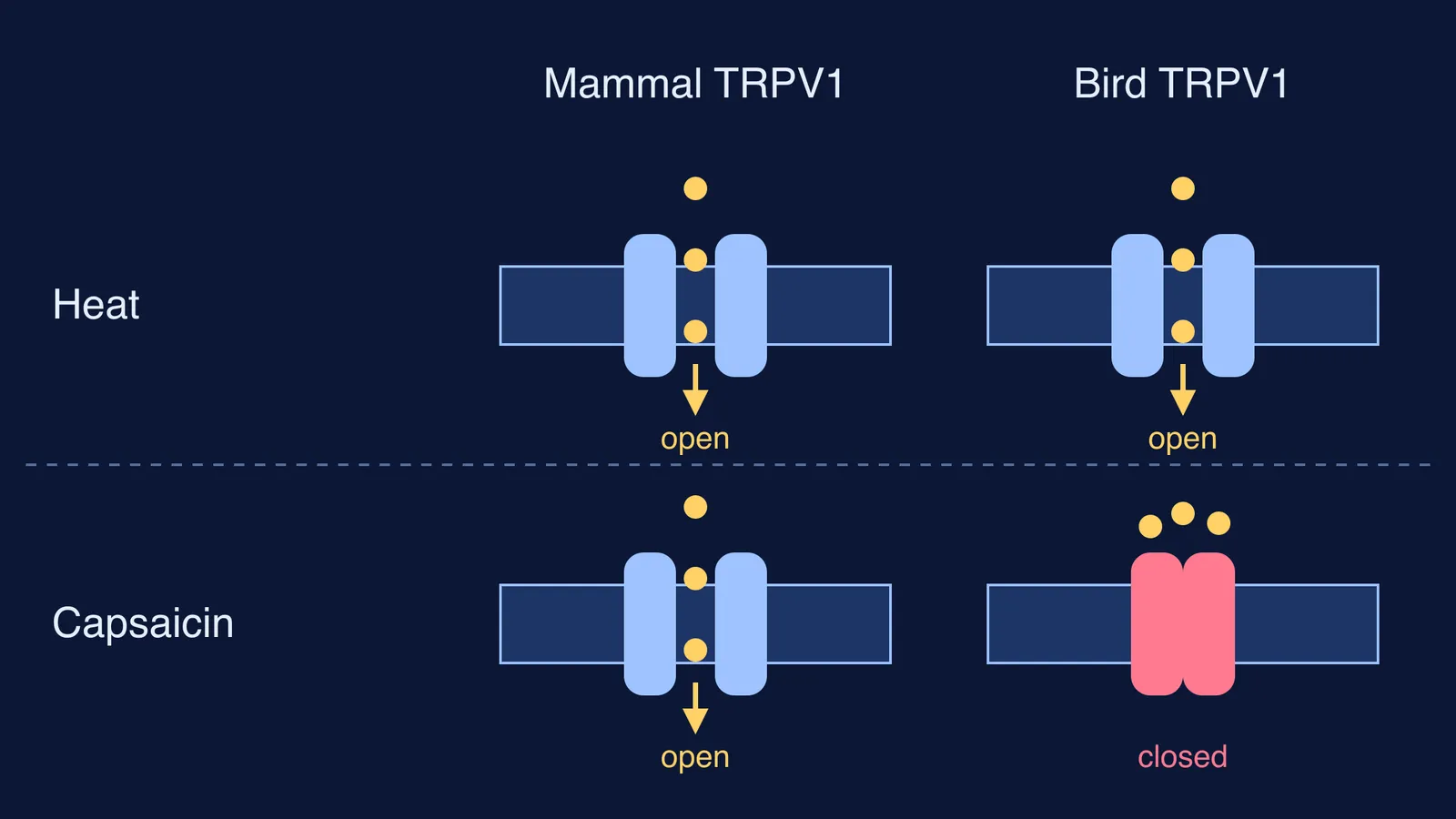
Capsaicin, the main pungent compound in chillies, causes burning pain by activating a receptor on sensory neurons that is also switched on by painfully high temperatures (Caterina and colleagues, Nature, 1997). That receptor is now called TRPV1. It is an ion channel: a gate in the nerve cell membrane that opens and lets charged particles flow in, which fires a pain signal to the brain.
Because the same gate opens for capsaicin and for scalding heat, your brain reads both as "burning". Nothing in your mouth has actually warmed up. If you want the human side of this, including why milk helps and water does not, read our explainer on why chillies burn and why milk helps.
Why don't birds feel the burn from chillies?
Birds have a TRPV1 receptor too, but capsaicin cannot open it.
In 2002, Sven-Eric Jordt and David Julius compared the rat receptor with the chicken one in the lab (Cell, 200200637-2)). They reported that birds are indifferent to the pain-producing effects of capsaicin, and that the chicken receptor is normally insensitive to it. When they transplanted one region of the rat receptor into the chicken version, it began responding to capsaicin.
The crucial detail: the chicken receptor still opens for heat and for acid, just like the mammal one. So birds do feel a hot stove. What they lack is the chemical shortcut that capsaicin uses. The authors suggest that detecting capsaicin-like substances is a recent addition to mammalian receptors.
A 2020 study narrowed the difference down further. In lab tests, changing a single amino acid in the chicken receptor, the alanine at position 578, to glutamic acid was enough to make it sensitive to capsaicin (Chu, Cohen and Chuang, Scientific Reports, 2020).
For the scientist behind the receptor's discovery, read our profile of David Julius and the chilli heat receptor.
Why would a chilli plant want birds, not mice?
A fruit exists to get seeds carried away. But not every animal that eats fruit is a good courier.
Joshua Tewksbury and Gary Nabhan watched wild chilli plants in southern Arizona and found that capsaicin discourages seed-destroying animals without putting off the better seed dispersers (Nature, 2001). As Scientific American reported, only birds, mostly curve-billed thrashers, ate the wild chillies, while cactus mice and packrats avoided them.
The feeding trials explain why. Because the mammals refused the hot chillies, the researchers fed them a mild relative of the wild chilli. Seeds eaten by the mice and packrats failed to germinate. Seeds that passed through thrashers germinated about as well as seeds planted straight from the fruit, and the birds often dropped them under the shade of other fruiting shrubs and trees, a good place for a seedling.
Biologists call this directed deterrence: a chemical that repels the wrong eaters and leaves the right ones free to feed. It is a sharp example of the animal-dispersal method in our guide to seed dispersal methods.
Capsaicin may do more than one job. A later study of wild chillies found that capsaicinoids also protect seeds from Fusarium, a fungus (Tewksbury and colleagues, PNAS, 2008).
How do you explain this in an exam answer?
Questions on adaptation, coevolution or receptors reward a clear cause-and-effect chain. Use this five-link chain and you will not miss a step:
Molecule: chillies make capsaicin.
Receptor: in mammals, capsaicin opens TRPV1, the same channel that opens for painful heat.
Difference: bird TRPV1 does not respond to capsaicin but still responds to heat and acid.
Behaviour: mammals avoid chillies; birds eat them.
Benefit to the plant: birds pass seeds that can germinate and drop them in good spots; in feeding trials, seeds eaten by small mammals failed to germinate.
Common mistakes to avoid:
Saying birds "cannot feel heat". They can; only the capsaicin response is missing.
Saying birds have "no taste buds" for spice. Chilli burn is a pain signal, not a taste.
Calling capsaicin a poison to birds that they tolerate. The point is that it does not trigger their receptor at all.
Ion channels opening and closing are easier to see than to read about. The Fermi Simulation Lab has interactive simulations for ideas like this, and if receptors and membranes still feel shaky, the Fermi Concept Library gives each biology concept its own lesson.
Next time you see a bird pecking at a chilli plant, you will know it is doing exactly what the plant evolved to want.


