

On this page
Have you ever wondered why eating a hot chilli pepper feels like your mouth is actually burning? The sensation is so convincing that your body reacts by sweating, as if it needs to cool down.
For a long time, biologists did not know exactly how our nerves sense temperature or the burning pain of spicy food. In the late 1990s, the American physiologist David Julius used the active ingredient in chilli peppers to track down the molecular sensor responsible. His work revealed how the nervous system translates physical heat into electrical signals, a discovery that won him the 2021 Nobel Prize in Physiology or Medicine.
What makes a chilli pepper hot?
The burning sensation of a chilli pepper comes from a chemical compound called capsaicin. It does not actually burn your tissue, but it somehow tricks your sensory nerves into sending a pain signal to your brain.
Scientists knew that capsaicin was responsible for the heat, but the exact mechanism remained a mystery for decades. Julius, working at the University of California, San Francisco, realised that capsaicin could be used as a chemical probe to find the nerve receptor for pain. The logic was simple: if they could find the exact protein that capsaicin binds to, they would find the pain sensor itself. This approach required meticulously sifting through the genetic material of nerve cells to find the one piece of code responsible.
How did David Julius find the TRPV1 receptor?
To find the receptor, Julius and his team took a functional approach. They built a library of millions of DNA fragments from sensory neurons—the nerve cells in the dorsal root ganglia that detect touch, pain and temperature (Nobel Prize). Each of these DNA fragments contained the instructions to build a different protein.
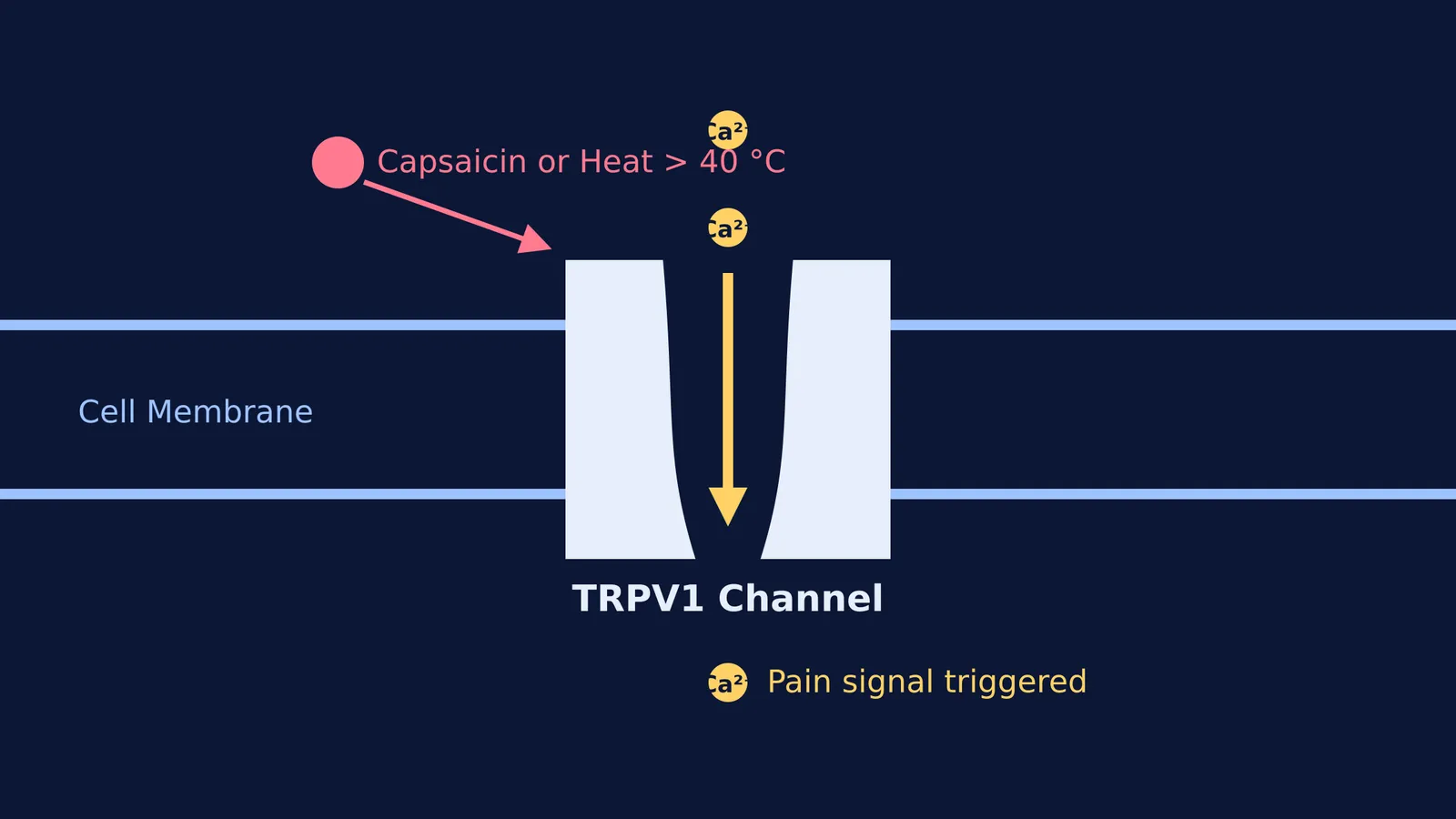
They took cells that did not normally react to capsaicin and began inserting these DNA fragments into them in batches. After an exhaustive search, they found a single gene that suddenly made the cells sensitive to capsaicin. This gene encoded a previously unknown ion channel protein, which they named TRPV1 (Transient Receptor Potential Vanilloid 1). It sits in the cell membrane and acts like a gatekeeper, remaining closed until the right trigger comes along.
If you are struggling to picture how cell membranes and ion channels work, the Fermi Concept Library has a lesson on every concept with its place in the map.
Why does spicy food feel like heat?
The most surprising part of the discovery came when Julius tested how this new TRPV1 channel reacted to temperature. He found that it was not just a chemical sensor for chilli peppers. TRPV1 is also activated by physical heat, specifically at temperatures above 40 °C (Nobel Prize).
When the temperature crosses 40 °C, or when capsaicin binds to the receptor, the TRPV1 channel changes its shape and opens. This allows calcium ions to rush into the nerve cell, triggering an electrical impulse that travels to the brain, signalling dangerously high heat.
Because the same receptor detects both the chemical capsaicin and noxious heat, your brain cannot tell the difference. This is why a spicy meal literally feels hot.
The receptors for cold and touch?
Julius did not stop at heat. By using menthol—the compound in mint that feels cool—his team later discovered TRPM8, the receptor that senses cold, starting around 28 °C (Nobel Prize). This confirmed that our bodies use a whole family of these ion channels to detect different temperature ranges. Around the same time, Ardem Patapoutian discovered the Piezo receptors that sense mechanical pressure and touch. The two scientists shared the 2021 Nobel Prize for these breakthroughs.
Understanding these channels explains the fundamental biology of how we perceive the physical world around us. Researchers are now using this knowledge of TRPV1 and other receptors to develop new classes of painkillers. By targeting the exact molecular gate where the pain signal begins, they hope to stop chronic pain without the addictive side effects of traditional opioid drugs.
When you are reviewing how signals pass from receptors to the brain, or membrane receptors vs intracellular receptors, it helps to see the big picture. And if you need to test your understanding of the discovery of the sodium-potassium pump or ion channels, Fermi's AI tutor can work out what you already know and build a plan for the session, so you sit down to a clear next step.


