

On this page
Why do plants need seed dispersal?
If every seed dropped directly beneath its parent tree, seedlings would compete fiercely for the same soil nutrients, moisture, and sunlight. In plant ecology, this intense intraspecific competition sharply restricts survival. As taught in the NCERT Science curriculum, seed dispersal carries offspring away from the parent, preventing resource exhaustion and helping species colonise fresh habitats.
Parent plants also harbor host-specific root pathogens, fungal spores, and seed-eating insects. Dispersing outward allows vulnerable seedlings to escape dense pest populations. While false fruits and parthenocarpy produce fleshy tissues without fertilisation, and apomixis and polyembryony yield maternal clones, all true seeds require transport mechanisms to establish new plants. Plants adapt to four environmental transport agents: wind, water, animals, and explosive dehiscence.
How do wind-dispersed seeds stay airborne?
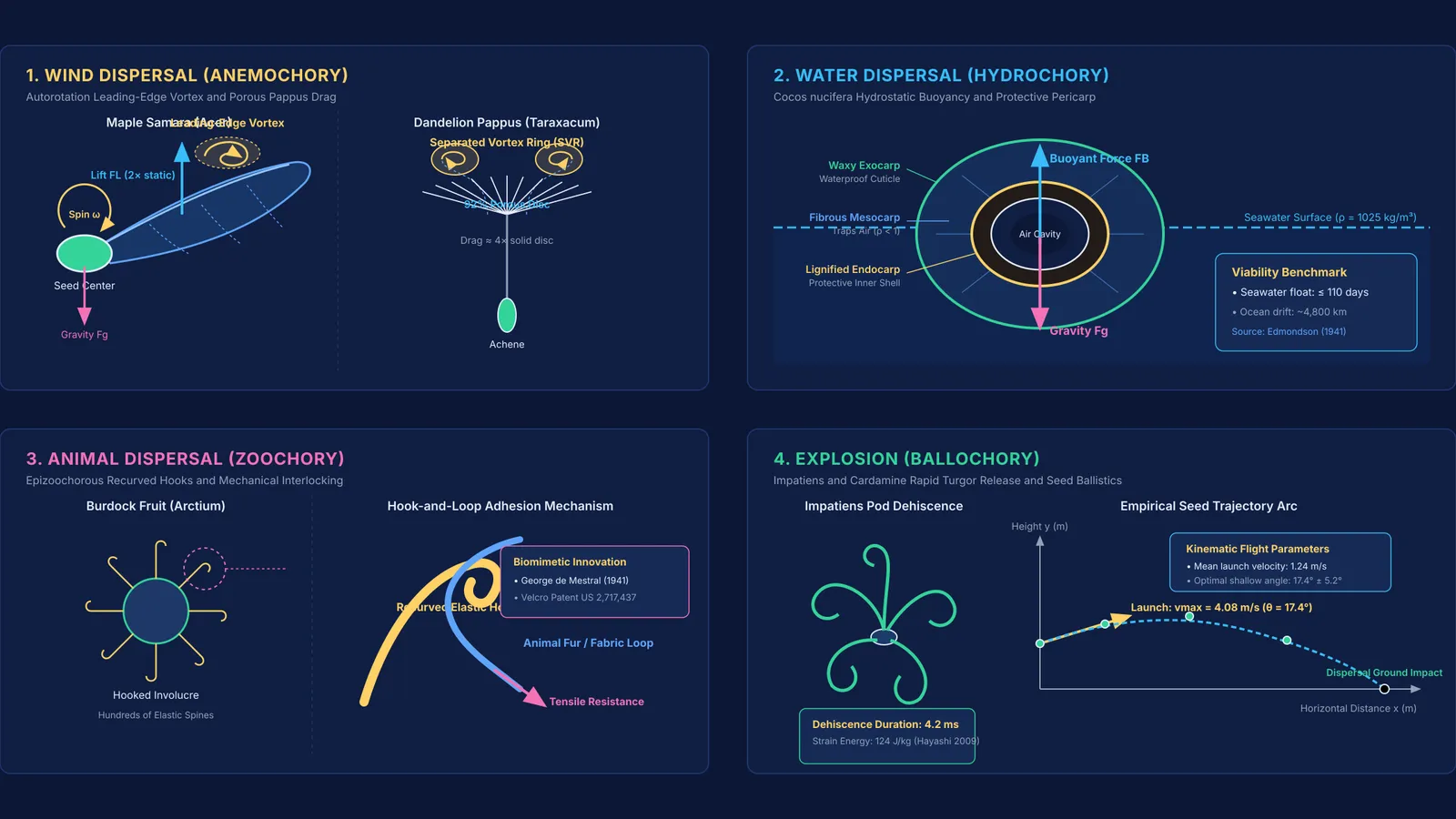
Wind dispersal, or anemochory, relies on aerodynamic structures that lower the settling velocity of falling seeds, allowing horizontal breezes to carry them across long distances. Plants achieve this using two aerodynamic strategies: spinning wings and porous parachutes.
Winged seeds and fruits, like the samaras of maple (*Acer*), drumstick (*Moringa*), and pine (*Pinus*), employ dynamic autorotation. As a maple samara descends, its asymmetrical centre of gravity initiates a rapid spin. Research by David Lentink and colleagues in *Science* demonstrated that autorotation creates a stable leading-edge vortex above the wing. This vortex generates up to twice the lift of a static blade, functioning like the wing of a hovering bat or hummingbird.
Plumed seeds like dandelion (*Taraxacum*) and *Calotropis* (Aak or Madar) rely on a hairy pappus. Cathal Cummins and co-authors showed in *Nature* that the dandelion pappus is 92% empty space. This precise porosity stabilises a detached low-pressure vortex ring directly above the hairs, generating four times more drag per unit mass than a solid parachute disk.
What makes water-dispersed seeds buoyant?
Water dispersal, or hydrochory, requires seeds and fruits to withstand prolonged soaking while floating on streams or oceans. Plants achieve buoyancy by enclosing air within protective pericarp layers.
The coconut (*Cocos nucifera*) is the classic ocean drift fruit. Its waxy exocarp seals out water, while a fibrous mesocarp traps air chambers that keep the seed buoyant. Beneath the husk, a thick, lignified endocarp shields the delicate embryo and nutrient-rich endosperm. In marine tests, Charles Howard Edmondson showed that coconuts float for up to 110 days while preserving germination viability, enabling drift across 4,800 kilometres of ocean.
Freshwater plants use similar strategies. Lotus (*Nelumbo nucifera*) embeds fruits in a spongy, obconical receptacle that floats downstream before rotting to release seeds. Water lilies (*Nymphaea*) surround seeds in an air-filled aril. These carpels reflect internal placentation types in flowers that determine how chambers open when submerged.
How do animals carry hooked and fleshy seeds?
Animal dispersal, or zoochory, operates through two paths: clinging to animal coats (epizoochory) or offering edible fruit (endozoochory).
Epizoochorous fruits produce stiff spines or recurved hooks that latch onto fur, feathers, and clothing. Plants such as *Xanthium* (cocklebur), *Urena*, and *Achyranthes aspera* spread by snagging grazing cattle and passing wildlife. In 1941, Swiss engineer George de Mestral examined burdock burrs (*Arctium*) under a microscope, noting hundreds of elastic hooks that led directly to his 1955 patented fastener, Velcro.
Endozoochorous plants, such as figs, guavas, and tomatoes, invest in sweet, colourful flesh. Animals digest the sugary pericarp, but the seeds possess thick, acid-resistant seed coats that survive digestive tracts unharmed. The seeds are excreted hours later in nutrient-rich droppings that fertilise the seedling.
How do bursting fruits explode to scatter seeds?
Self-dispersal, or autochory, requires no wind, water, or animals. Plants build internal mechanical tension as fruits mature, culminating in explosive dehiscence, or ballochory.
In touch-me-not balsam (*Impatiens*), ripe pods build high turgor pressure against stiff inner layers. When touched, the seam ruptures instantly. Research by Marika Hayashi and colleagues in the *Journal of Experimental Botany* found that *Impatiens* pod valves uncoil in just 4.2 milliseconds, releasing elastic energy of 124 J/kg and ejecting seeds at speeds up to 4.08 m/s.
Similar mechanical ruptures occur in popping cress (*Cardamine hirsuta*), where Hugo Hofhuis and colleagues in *Cell* found that asymmetric cell-wall lignification drives explosive silique coiling. In castor (*Ricinus communis*), differential drying forces three-chambered regma capsules to burst apart violently, flinging seeds several metres.
How should students classify dispersal adaptations?
When analysing seed dispersal in exams, apply this four-step diagnostic method:
Check external appendages: Identify flattened wings (*Acer*, *Moringa*), silky plumes (*Calotropis*), or recurved hooks (*Xanthium*).
Inspect tissue density: Look for fibrous air cavities (*Cocos*) or spongy floral receptacles (*Nelumbo*) that enable floating.
Test for explosive tension: Look for tense, curled pod valves (*Impatiens*) or dry splitting capsules (*Ricinus*).
Distinguish hitchhiking from ingestion: Separate hooked barbs meant for fur from sweet, edible flesh with resistant seed coats.
For students exploring morphological adaptations, the Fermi Concept Library organizes every concept in biology and physics, showing where each physical mechanism fits into the broader discipline. When tackling plant biomechanics problems, the Fermi Problem Library offers worked problems with a step-by-step solver that explains the underlying reasoning rather than merely printing an answer.


