On this page
If your teenager has started talking about Bitcoin, Nifty options or a "sure-shot" tip from a friend's group chat, a flat no rarely ends the interest. A better answer is "yes, to learning first". Markets run on maths your teen already studies (percentages, compounding and probability), plus a hard lesson in self-control. The aim is simple: your teen learns how money grows and how it is lost before any real money is at risk.
Why does my teenager want to trade crypto or stocks?
Usually because friends, influencers and trading apps make it look fast and easy, and peers count for more at this age. In an experiment with 306 people aged 13-16, 18-22 and 24 and over, Gardner and Steinberg (2005) found that participants took more risks and focused more on benefits than costs when they were with peers than when alone, and the peer effect was stronger in adolescents and youths than in adults. A group chat celebrating one friend's profit is exactly that setting, which is why the rules should come before the excitement.
Why are trading tips and borrowed money so dangerous?
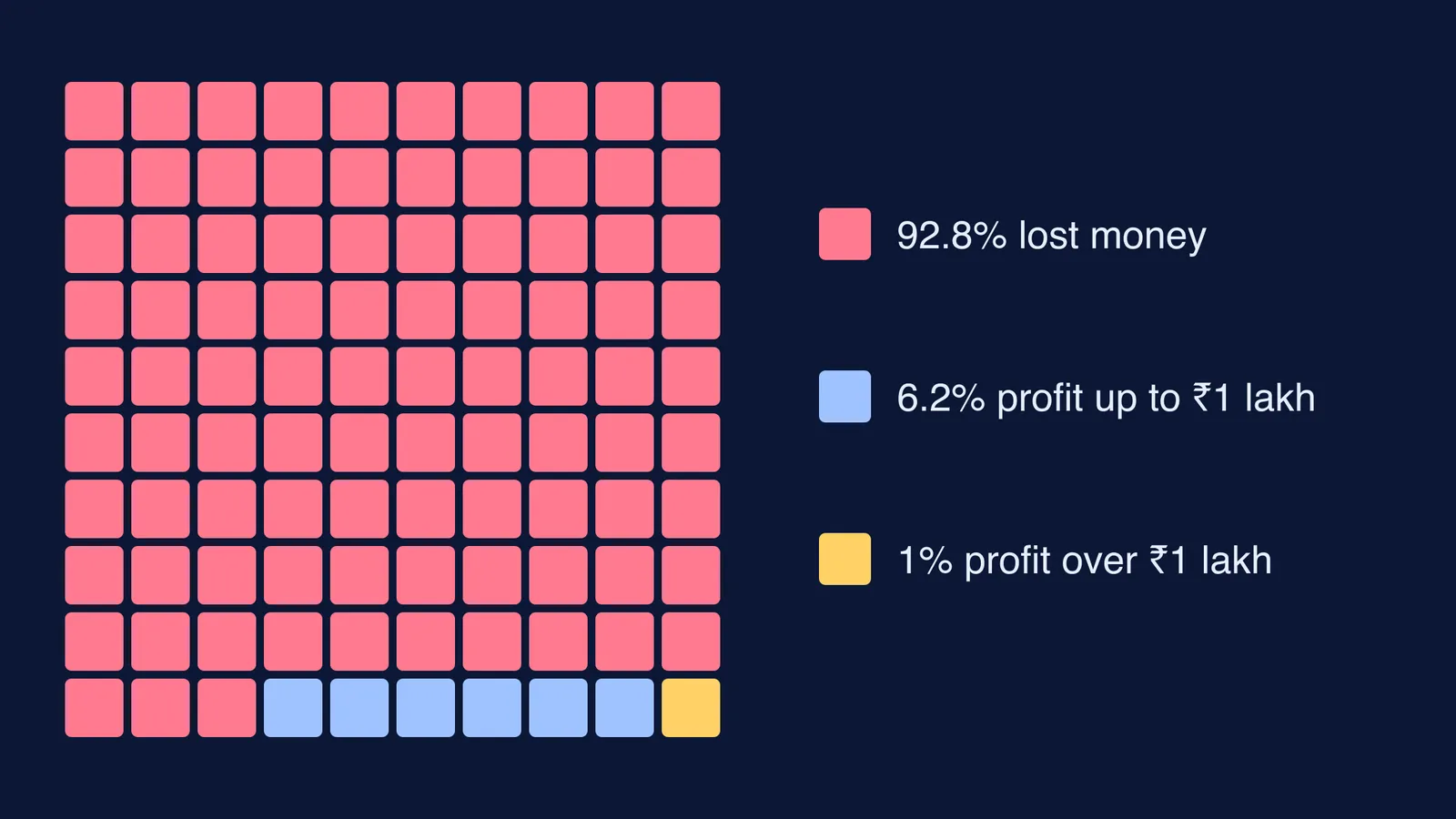
SEBI's study of equity futures and options (F&O) found that 92.8% of individual traders lost money over FY22 to FY24, on average about ₹2 lakh each, including transaction costs. Only 7.2% made a profit over those three years. Traders under 30 grew from 31% of F&O traders in FY23 to 43% in FY24, and nearly 93% of these young traders lost money in FY24.
F&O lets a trader control a large position with a small payment, so a small market move can quickly wipe out the money put in. Trading more often does not help either. In a study of 66,465 US households from 1991 to 1996, Barber and Odean (2000) found that those who traded most earned 11.4% a year while the market returned 17.9%.
Tips are the other trap. On 22 October 2026, SEBI warned investors about invitation-only WhatsApp groups where unregistered operators pose as market experts and planted members post false profit claims to make the calls look credible. SEBI advised investors not to join such groups, not to open accounts on apps they suggest, and to deal only with registered intermediaries, which you can check on SEBI's intermediaries page.
Crypto carries its own warning: the Reserve Bank of India has cautioned users of virtual currencies about economic, financial, operational, legal, customer-protection and security risks, and said in 2017 that it had not licensed any entity to deal in Bitcoin or any virtual currency.
How can I turn my teen's trading interest into learning?
Run it as a 12-week project with a written journal. Your teen does the work; you review it once a week.
Weeks 1-2, learn the words: share, index, mutual fund, future, option, crypto token. Your teen explains each to you in two sentences, including how you can lose money on it.
Weeks 3-8, paper trade with an imaginary ₹1,00,000 in a notebook or spreadsheet. Before every buy, write the reason, the price to sell at and the loss at which to get out. Every Sunday, compare the result with simply holding one index.
Weeks 9-12, a small real amount the family can lose without stress, ideally saved from your teen's own pocket money. It sits in a parent's account; your teen proposes, you both sign off. No F&O, no intraday trades, no crypto apps, no borrowing, no tips, at most one trade a week.
Week 12, read the journal together. Did the written rules hold? What would your teen change?
Why do losses hurt more than gains help?
Suppose ₹1,000 falls 50% to ₹500. To get back to ₹1,000 it must now rise 100%, because ₹500 has to double. A 20% fall, to ₹800, needs a 25% gain to recover. Fees come out of every trade, so breaking even on prices still leaves you behind. Then see how compound interest builds year by year, the patient side of the same maths. If percentages or compounding feel shaky, the Fermi Concept Library has a lesson for every concept in mathematics, so your teen can check the maths behind a return before trusting a screenshot of one.
What should I say when my teen asks to start trading?
Try something like this:
"I'm glad you're curious about markets, and I'm not saying no. I'm saying we learn it properly first. For six weeks, trade on paper and keep a journal. If your rules hold up, we'll put in a small amount we can both afford to lose, from my account, and look at it together every Sunday. Two things are off the table: tips from groups or influencers, and anything that uses borrowed money."
If trading turns secret, your teen borrows from friends to cover losses, or money worries start affecting sleep or mood, talk calmly and bring in a school counsellor. Tele MANAS, India's mental-health helpline, is on 14416.
Start with the notebook this weekend. The real money can wait eight weeks.