On this page
A rocket is on the pad at Sriharikota, or the whole street is talking about an eclipse. You don't need to know the answers to use moments like these. You need a few good questions and the patience to let your child try first.
Why talk to kids about science news at all?
The questions you ask can shape the conversation you have. In a Child Development study, Erin Jant, Catherine Haden and colleagues randomly assigned 78 young children (average age 4.9) and their parents to get museum conversation cards with elaborative questions, objects to handle, both, or neither. Families with cards talked about the first exhibit in more depth, and children carried information from the museum into talk at home.
Who you explain to matters too. In a 2001 science museum study, Kevin Crowley and colleagues found parents were three times more likely to explain science to boys than to girls. So ask your daughter the "why" question as often as your son.
How do you turn a news story into a family conversation?
Use the same four steps for any story:
Notice: "What did you see or hear?"
Wonder: "What's strange or surprising about it?"
Guess: "What do you think will happen, and why?"
Check: look it up together, or watch and see.
Don't skip the guess: it gives your child their own idea to test. And "I don't know, let's find out" is a fine answer: see what to do when your child asks a science question you can't answer.
What questions can you ask about an eclipse?
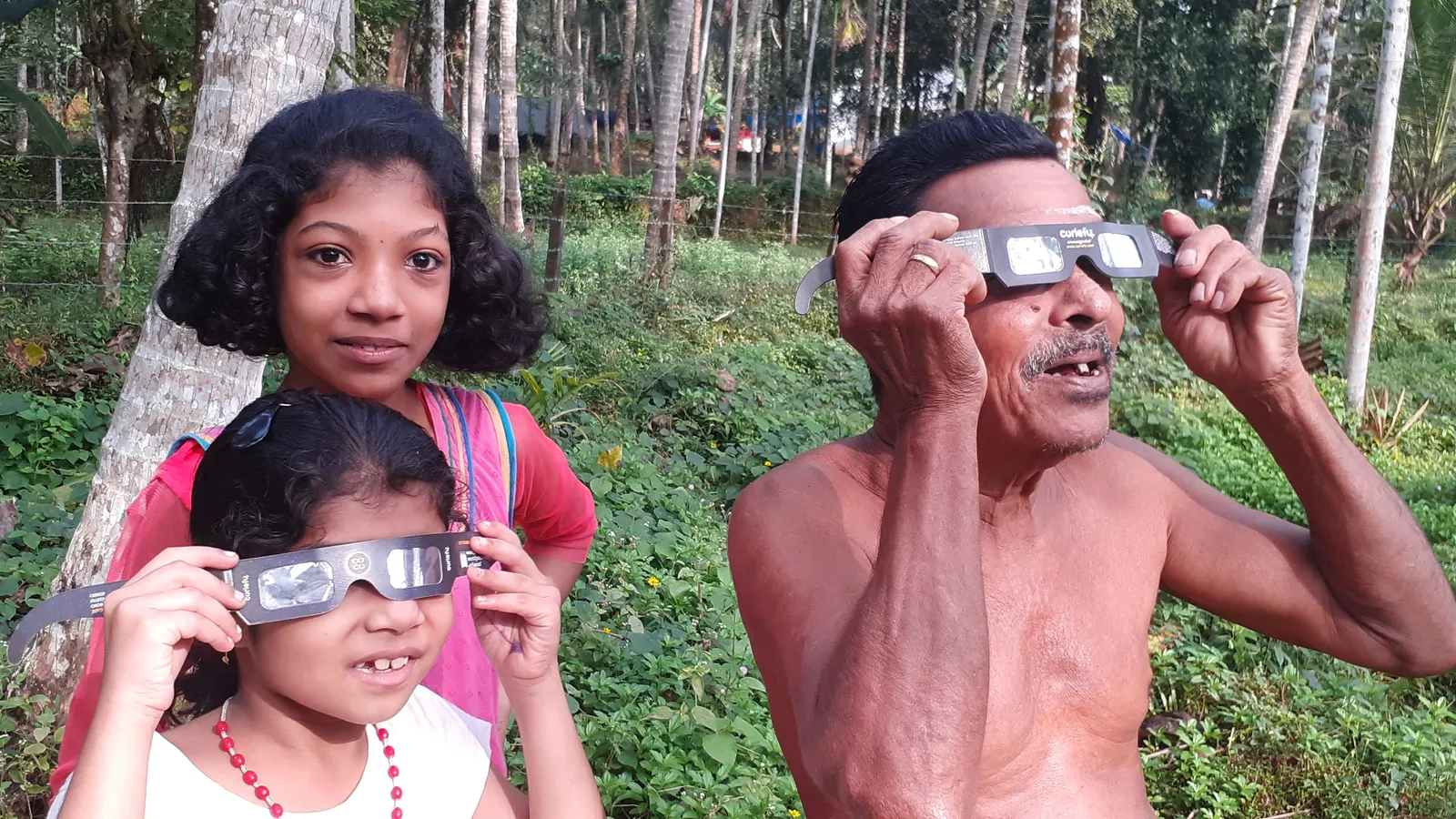
Safety comes first. NASA's eclipse safety guide says it is never safe to look directly at a partial or annular solar eclipse without proper eye protection. It also says ordinary sunglasses, however dark, are not safe, that eclipse glasses should meet the ISO 12312-2 standard, and that you should never look through binoculars, a telescope or a camera while wearing them. A pinhole projector, a hole in a card that throws an image of the Sun onto a surface, is also safe. Our guide on how to watch a solar eclipse safely has the details.
Ages 4 to 7: "What shape is the light coming through the hole? Is it changing?"
Ages 8 to 12: "The Moon goes round the Earth every month. Why don't we get an eclipse every month?"
Ages 13 to 17: "Eclipse glasses protect your eyes. So why is it dangerous to look through binoculars while wearing them?"
When a drawing on paper isn't enough, the Fermi Simulation Lab has interactive simulations for ideas that are easier to see than to read.
What can a rocket launch teach your child?
The registration page for ISRO's Launch View Gallery at Sriharikota lists the GSLV-F18/NVS-03 launch for 30 October 2026 at 11:51 pm and says watching from the gallery is free. You register online, with an Aadhaar card, driving licence or other government ID. Launch dates can move, so check first. NVS-03 is a navigation satellite for NavIC, India's own satellite navigation system.
Ages 4 to 7: "Let's count down together. What do you think is inside the rocket?"
Ages 8 to 12: "Why does the rocket drop parts of itself on the way up?"
Ages 13 to 17: "Phones can already use GPS. Why would India build its own navigation system?"
How do you explain a monsoon forecast to a child?
A forecast teaches probability, because it doesn't promise an outcome. In its April 2026 long range forecast, IMD said June to September rainfall was likely to be 92% of the long period average (87 cm), plus or minus 5%. It gave "deficient" rain a 35% chance, "below normal" 31%, "normal" 27%, "above normal" 6% and "excess" 1%. For background, see what causes the Indian monsoon.
Ages 4 to 7: "If the forecast says it will probably rain, should we take an umbrella? What if it doesn't rain?"
Ages 8 to 12: "Normal rain got a 27 in 100 chance. Is that likely or unlikely? Which result had the biggest chance?"
Ages 13 to 17: "92%, give or take 5, covers 87% to 97%. Why give a range? Was the forecast wrong if the real figure ended up outside it?"
Here is how that might sound at dinner with a 12-year-old:
You: "The weather office said this year's monsoon would probably be weaker than usual. What do you think 'probably' means?"
Child: "That it will be weaker."
You: "They gave normal rain about a one-in-four chance. If something has a one-in-four chance, can it still happen?"
Child: "Yes, like rolling a dice and getting a six. That's even less likely."
You: "Good. Let's check what actually fell this season and see who guessed right."
One story a week is plenty. Stop while your child is still interested.
Teenagers can look up the idea behind a headline in the Fermi Concept Library, which has a lesson for each concept in physics, chemistry, biology, mathematics and computing.