

On this page
For many engineering and science students, the first round of campus placements is not an interview. It is often an online aptitude test, and it can decide who gets to the interview at all. The good news is that the syllabus is mostly school maths, logic and English. The hard part is speed under a timer, and speed can be practised.
If you are unsure when to start, our placement preparation timeline for college students sets aptitude practice alongside resumes and coding.
What is in a campus placement aptitude test?
Formats differ by company and year, so check the recruiter's current pattern. The three sections below are common. As one example, the TCS iON National Qualifier Test page describes its cognitive test as verbal ability, reasoning ability and numerical ability.
Quantitative (numerical) ability: number system, arithmetic, basic statistics and data interpretation, which in practice means percentages, ratios, averages, time and work, and reading charts.
Logical reasoning: number and word patterns, puzzles and arrangements, statements and conclusions, and visual or spatial questions.
Verbal ability: grammar, correct usage and reading comprehension.
What trips students up is picking the right method fast, then calculating without a calculator.
Why does mixed practice beat topic-wise practice?
Most aptitude books are arranged by chapter: thirty percentage questions, then thirty ratio questions. That feels productive because you know the method before you read the question. The real test never tells you.
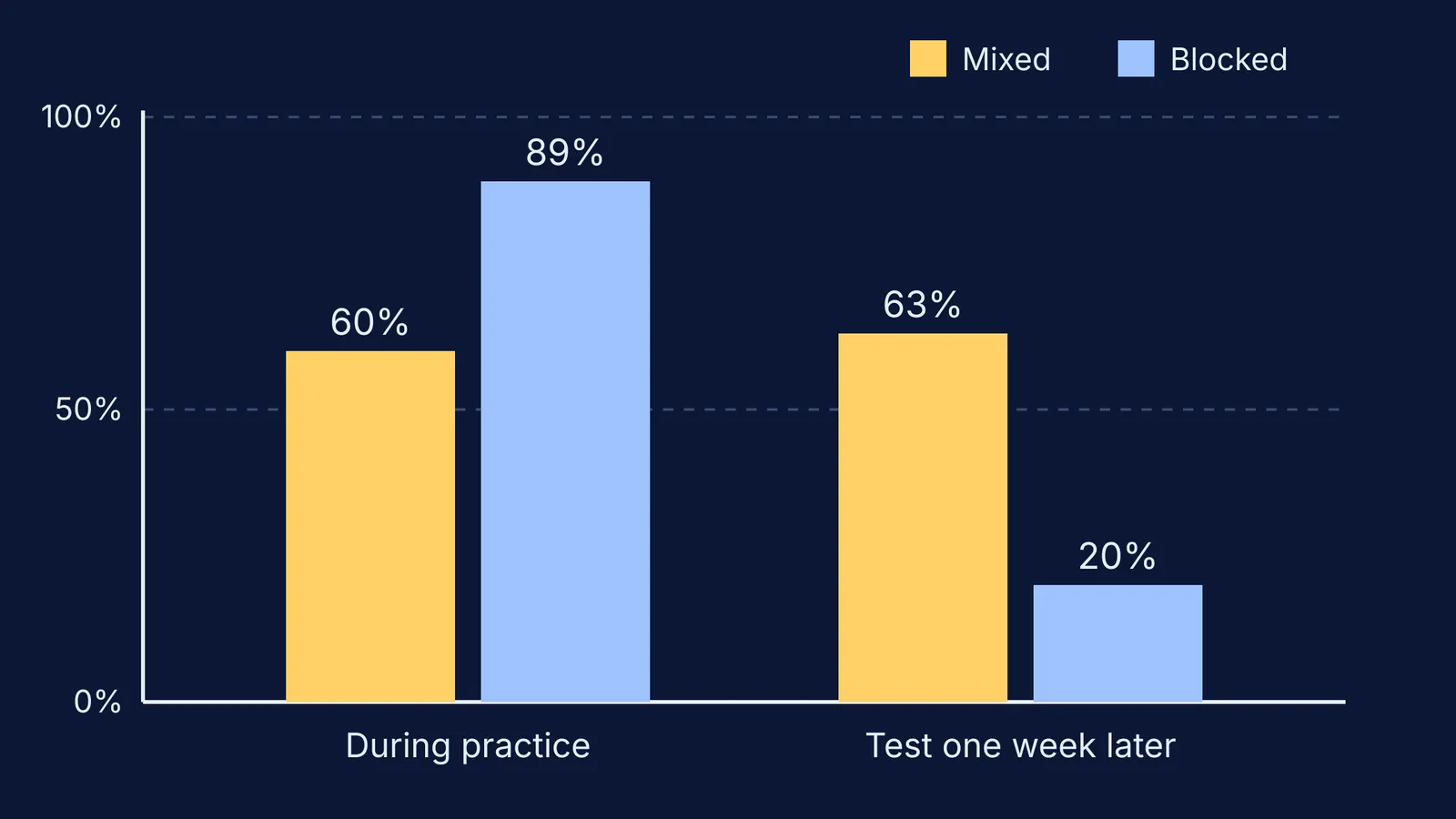
Doug Rohrer and Kelli Taylor tested this directly. In the second experiment of their 2007 study in Instructional Science, 18 college students learned to find the volumes of four unfamiliar solids. One group practised the problems grouped by shape; the other practised the same problems shuffled together.
During practice, the grouped students scored higher, 89% against 60%, according to the same paper. On a test one week later, the shuffled group scored 63% and the grouped group 20%. The authors argue that mixing forces you to learn which method fits which problem, not just how to run the method. It was a small lab study, so treat it as a strong hint rather than a guarantee.
A larger review backs testing yourself. A 2013 review of ten study techniques by John Dunlosky and colleagues rated practice testing and spaced practice as the only two high-utility techniques, and rereading as low utility. It rated mixed (interleaved) practice as moderate, because the evidence was still limited.
For more on building mixed sets in any subject, see our interleaved practice plan.
How should you prepare for aptitude tests each day?
Here is a four-week routine that takes about 50 minutes a day and fits around classes.
Week 1, diagnose: take one full timed practice test from a recent pattern. Mark every question as right, wrong, or skipped, and note the topic. This list is your starting syllabus.
Weeks 1 to 2, fill gaps: spend 15 minutes a day relearning the two or three weakest topics from the basics, then 30 minutes on a mixed, timed set of 15 questions from all three sections.
Weeks 3 to 4, build speed: move to mixed sets with a strict timer of about one minute per question, and add one full timed test each weekend.
Every day, last 5 minutes: update your error log (see below).
Quick mental arithmetic saves a lot of time in the quantitative section. Our guide on how to calculate percentages mentally makes a good ten-minute warm-up.
What does a mixed practice set look like?
Three questions in a row, each needing a different first move:
Quant: a price rises 20%, then falls 20%. Net change? Multiply the factors: 1.2 × 0.8 = 0.96, so a 4% fall, not zero.
Logic: "All coders are graduates. Some graduates are designers." Does it follow that some coders are designers? No. The designers could all be graduates who are not coders.
Verbal: "Neither the manager nor the interns was ready." With "neither... nor", the verb agrees with the nearer noun, so it should be "were".
The skill being trained is spotting the type in seconds, which chapter-wise practice skips.
What should you do with the questions you get wrong?
Keep an error log with four columns: question, your answer, the reason it went wrong, and the fix. Use only four reasons: did not know the concept, chose the wrong method, made a calculation slip, or ran out of time. After a week, the most common reason tells you what to practise next.
For wrong-method mistakes, rework the question before you look at the solution. If you still need help, the Fermi Problem Library has worked problems with a step-by-step solver that explains the reasoning rather than printing an answer. For concept gaps such as probability or ratios, the Fermi Concept Library gives each mathematics concept its own lesson.
One weak aptitude round is common and fixable. If worry about placements is affecting your sleep or daily life, talk to someone you trust or call Tele MANAS, the free 24x7 national mental-health helpline, on 14416.
Start today: take one timed mixed set of 15 questions, and log every mistake.


