On this page
When should I start placement preparation in B.Tech?
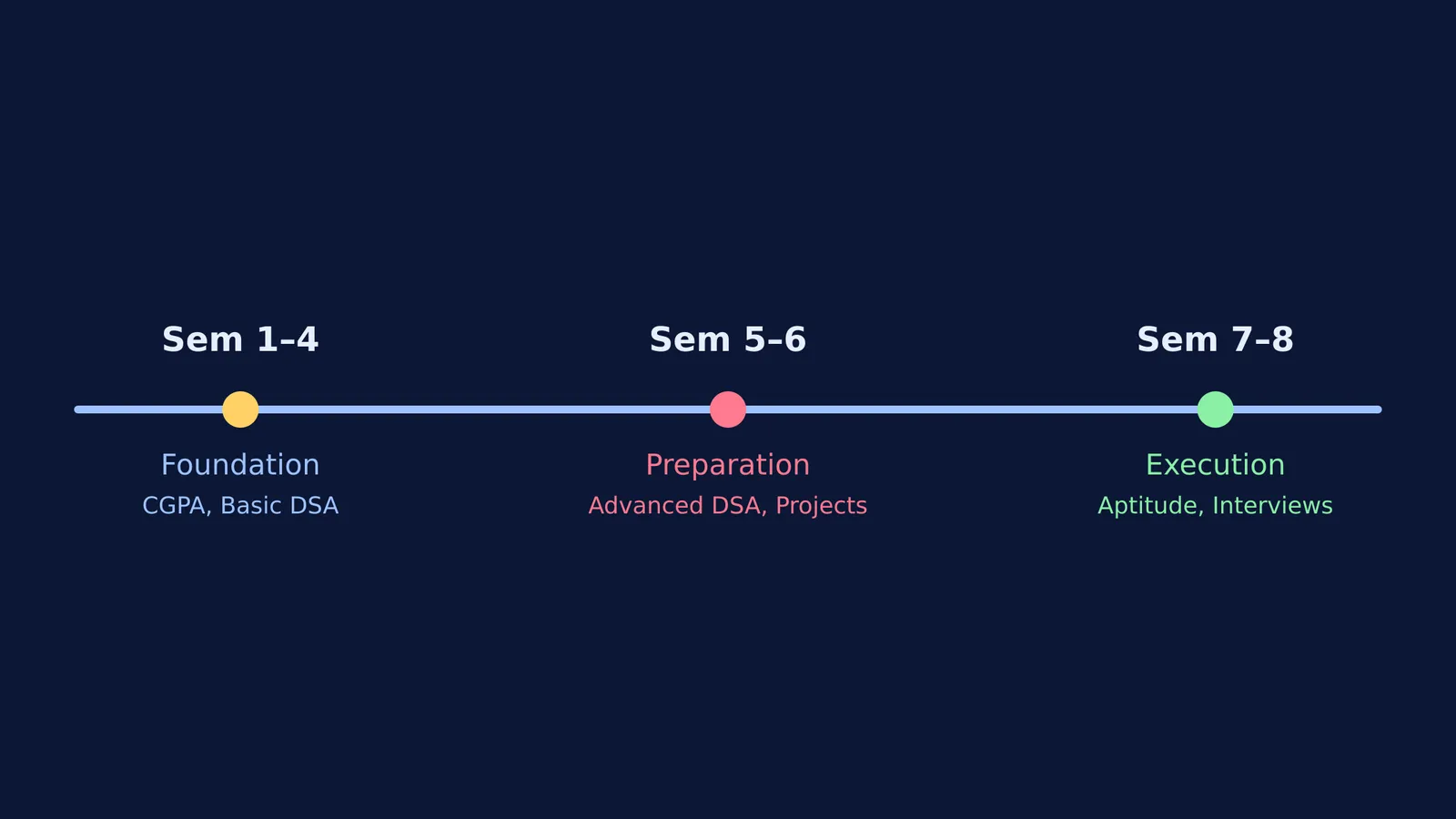
Start your intensive placement preparation in the fifth semester (the beginning of your third year). Campus recruitment drives typically begin in the seventh semester (July or August of your final year). Starting in the fifth semester gives you a full 12-month runway to master data structures, build projects and practise aptitude tests.
If you start earlier, you risk burning out or neglecting your core degree subjects. If you start later, you may not have enough time to cover both technical skills and the quantitative aptitude that companies test in the first round. The goal is to build a steady, sustainable habit rather than cramming everything into the month before companies arrive.
What should I learn in my first and second year?
Your first two years are for building a foundation, not for stressing over interviews. During this time, your main goal is to become comfortable with writing code and passing your university exams.
Pick one language: Choose C++, Java or Python and learn it well. It is better to know one language deeply than three languages poorly. C++ and Java are preferred by many for competitive programming because they force you to understand memory management, while Python is excellent if you plan to move into data science or machine learning.
Maintain your CGPA: Keep your Cumulative Grade Point Average (CGPA) above 7.0, or 7.5 if possible. Many product-based companies use 7.0 as a strict cutoff for shortlisting resumes. If your CGPA drops below this, you may not even get the chance to write the coding test.
Start basic data structures: Learn how arrays, strings and linked lists work in your chosen language. You do not need to solve hard problems yet; just understand how to traverse an array or reverse a string.
Improve your communication: Many technically sound students fail the final HR round because they struggle to articulate their thoughts. Start participating in college clubs or debates to build your confidence.
If you struggle to write basic code or understand fundamental maths, Fermi's AI tutor can work out what you already know and build a plan for the session, helping you master the basics before moving on.
How should I prepare in my third year?
This is when the real work begins. According to the India Skills Report 2024, which surveyed 388,000 students, 64.7% of B.E./B.Tech graduates are highly employable (Source). To join this group, you must move beyond basic coding and prove you can solve real problems.
Master advanced DSA: Move on to trees, graphs and dynamic programming. These are the topics most frequently asked in technical rounds by top-tier product companies. Aim to solve two to three problems daily on a platform like LeetCode or GeeksforGeeks.
Build two projects: Create two working projects that solve a real problem and host the code on GitHub. When deciding how to build your first mobile app as a student, choose something you can explain from scratch in an interview. Avoid generic tutorial projects like a basic to-do list; instead, try building a full-stack booking system or a data scraper.
Study core subjects: Revise Operating Systems (OS), Database Management Systems (DBMS) and Computer Networks. Interviewers will ask about these to test your engineering judgment. They want to know if you understand how memory is allocated or how a database query executes under the hood.
What should I do when campus placements begin?
By July of your final year, companies will begin visiting your campus. If you are looking at how to get a job off campus as a fresher in India, this is also when you should start applying on company portals.
Practise aptitude tests: The first round of almost every placement drive is an aptitude test covering quantitative ability, logical reasoning and verbal ability. If you cannot pass this, nobody will look at your code. Dedicate at least 30 minutes a day to solving standard quantitative problems.
Do mock interviews: Practise speaking your thoughts aloud while you write code on a whiteboard or a blank text editor. Interviewers care as much about your thought process as they do about the final correct answer.
Polish your resume: Keep it to one page. Highlight your skills, the two projects you built in your third year, and any internships you have completed. Be prepared to answer questions on every single line of your resume.