

On this page
Most families buy a fish tank for the fish. The real teacher is the water. A glass box with a filter, a few plants and three or four fish is a closed system, and keeping it healthy means your child has to think like an ecologist, a chemist and a caretaker at the same time.
What does a home aquarium teach children about ecosystems?
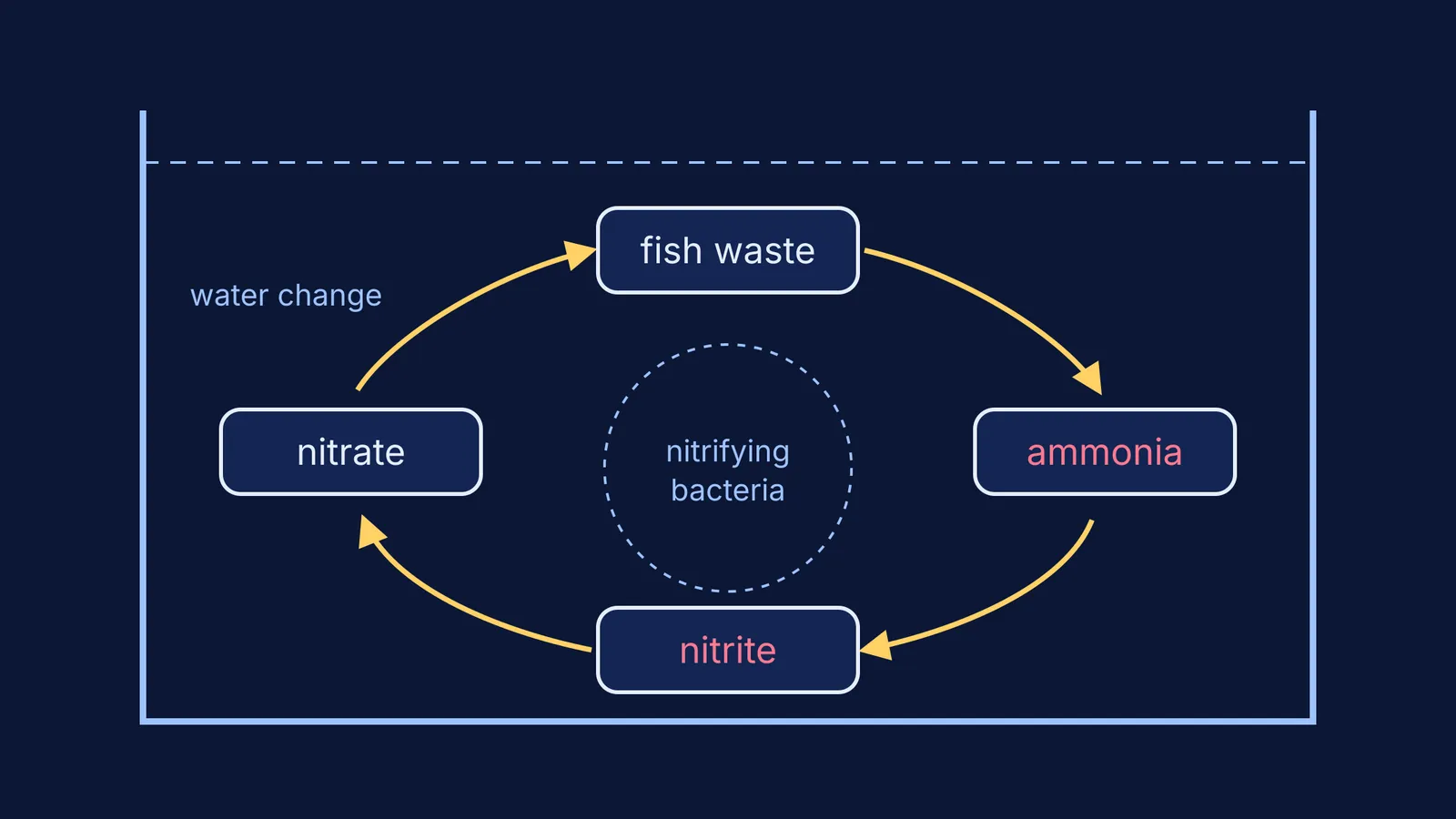
The big idea is the nitrogen cycle. The Royal Veterinary College's aquarium fact sheet describes an aquarium as a closed system where uneaten food, dead plants and waste build up into toxic compounds such as ammonia and nitrite.
Nitrifying bacteria, which typically live in the filter or the gravel and other substrate, convert ammonia into nitrite and then into much less harmful nitrate. The University of Florida IFAS fact sheet on ammonia names some of the groups involved: ammonia-oxidising bacteria such as Nitrosomonas, and nitrite-oxidising bacteria such as Nitrobacter and Nitrospira.
That gives a child something a textbook diagram cannot: a cycle they are part of, ending with them removing nitrate in a partial water change. If your child has drawn a pond ecosystem for school, a tank has the same producers, consumers and decomposers at desk size; our explainer on the parts of a pond ecosystem maps them out.
Why is water quality the real science lesson?
Because the danger is invisible. Clear water can still harm fish, so the only way to know is to measure.
The UF/IFAS fact sheet gives a striking number: un-ionised ammonia (NH3) is about 100 times more toxic to fish than the ionised form (NH4+), and the toxic share rises as pH and temperature go up (UF/IFAS). It also says nitrite can be toxic to fish at levels as low as 0.10 mg/L. It recommends testing ammonia once a week, and straight away whenever fish change how they look or behave.
Here pH stops being a word in a chapter and becomes the reason the same ammonia is more dangerous in one tank than another. In an Indian summer, a tank by a sunny window warms up, and warmer water shifts more ammonia into its toxic form.
If the pH, equilibrium or ionisation ideas behind those test strips are new, the Fermi Concept Library gives each concept in chemistry and biology its own lesson, so your child can look up the idea the moment the tank raises it.
How much responsibility can a child take on?
More than most parents expect, as long as the jobs are small and regular. The NSW Department of Education's guidance on classroom aquariums says a tank lets students experience the responsibilities of caring for animals, and asks schools to arrange care during the holidays. The same holds at home: decide before the Diwali trip or the summer visit to grandparents who will feed the fish and check the filter.
Be honest with your child about the commitment. The RSPCA points out that goldfish can live for up to 25 years and some grow over 30 cm, which is very different from the fairground-bowl picture.
On learning benefits, keep expectations modest. A 2017 conference paper by researchers including the University of the West of Scotland set out to test fish in primary classrooms because the authors knew of no quantitative evidence for their teaching value. An aquarium is a good hands-on project, not a proven way to raise marks.
How do you set up a first aquarium with your child?
The Royal Veterinary College says a new tank takes about 8 weeks to grow a healthy bacterial population, and warns that suddenly adding many fish to an unestablished tank could kill them (RVC fact sheet). The RSPCA says to run a tank for at least two weeks before adding any fish. Use that waiting time as the lesson.
Week 1: set up the tank, filter and plants together. Your child starts a logbook with date, water temperature and what they see.
Weeks 2 to 8: test the water each week and record ammonia, nitrite, nitrate and pH. Ask your child to predict the next reading before testing.
Once the tank is established: add a few hardy fish, not a full tank. The RVC advises adding new animals gradually, over a few days to weeks, and testing before and after.
Every week after that: testing and a partial water change. The RVC warns never to empty and scrub the whole tank, because that wipes out the helpful bacteria.
Every day: one feeding job and one look at the fish, with any change noted in the logbook.
A logbook turns this into real data. Our guide to keeping a science journal at home shows simple page layouts that work well here.
Try this script when a reading goes wrong: "The nitrite went up this week. What changed since last time? Food, new fish, temperature, or the filter?" You are teaching your child to look for causes, not to panic.
If the tank turns into a lasting interest in living things, our piece on supporting a child who is interested in biology has ideas for what to try next.


