On this page
Your child starts Class 1 and the reader is suddenly full of small words: the, was, said, they. These are sight words, and making them automatic helps early reading feel less like hard work. If you are still checking the basics, start with our home checklist for Class 1 readiness.
What are sight words?
A sight word is a word a child reads instantly from memory, without sounding it out. Linnea Ehri's 2014 review in Scientific Studies of Reading explains how this happens: children form letter-sound connections that bond a word's spelling, pronunciation and meaning in memory, a process she calls orthographic mapping. The review adds that this depends on phonemic awareness and knowing which letters stand for which sounds.
That matters at home. Sight words are not pictures to memorise by shape. They stick when your child links the letters to the sounds, even in a word like “said”, where only the middle is odd.
A well-known older list is E. W. Dolch's “A Basic Sight Vocabulary” (1936): 220 words and no nouns. They are service words that turn up in almost any book, whatever it is about.
Which sight words should a Class 1 child learn first?
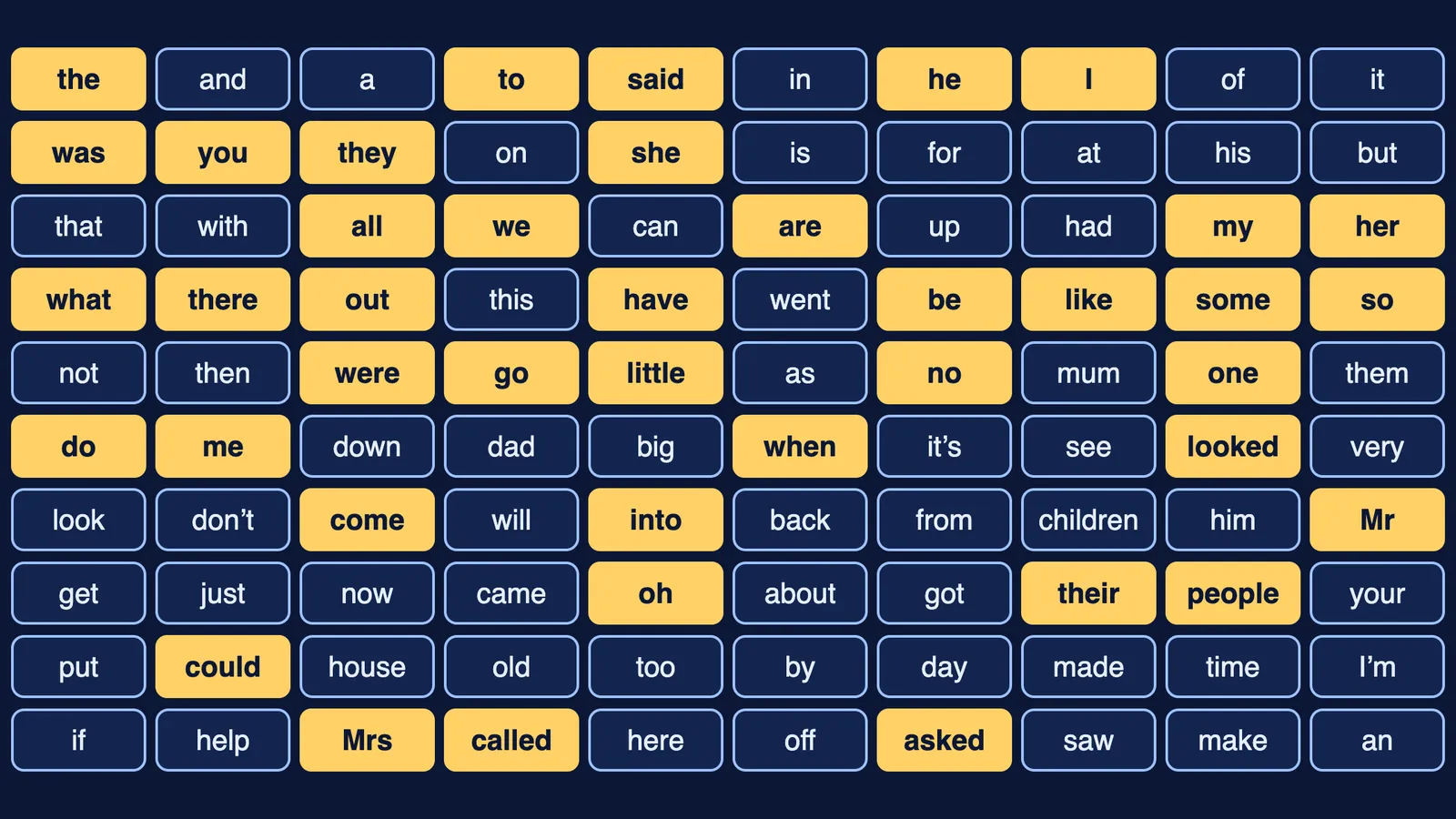
Start with the words that turn up most. The UK government's phonics guide Letters and Sounds (DfES, 2007) lists 100 high-frequency words, in order, from the Children's Printed Word Database of words in children's books. Here are the first 50, in sets of ten:
Set 1: the, and, a, to, said, in, he, I, of, it
Set 2: was, you, they, on, she, is, for, at, his, but
Set 3: that, with, all, we, can, are, up, had, my, her
Set 4: what, there, out, this, have, went, be, like, some, so
Set 5: not, then, were, go, little, as, no, mum, one, them
The same guide splits the 100 words into decodable and tricky words. By its tables, 59 of the 100 can be sounded out with early phonics and 41 are tricky when children first meet them. In Set 1, the tricky ones are the, to, said, he and I. The list comes from British books, so swap “mum” for whatever your family says.
How do you teach sight words without endless flashcards?
Try one set of ten words a week, about ten minutes a day. Steps 1 and 2 follow the letter-sound approach in Ehri's review; the other steps and the pace are our suggestions, not tested ones.
Say the word and use it in a sentence your child cares about: “The dog is asleep.”
Point to each letter and say the sounds you hear. For a tricky word, name the odd part.
Write it once, with a finger on the table, chalk or a pencil.
Find it in a real book before bed.
At the weekend, mix all the words so far and carry any that still cause a pause into next week.
If letter sounds are still shaky, go back a step with these ways to learn the alphabet without flashcards.
Five sight word games to play at home
India's foundational literacy mission, NIPUN Bharat, calls for play, discovery and activity-based learning, and lists games among its ways of assessing children. These five need only paper and chalk.
Word hunt. Pick two words from this week's set and hunt for them on cereal boxes, the newspaper or shop boards on the way home.
Saap-seedi words. Write a sight word on every square of a snakes and ladders board. Read the word you land on before moving; miss it and you stay put.
Stapu reading. Chalk a hopscotch grid with one word in each box. Your child reads each word aloud as they hop on it.
Sentence builder. Write words on slips and build short sentences together: “I can see a big dog.” NIPUN Bharat's goal for Grade 1 is that a child reads small sentences of at least 4-5 simple words in an unfamiliar text.
Catch my mistake. Read a sentence from their book and swap one sight word (“The cat was big” becomes “The cat is big”). Your child follows with a finger and stops you.
What if my child keeps guessing words by the end of Class 1?
Guessing from the first letter or the picture is common early on. Ask your child to look through the whole word before saying it. Our post on why children skip hard words while reading has scripts for that moment.
If the guessing goes on for months, talk to the class teacher first. The NIPUN Bharat document says early assessment should spot learning gaps and, where needed, lead to referral to specialists. A paediatrician or special educator can tell you whether an assessment would help.
If an older child needs help with school science or maths the same evening, Fermi's AI tutor works out what they already know and builds a plan for the session, which leaves you free for ten words with your Class 1 reader.