On this page
If your child is about to start Class 1, the age rule is the easier part: in February 2023 the Ministry of Education asked all states and Union Territories to admit children to Class 1 at six years and above, as The Tribune reported. The harder question is whether your child is ready to learn there. You can answer it at home in a week.
NCERT's Class 1 school-preparation guide, Vidya Pravesh, lists what children are expected to do by the end of Balvatika, the last preschool year. Its month-wise tracking sheets also give teachers a three-point scale for many skills: needs help, can do with difficulty, can do. The checklist below borrows both.
What skills does a child need before Class 1?
A 2007 study in Developmental Psychology by Greg Duncan and colleagues analysed six longitudinal data sets to see which school-entry skills predicted later reading and maths achievement. The strongest predictors were school-entry maths, reading and attention skills, with early maths the strongest. Social skills and behaviour problems were generally not significant predictors of later academic performance.
That is about marks, not settling in. A child who cannot open their tiffin will struggle early, so independence is on the list too.
Is my child ready for Class 1? The home checklist
Over an ordinary week, rate each item on that scale. The items are from the Balvatika learning outcomes in Annexure I of Vidya Pravesh.
Independence:
Keeps up basic hygiene and healthy eating habits with growing independence
Does buttons, pours water and cuts along a line
Holds a crayon between index finger and thumb (a pincer grip)
Follows simple instructions and the rules of a game
Talks to an unfamiliar adult, such as a new teacher, in their own language
Attention:
Finishes a small task someone else gives them
Remembers 4 to 5 objects seen at one time
Arranges 4 to 5 picture cards in order of size or of events in a story
Early reading:
Picks a book and guesses the story from the pictures
Notices repeated sounds in words in familiar stories and poems
Tries to write their own name, even with invented spellings
Early numbers:
Counts up to 10 objects
Counts forward and backward from a given number up to 9
Recognises and writes numerals up to 9
Compares two numbers up to 10 using more than and less than
What if my child is not ready for Class 1 yet?
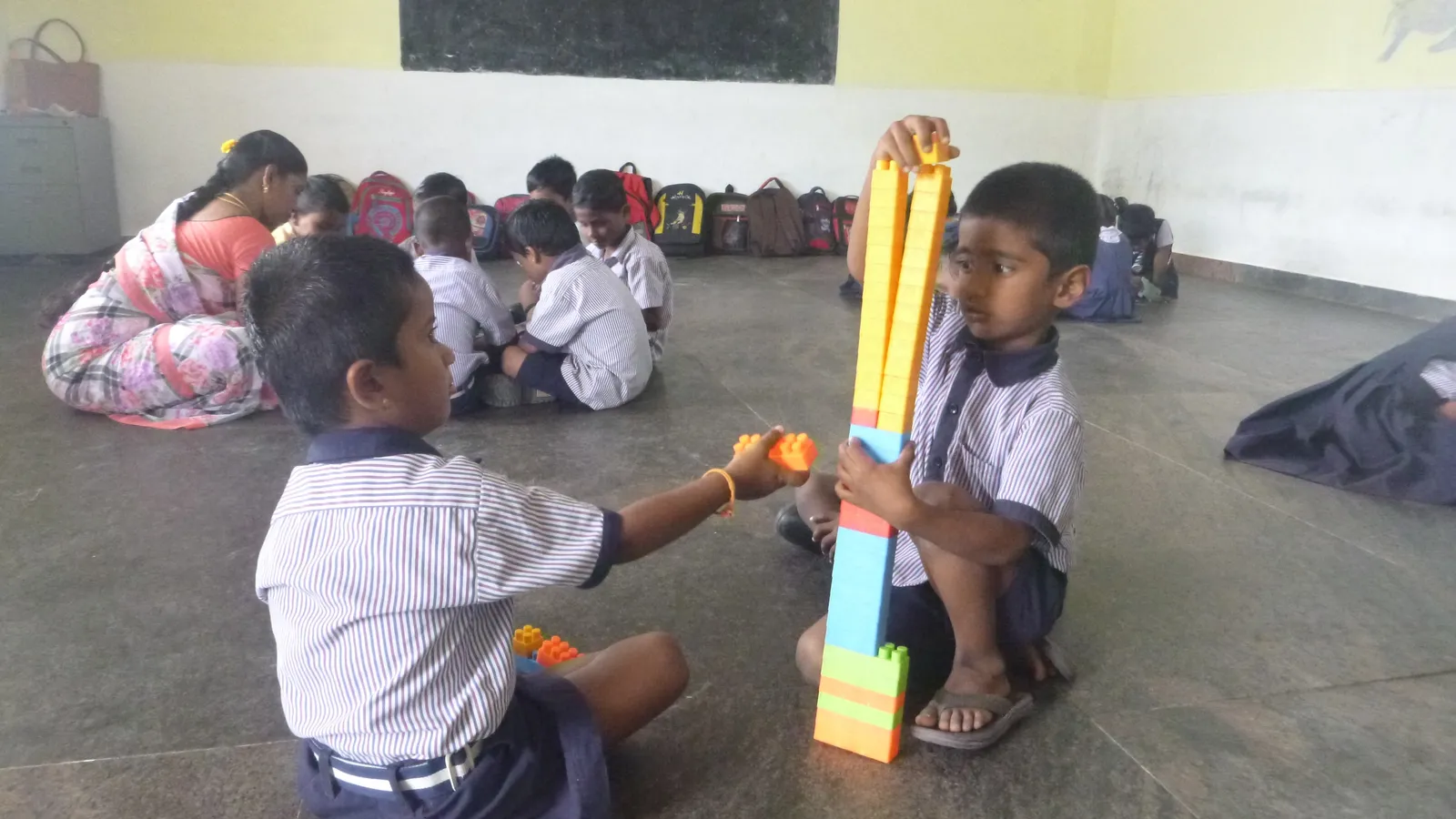
Close gaps through play, not extra worksheets. Vidya Pravesh is a play-based programme for the first three months of Class 1, suggested at four hours a day with local play materials, according to the NCERT guidelines. At home, work on one or two weak areas a little each day.
Independence: give one real job, such as packing the school bag. Wait before you rescue.
Attention: play What's missing? Put five objects on a tray, cover it and take one away.
Early reading: read one picture book a day and pause to ask, What will happen next? Play I spy with sounds in your home language.
Early numbers: count stairs, rotis and buttons aloud. Make two piles of peanuts and ask, Who has more?
If reading is the main worry, see our guide to closing the UKG to Class 1 reading gap. If your child resists the pencil, read what to do when a Class 1 child does not want to write.
For example, say your daughter rates can do on counting, can do with difficulty on story order, and needs help on buttons.
Week 1: she buttons her own shirt each morning while you wait. After the bedtime story, ask: What happened first? What happened next?
Week 2: keep the buttons going. Draw three scenes from a familiar story on slips and let her put them in order.
Day 14: rate the same items again before choosing the next gap.
What should I say to my child about starting Class 1?
Keep it short and hopeful:
In Class 1 you'll have a teacher whose job is to help you.
You don't need to know everything yet. School is where you learn it.
What's one thing you want to ask your teacher?
Skip warnings like the teacher will scold you. Once school starts, a calm daily rhythm helps more than drilling; here is a simple study routine for a Class 1 child.
When should I ask for help?
If your child often seems not to hear you, struggles to see pictures, is hard for family to understand, or rates needs help across most of the list, talk to your paediatrician or the class teacher rather than waiting. If the worry is weighing on you, Tele MANAS, the free national mental health helpline, is on 14416.
Finding out what a learner already knows and planning from there is also how Fermi's AI tutor works with older students in maths and science: it works out what they know and builds a plan for the session.