

On this page
Starting primary school is a big transition, and parents often wonder how much time their young child should spend studying at home. While it is tempting to start rigorous academic routines early, a 20-minute daily mix of reading, number games and drawing is more than enough to build a solid foundation, especially given that experts advise no more than 10 minutes of formal homework.
How much should a Class 1 child study at home?
When deciding how much homework helps, less is more for young children. Duke University researcher Harris Cooper reviewed decades of studies and found that for elementary students, there is no measurable link between the amount of homework completed and academic achievement. Cooper's widely cited rule of thumb recommends a maximum of 10 minutes of homework per night for a first grader.
In India, the official guidance is even lighter. The School Bag Policy 2020, released by the Ministry of Education, clearly states that there should be no formal homework for students in Classes 1 and 2. The policy emphasises that children at this age—in the foundational stage of their education—are too young for long hours of structured academic work. The goal is not to drill facts, but to foster curiosity and establish a predictable, stress-free routine.
What does a 20-minute daily study routine look like?
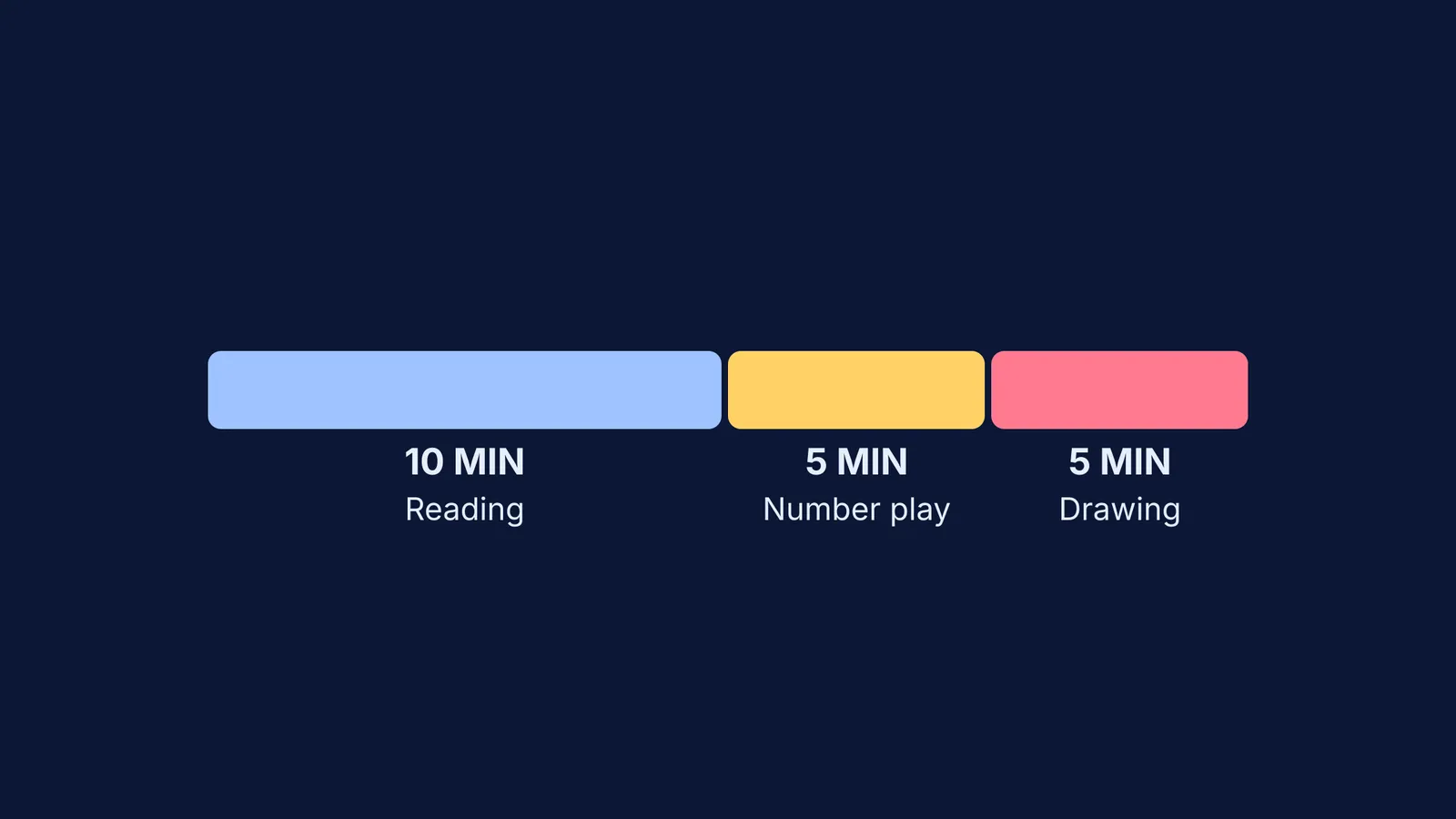
Instead of worksheets or copying text, a daily study session should focus on exposure, connection and active play. You can use this 20-minute framework to structure the time, keeping formal tasks within the 10-minute limit:
10 minutes: Reading for pleasure. Rather than forcing the child to sound out every word alone, try shared reading with young children. Read a picture book to them, ask what they think will happen next, or let them read the familiar words. This builds vocabulary and a love for stories.
5 minutes: Number play. Keep maths physical and visual. Count the stairs you climb, group toys by colour, or play a quick board game with dice. Simple maths talk with young children builds number sense without the pressure of feeling like a formal test.
5 minutes: Drawing and fine motor skills. Give them a blank sheet of paper and some crayons. Drawing builds the hand strength and coordination needed for handwriting, while giving them a chance to express what they learned that day.
Why is more homework not better for first graders?
You might worry that a short routine is too little, especially if older siblings are studying for long periods. However, young brains learn differently, and as Cooper's research shows, long periods of seated, focused attention lead to physical fatigue and can make children actively dislike school.
According to Cooper, the main benefit of homework for a young child is not academic gain, but learning time management and responsibility. Keeping the routine short ensures that learning remains a positive, manageable experience.
As your child grows and encounters harder questions in science and maths, the Fermi Concept Library has every concept in physics, chemistry, biology, mathematics and computing, each with its own lesson and its place in the map. But in Class 1, the most effective learning tool is a relaxed conversation with a parent.
How can parents make the routine consistent?
Building the habit of sitting down to learn is the real victory in Class 1. To make this short routine stick, attach it to an existing part of your daily schedule. Doing it right after an afternoon snack, or just before dinner, creates a predictable rhythm that children can rely on.
Keep distractions to a minimum during this time. Turn off the television and keep smartphones in another room. If you sit with them and read a book yourself during their drawing time, it models that focused, quiet time is something the whole family values. High expectations for their participation are fine, but as research on expectations vs pressure shows, young children thrive when the environment is supportive rather than demanding.
By keeping the daily routine brief, active, and focused on play, you help your child build a positive association with learning that will serve them long after they leave primary school.


