

On this page
Many parents panic when their five- or six-year-old child enters Class 1 and cannot read yet. The leap from Upper Kindergarten (UKG) to primary school brings formal textbooks, structured timetables, and sudden academic pressure.
If you find yourself searching for answers about your child's reading ability, you are not alone. But before you resort to stressful drilling, it helps to understand what educational science and official guidelines actually expect at this age, and the role that home environments play in developing early literacy.
What reading skills are expected in Class 1?
It is a common misconception that children should be fluent, independent readers by the time they start primary school. In India, the Ministry of Education's NIPUN Bharat guidelines lay out clear, manageable goals for foundational literacy to ensure realistic expectations for early learners.
For a child in Grade 1, the expectation—known as a Lakshya—is simply to read small sentences consisting of at least 4 to 5 simple words in an unknown, age-appropriate text by the end of the academic year. The national guidelines emphasise oral language development, listening comprehension, and connecting sounds to symbols (phonological awareness) over speed reading. A child entering Class 1 who knows their alphabet sounds and can blend basic two-letter words is exactly where they need to be.
Why is my child struggling with letter sounds?
Reading is not a natural biological instinct like speaking or walking; it must be explicitly taught and practiced. Children often struggle when they are asked to memorise whole words as visual shapes rather than learning the individual sounds the letters make, an approach known as phonics.
If a child cannot decode a word by sounding it out letter by letter, they will attempt to guess the word based on accompanying pictures or the context of the sentence. This coping strategy inevitably fails when books introduce new, complex vocabulary without illustrations. Early struggles with letter sounds usually mean the child needs more direct practice bridging spoken words to printed symbols. This repetitive decoding process physically reshapes neural pathways to process language efficiently. If you want to know more about how different regions manage complex tasks, you can explore Parts of the human brain: forebrain, midbrain and hindbrain roles.
Should I worry if my child cannot read in Class 1?
If your child is around six years old and shows a delay in blending sounds, there is generally no immediate cause for alarm, provided you introduce regular, low-stress practice.
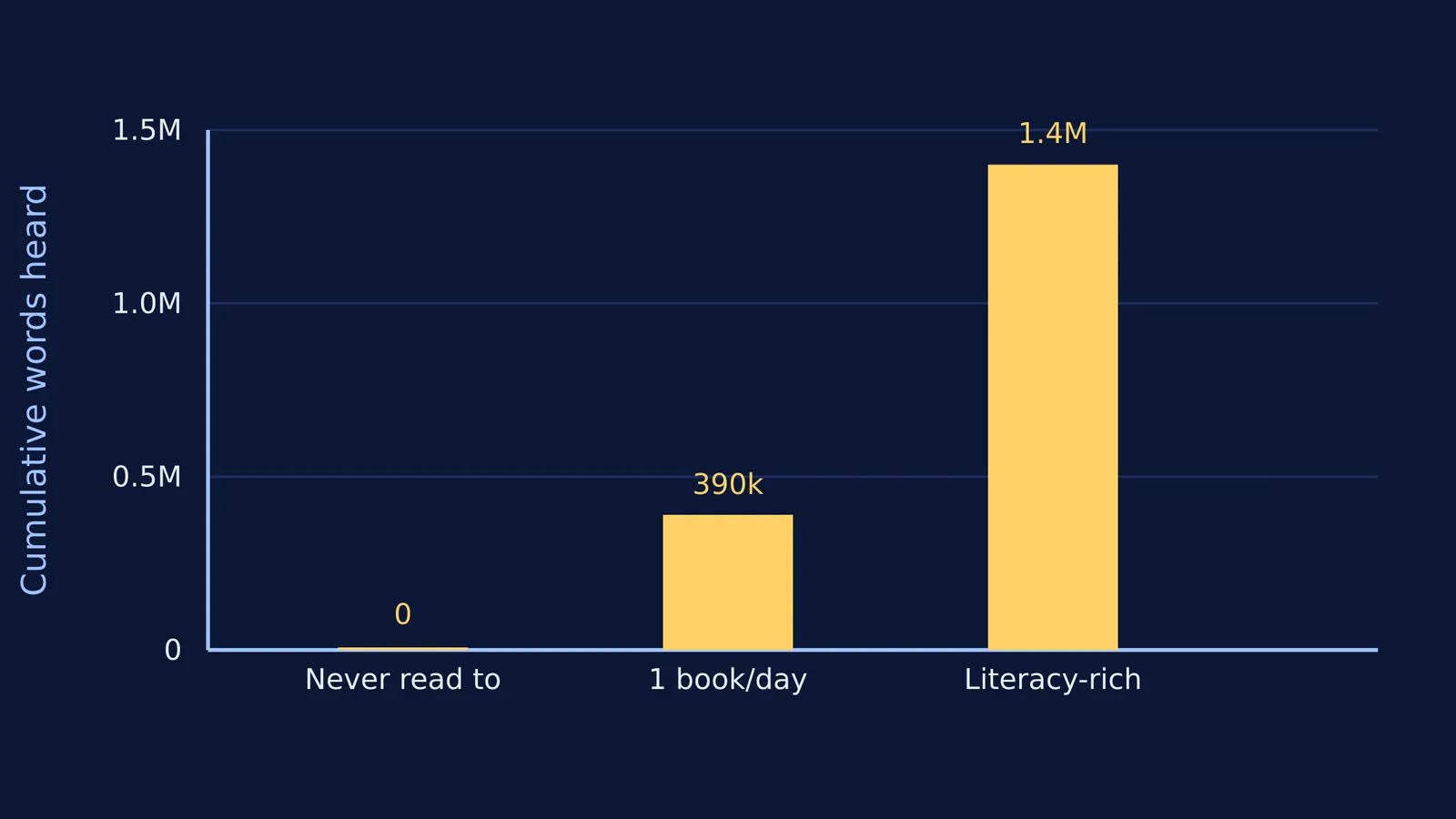
However, the volume of words a child is exposed to at home matters immensely. A benchmark 2019 study by Jessica Logan at The Ohio State University measured what is known as the "Million Word Gap." Researchers found that children whose parents read them just one picture book a day hear about 78,000 words a year. Cumulatively, over the five years before kindergarten entry, children in literacy-rich environments hear 1.4 million more words during storybook reading than children who are never read to. This vast, cumulative exposure to varied vocabulary and sentence structure provides the crucial foundation required for independent reading later on.
How can I build my child's reading skills at home?
You do not need to be a trained educator to help your child bridge the reading gap. Short, consistent, positive habits are far more effective than long, frustrating study sessions that end in tears.
Read aloud every day. Make a dedicated read-aloud session a non-negotiable part of your daily routine. Run your index finger under the words as you read so your child begins to visually link the spoken sounds to the written text on the page.
Focus on phonics, not just letters. Teach the sounds the letters make, not just their alphabetical names. For example, explain that the letter 'C' makes a hard /k/ sound like in "cat," rather than just the name "see."
Play sound games. Ask your child to identify words that start with the same sound (e.g., "What else starts with the /b/ sound like bat or ball?"). This builds the phonological awareness required for accurate decoding.
Let them choose the book. Children engage more deeply and pay better attention when they are genuinely interested in the topic. Instead of forcing them to read a dry textbook, allow them to pick a story they enjoy. For more on this approach, read about Choice and autonomy: parenting that builds real motivation.
When children grow older and their reading skills evolve to tackle complex STEM subjects, Fermi's AI tutor can work out what they already know and build a plan for the session, ensuring they never sit down to a blank page. Until then, the most effective intervention is simply opening a good book together and exploring the sounds of language.


