On this page
Families filling in Class 11 subject forms see psychology on the list and wonder whether it is a soft option or a sensible one. It is neither: it is a science of behaviour with its own methods, and it suits some students far better than others.
What does Class 11 psychology actually cover?
CBSE offers psychology (subject code 037) as an elective, and its 2026-27 curriculum describes the field as focusing on "human experiences, behaviors, and mental processes" in their social, cultural and historical context.
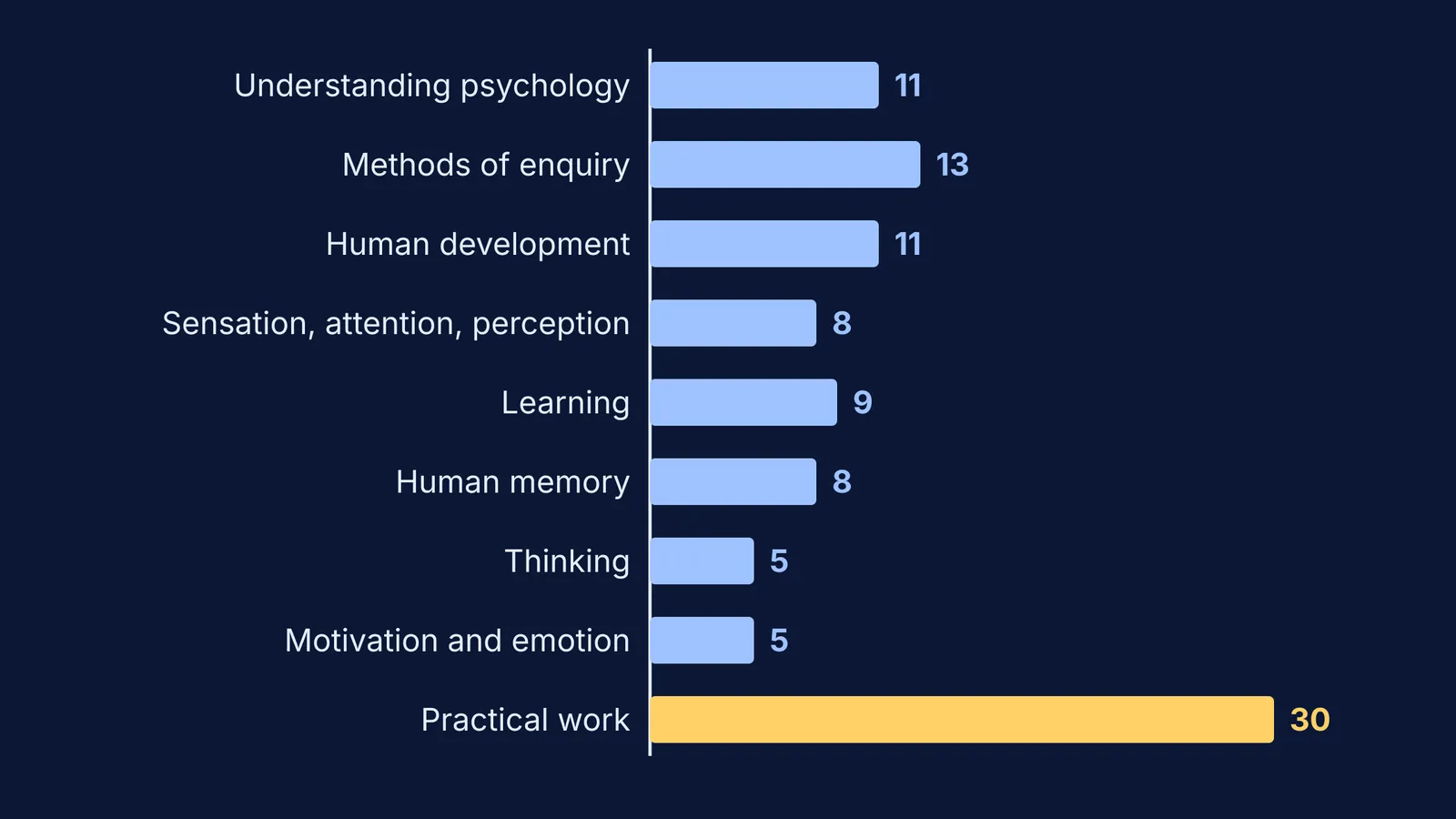
The Class 11 theory paper is 70 marks, spread across eight units:
Understanding psychology (11 marks)
Methods of enquiry in psychology (13 marks)
Human development (11 marks)
Sensory, attentional and perceptual processes (8 marks)
Learning (9 marks)
Human memory (8 marks)
Thinking (5 marks)
Motivation and emotion (5 marks)
The largest unit is research methods: observation, experiments, correlational research, surveys, psychological testing, case studies and how to analyse the data. The other 30 marks are practical work, with one project or small study and two experiments, on topics such as cyberbullying, sleep hygiene, peer pressure and the impact of social media on young people.
In the same document, CBSE's question paper design gives 50% of theory marks to remembering and understanding, 35% to applying ideas to new situations, and 15% to analysing, evaluating and creating. Class 12 moves to intelligence, personality, psychological disorders and therapeutic approaches. We have a separate guide on how to study the Class 12 psychology board paper.
Who tends to enjoy psychology?
There is no aptitude test for this. These are the signs worth looking for:
They ask why people behave as they do, and are not satisfied with "that's just how they are".
They like writing explanations and do not mind long-answer questions.
They are patient with method: designing a fair test, keeping records, writing up results.
They can talk about feelings and behaviour as things to study, not only as things to have opinions about.
Reasons to pause matter too. Psychology is not a counselling session; it is definitions, theories, experiments and data. A child who picks it to avoid hard work may be disappointed.
The Tele MANAS helpline (14416) is free, open 24x7 and run under the Ministry of Health and Family Welfare.
Can you take psychology with science, commerce or arts?
Usually, yes. Under CBSE's scheme of studies for 2026-27, a student takes at least five subjects in Class 11 and continues the same subjects in Class 12, with an optional sixth. Apart from language rules, the combinations CBSE rules out are Business Studies with Business Administration, more than one of Computer Science, Informatics Practices and Information Technology, and Mathematics with Applied Mathematics. Psychology is not on that list, so the real limit is what your school offers and how it fits in the timetable.
Psychology also links to other fields in research. Kevin Boyack, Richard Klavans and Katy Börner mapped citations among 7,121 journals covering over 1 million documents and found the social sciences tied to psychology, and medicine tied to psychology directly and through neurology (Scientometrics, 2005).
In practice, the fit looks like this:
With PCB: sense organs, perception and human development overlap with biology.
With PCM: the methods unit uses data, measurement and careful design, so it suits students who like structure.
With commerce: motivation and decision-making connect with ideas in business studies and economics.
With humanities: it pairs naturally with sociology, political science and economics.
If a science student takes psychology as a sixth subject, check the extra load honestly. When physics or chemistry starts to feel squeezed, Fermi's AI tutor can work out what you already know and build a plan for the session, so the time you do have goes further.
How do you decide before the form is due?
Try this 30-minute plan together:
Read the unit list above aloud. Which three topics would your child happily read about on a Sunday?
Try a mini-experiment linked to the memory unit. Read out 15 unrelated words and ask for as many as they can recall. Then read 15 new words sorted into three groups (fruits, tools, animals) and test again. Talk about why grouping might help.
Ask the school four questions: Is psychology offered with my child's stream? Which timetable slot is it in? Who supervises the practical work? Can it be a sixth subject?
Use this script: "I'm not asking whether psychology is easy. I'm asking which part of it you would enjoy in March, when the project is due."
If your child is still weighing it against computer science or physical education, read our comparison of Class 11 optional subjects. If they are already thinking further ahead, see careers after a BA or BSc in psychology.