

On this page
A BA or BSc in psychology gives you a foundation in human behaviour, statistics and biology. However, most professional roles in India require postgraduate study. Whether you want to work in a hospital, a school or a corporate office, your next step will define your career.
What are the main pathways after a psychology degree?
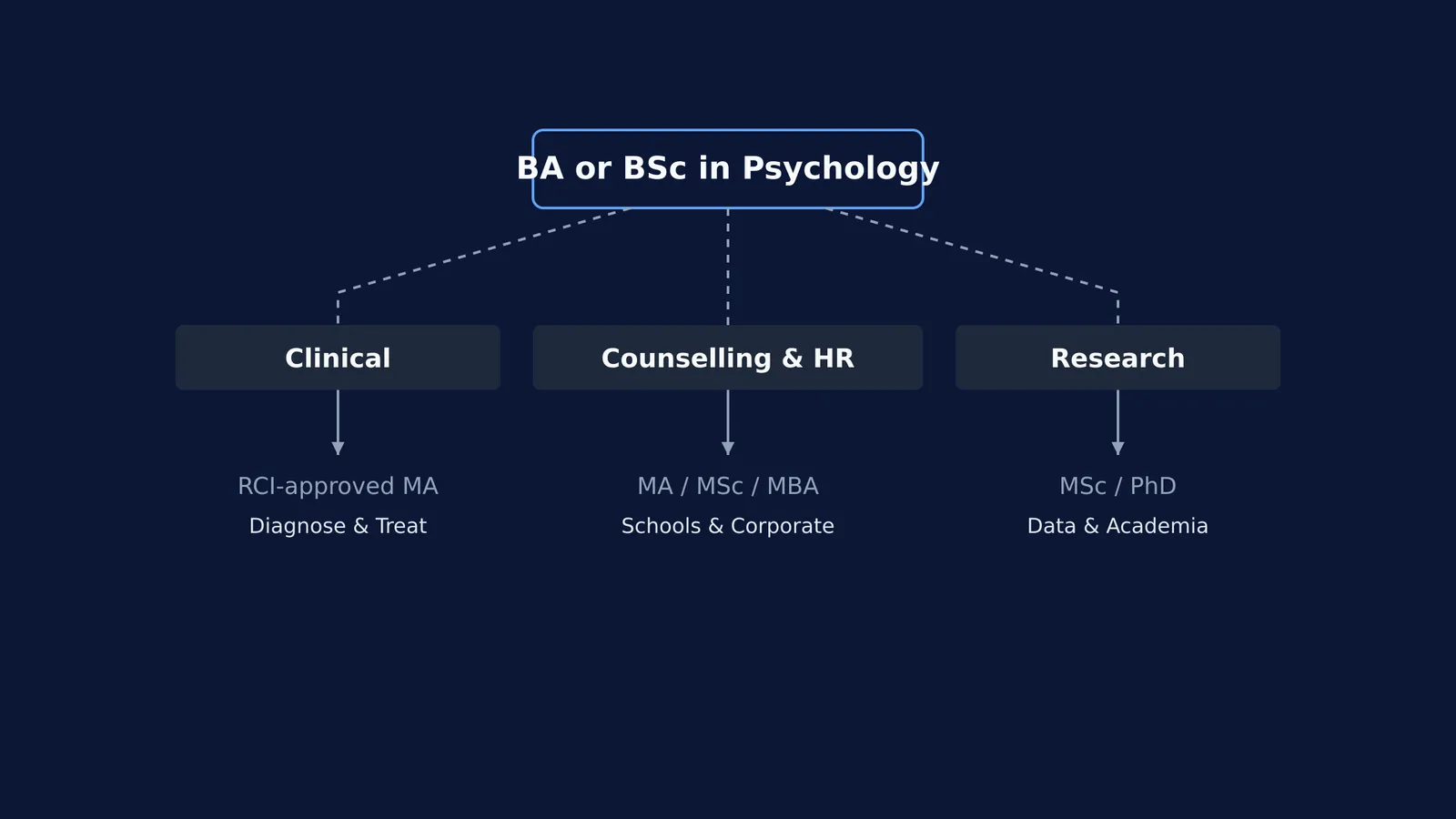
While a bachelor's degree qualifies you for entry-level roles such as a counselling assistant, wellness coordinator or HR executive, you cannot call yourself a psychologist yet. You need to choose a specialization for your master's degree.
India faces a critical shortage of mental health professionals. A 2023 Parliamentary Standing Committee report highlighted a significant gap in the number of psychiatrists, as well as an equally severe shortage of clinical psychologists across the country. This means there is a massive demand for qualified professionals who complete their postgraduate training and clinical supervised hours.
How do you become a clinical psychologist in India?
If you want to diagnose and treat mental health disorders, you must follow the clinical pathway. This is a highly regulated profession in India because it involves working with vulnerable individuals and prescribing therapeutic interventions.
To practice legally, you must be registered in the Central Rehabilitation Register maintained by the Rehabilitation Council of India (RCI). Historically, this required completing a two-year M.Phil in Clinical Psychology from an RCI-approved institution. However, following the National Education Policy 2020, the M.Phil is being phased out. From the 2025–2026 academic session, the new standard pathway will be an RCI-approved MA in Clinical Psychology. This new professional degree will serve as the qualifying requirement for registration.
Can you practise counselling without a clinical license?
Yes, counselling psychology is a distinct path that focuses on guidance rather than medical diagnosis. Counselling psychologists help people manage everyday life challenges, stress, grief and career decisions, rather than treating severe psychiatric illnesses.
To become a counselling psychologist, you typically need an MA or MSc in Counselling Psychology or Applied Psychology. You do not need an RCI license to practise general counselling. If you want to work in schools, a one-year Postgraduate Diploma in Guidance and Counselling is often the quickest route after your bachelor's degree. These roles are critical in educational settings, where students need support managing academic pressure and social development.
What is the career path in HR and corporate psychology?
Applying psychological principles to the workplace is known as Industrial-Organizational (I/O) psychology. This is often one of the most financially rewarding non-clinical paths for graduates who prefer corporate environments over healthcare.
As a recent graduate, you can enter Human Resources (HR) in entry-level roles such as talent acquisition, employee engagement, or learning and development. These positions rely heavily on your understanding of human motivation and team dynamics. To progress to senior roles like a people analytics manager or an organizational development consultant, further study is essential.
An MBA in HR is the traditional route to senior corporate roles in India, often commanding higher starting salaries and opening doors to leadership positions. However, an MA or MSc in I/O Psychology offers a specialized, data-driven path that is highly valued by multinational corporations and consulting firms focused on workplace efficiency.
What does a research psychology career involve?
If you enjoy analyzing data, conducting experiments, and identifying behavioural patterns, research is a strong long-term option. Researchers work in academia, public health policy, or the rapidly growing field of User Experience (UX) research for technology companies. UX researchers, in particular, apply cognitive psychology principles to understand how people interact with digital products and software.
Research roles require a deep understanding of experimental design, advanced statistics, and often neurobiology. You will need at least a master's degree to secure a dedicated research assistant position, and a PhD is necessary for high-level academic posts or to lead your own laboratory. If you need to revise the statistics or biology that underpins psychology research, the Fermi Concept Library explains these foundations step by step.
It is common for families to worry when a student chooses a path that requires long-term postgraduate study, especially when the destination is not as visible as an engineering or medical degree. If you are discussing these options at home, our guides on when your child's career choice differs from yours and talking about STEM careers beyond engineering and medicine offer practical advice for navigating those conversations constructively.


