

On this page
The reality of the Class 12 psychology board paper is that rote learning will only get you so far. According to the official CBSE curriculum, the 70-mark theory paper dedicates 45% of its weight (31 marks) to "Applying". In contrast, "Remembering and Understanding" accounts for only 35% (25 marks). The examiners want to see if you can take a concept like cognitive dissonance or the General Adaptation Syndrome and spot it in a real-world case study.
Here is how to align your study habits to the way the paper is designed.
How do you learn psychology terms with examples?
Psychology is full of terms that look like everyday English but have strict scientific definitions. Reading the glossary over and over is a low-utility strategy. Instead, use a technique called elaborative interrogation.
Elaborative interrogation means pausing after you read a fact and asking yourself *why* or *how* it is true. A 2010 study of science students found that those who used elaborative interrogation scored 76% on a follow-up test, compared to 69% for those who used standard study methods—a clear 7 percentage point increase.
For example, when you learn that "Eustress is the good stress that motivates us", do not just repeat it. Ask: *Why would stress ever be good?* You might answer: *Because the adrenaline from eustress gives a student the focus they need on the morning of an exam.* Connecting the abstract term to a concrete example creates multiple paths in your memory to retrieve the fact later.
Which theories recur in the exam?
The CBSE paper frequently tests the big frameworks from the first three units. You must know these inside out, as they often form the basis of the 4-mark and 6-mark questions.
Intelligence (Unit I): You need to distinguish between psychometric approaches (which view intelligence as a single or multiple set of abilities, like Gardner's Multiple Intelligences) and information-processing theories (which focus on how people process information, like the PASS model).
Personality (Unit II): Expect to contrast type theories (like those of Carl Jung) with trait theories (like the Big Five factors). You should also be familiar with how personality is assessed, distinguishing between direct self-report measures and indirect projective techniques.
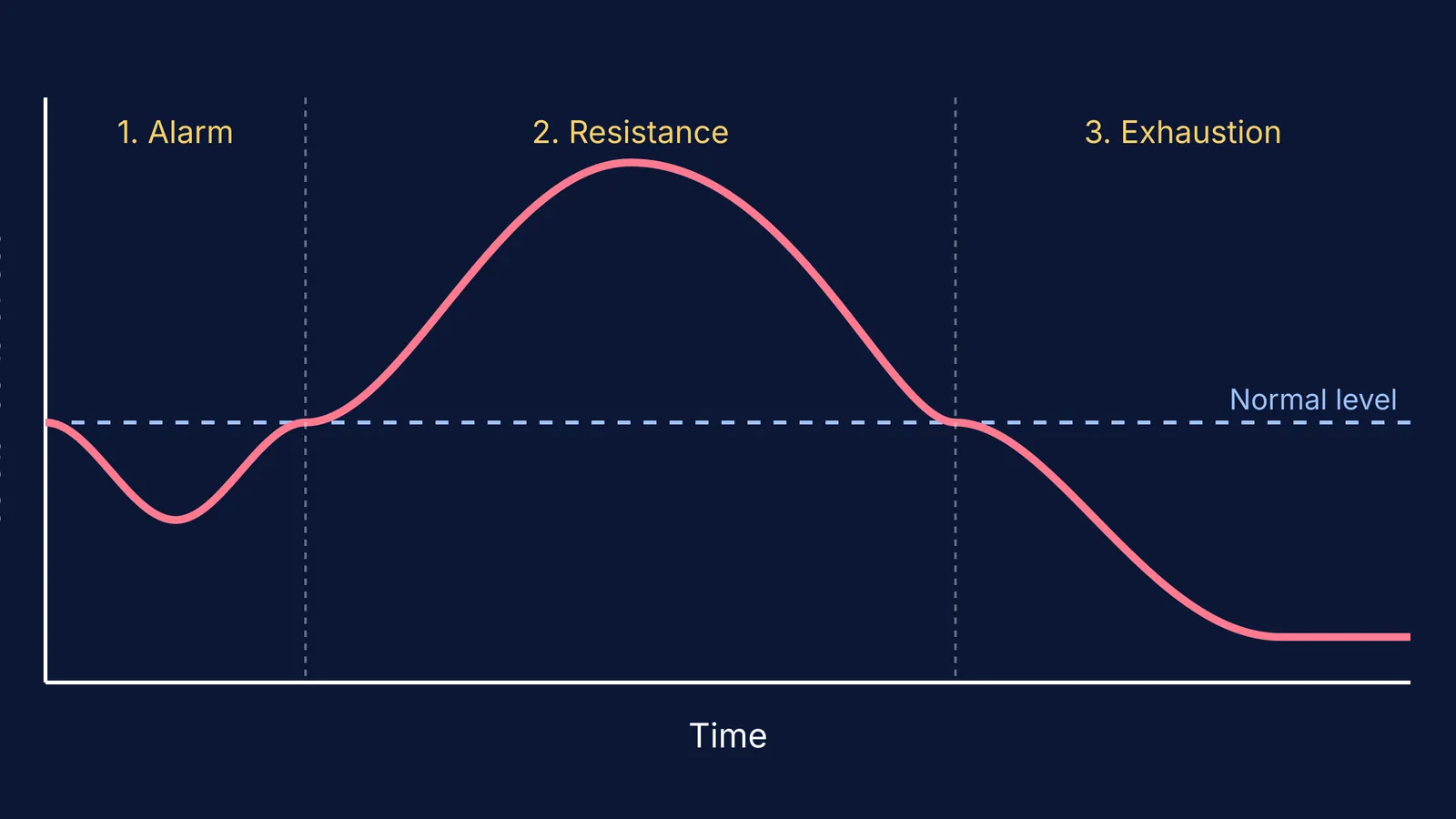
Stress (Unit III): Hans Selye's General Adaptation Syndrome (GAS) is a cornerstone. You must be able to draw its three stages—Alarm, Resistance and Exhaustion—and explain how prolonged resistance depletes the body's immune system. (See the Neurotransmitter vs Hormone: The Difference Explained post for more on the chemical systems involved in responses.)
To lock these frameworks in, draw flowcharts. Visualising the hierarchy of a theory makes it much easier to reproduce under exam pressure than relying on blocks of text.
What does the 30-mark practical exam test?
The theory paper is only part of the battle. The remaining 30 marks come from the practical exam, which tests your ability to act as a working psychologist. You are required to administer five psychological tests—measuring attributes like intelligence, personality, or aptitude—and develop a comprehensive case profile.
For the viva voce, examiners will test your conceptual clarity on the practicals you have conducted. You must be ready to explain the reliability (consistency) and validity (accuracy) of your tests. Do not just memorise the procedure; understand *why* the test was designed that way and what the scores actually mean for the subject.
How do you answer application and case-based questions?
In Section E (long answers) and Section F (case studies), the examiner gives you a paragraph about a person's behaviour and asks you to diagnose the issue or suggest a therapeutic approach.
When you practise these questions, do not just check the marking scheme and nod. You need to practise holding a line of reasoning. This is where Fermi's AI tutor can help. Instead of simply printing the answer, Fermi teaches—it works out what you already know, builds a plan for the session, and checks your understanding as it goes. If you are stuck on a case study about a student with anxiety, Fermi will prompt you to apply the theories of behaviour rather than doing the thinking for you.
When reading cases, look for the "italicised" symptoms in your mind. Are they showing signs of conformity or obedience? Are they dealing with a somatic symptom disorder or a dissociative one? The way a subject behaves in an experiment—like in Wilhelm Wundt and the 1879 psychology laboratory that timed thought—follows observable rules, and your job is to name the psychological rule the human in the case study is following.
Make your final revision active. Test yourself with past papers, draw the curves, and ask *why* every time you hit a new definition. If you enjoy this, you might even consider careers after a BA or BSc in psychology.


