

On this page
In 1879, a German scientist named Wilhelm Wundt opened a small room at the University of Leipzig. It was the world's first laboratory dedicated entirely to experimental psychology (OpenStax). Before this, the mind was studied by philosophers who debated its nature. Wundt brought in pendulums, telegraph keys and chronoscopes, treating the mind as something that could be measured with the precision of physics.
His most famous experiments asked a simple question: how fast is a thought? By timing how quickly his subjects reacted, Wundt proved that the mind's decisions have a measurable duration.
What is experimental introspection?
Wundt believed that the only way to study consciousness was to break it down into its smallest parts. To do this, he developed a method called experimental introspection, or "internal perception" (OpenStax).
Unlike casual self-reflection, this was a highly controlled scientific process. Wundt rigorously trained his observers to report only their immediate sensory experiences, such as the brightness of a light or the loudness of a tone, without adding any personal interpretation. By presenting the same stimuli repeatedly under strict laboratory conditions, he ensured that his results could be replicated. This approach moved psychology away from subjective philosophy and into the realm of hard science.
What is the difference between simple and choice reactions?
Wundt used instruments to measure reaction times to the thousandth of a second (OpenStax). In a standard setup, a subject would listen for a sound, such as a ball dropping, and press a key the moment they heard it.
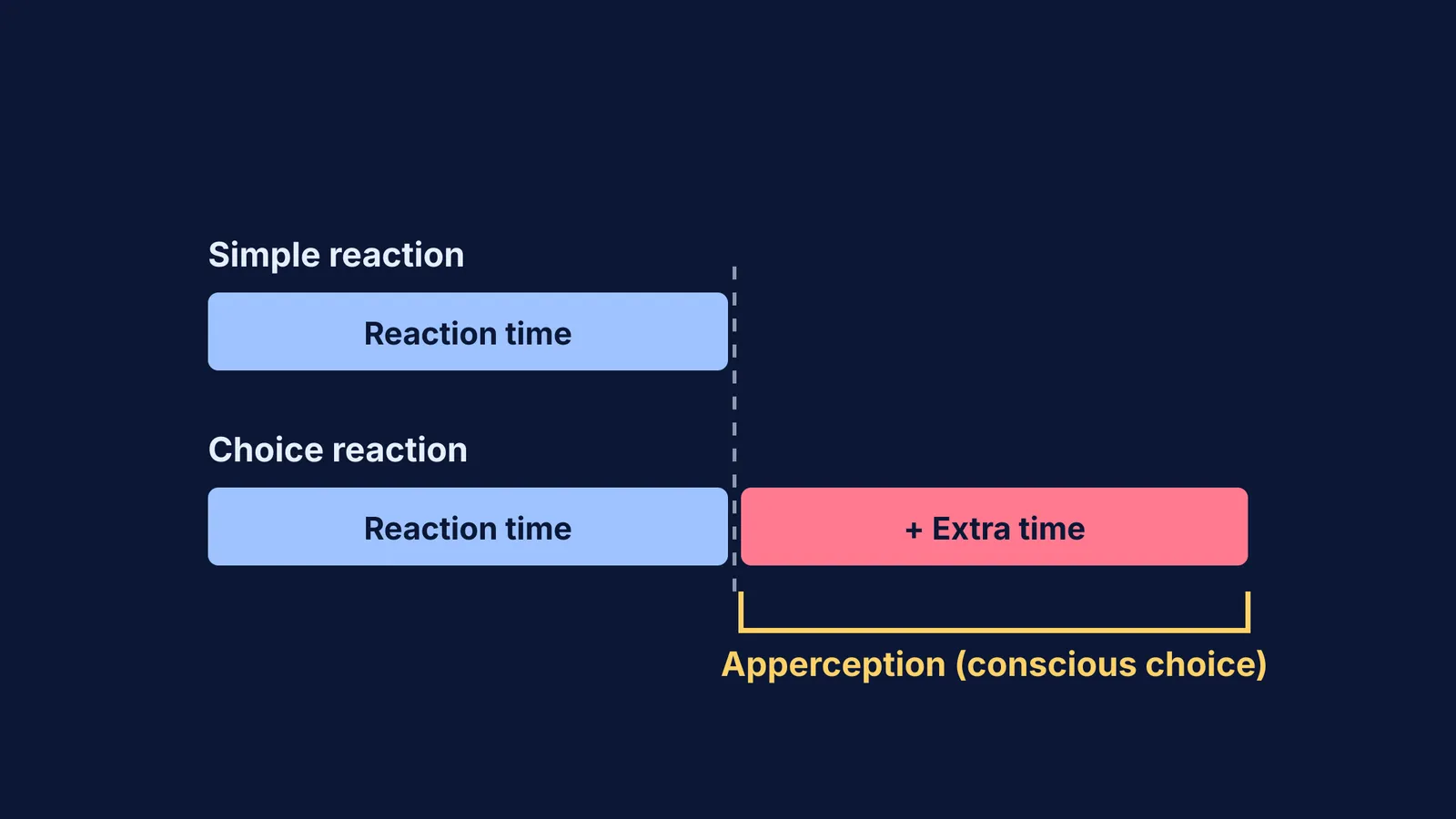
When subjects were told to focus simply on the physical act of pressing the key, they performed what Wundt called a simple reaction (Simply Psychology).
However, he then changed the rules. If a subject had to decide between two keys depending on the sound, or if they were told to focus on consciously perceiving the sound before acting, the task changed. This choice reaction took longer than a simple reaction.
The difference was small but profound. Wundt concluded that this extra, measurable duration was the time required for the brain to make a conscious choice.
What is perception vs apperception?
To explain his findings, Wundt made a distinction between two ways we experience the world:
Apprehension (passive perception): The raw sensory data entering the mind. You hear a noise in the background, but you do not focus on it.
Apperception (active perception): The voluntary, conscious act of focusing your attention on a stimulus and bringing it into clear comprehension.
Wundt believed that apperception was an active, creative process where the mind organises information. This focus on the mind's active role in organising experience is why his school of thought was later called voluntarism.
How can active perception improve your study routine?
Wundt's distinction between passive and active perception still matters for students today. Reading a textbook while your mind wanders is apprehension—the words enter your eyes, but you are not organising them. True learning requires apperception, where you actively focus on the logic and structure of what you are reading.
If you are stuck on a physics numerical, copying the final answer is a passive act. Instead, you can use the Fermi Problem Library, which offers worked problems with a step-by-step solver that explains the reasoning rather than printing an answer. Because it walks through the logic, you are forced to consciously engage with each step.
You can also apply this to how you plan your time. Before you open a book, decide exactly what you intend to master in that hour. Fermi's AI tutor can work out what you already know and build a plan for the session, so you sit down to a clear next step.
A script for an active study block
To turn passive reading into active apperception, try this structure for your next study block:
Set a single target: Choose one specific concept or problem type. Do not just sit down to "study chemistry".
Remove the choice reaction: Do not decide what to study next while you are studying. Make your decisions before you begin, so your mental energy goes entirely into the task.
Test your focus: Stop every fifteen minutes and ask yourself to summarise what you just learned. If you cannot, you have slipped back into passive reading.
Wundt's 1879 laboratory proved that the mind is active, not a passive mirror of the world. By treating your own study sessions as an active process, you can ensure that the time you spend translates into real understanding.
Read more:


