On this page
Three common choices for Indian families saving for a child's college are a Public Provident Fund (PPF) account, a bank fixed deposit (FD) and a mutual fund. The right mix depends mostly on one number: how many years you have before the first big fee is due. This is general information, not personal financial advice.
How does PPF work for a child's education?
PPF is a government savings scheme that runs for 15 years from the end of the financial year in which you open it, under the Public Provident Fund Scheme, 2019. You can deposit between ₹500 and ₹1.5 lakh a year, and the ₹1.5 lakh limit covers your own account and any account you open for a minor child together.
The government sets the rate each quarter. For October to December 2026 the PPF rate is 7.1% a year, unchanged from the previous quarter (Department of Posts order, 30 September 2026; Business Today).
Three rules in the scheme notification matter most for education:
Interest for each month is paid on the lowest balance between the 5th and the month's end, so deposit by the 5th.
After five years from the end of the opening year, you can withdraw up to half of an earlier balance, once a year.
After those five years, you can close it early for the higher education of the holder or dependent children, with admission documents and fee bills, but interest drops by one percentage point.
For a daughter, Sukanya Samriddhi has its own rules; see can you withdraw Sukanya Samriddhi for education.
Is a fixed deposit safe for school or college fees?
An FD locks money for a term you choose at a rate fixed when you invest, which suits fees due within a few years. Compare current rate cards across banks.
The Deposit Insurance and Credit Guarantee Corporation insures each depositor up to ₹5 lakh per bank, covering savings, fixed and recurring deposits. Deposits in different branches of one bank count together. Ask what the bank deducts if you break an FD early.
Are mutual funds a good idea for a child's future?
A mutual fund pools many investors' money and buys shares, bonds or both. Its unit price, the NAV, "changes every day as a result of changes in the market price of the securities" it holds, says SEBI's FAQs for mutual fund investors. Over many years a fund may grow faster than a deposit, but it can be worth less than you put in just when the fee is due.
On 26 February 2026, SEBI discontinued the "solution oriented" category, which included children's funds; those schemes stopped taking new money and are to be merged with similar ones. SEBI added "life cycle funds", which follow a glide path to a set maturity date for goal-based investing. If someone offers you a child plan today, ask which SEBI category it is in.
A worked example: 10 years to college
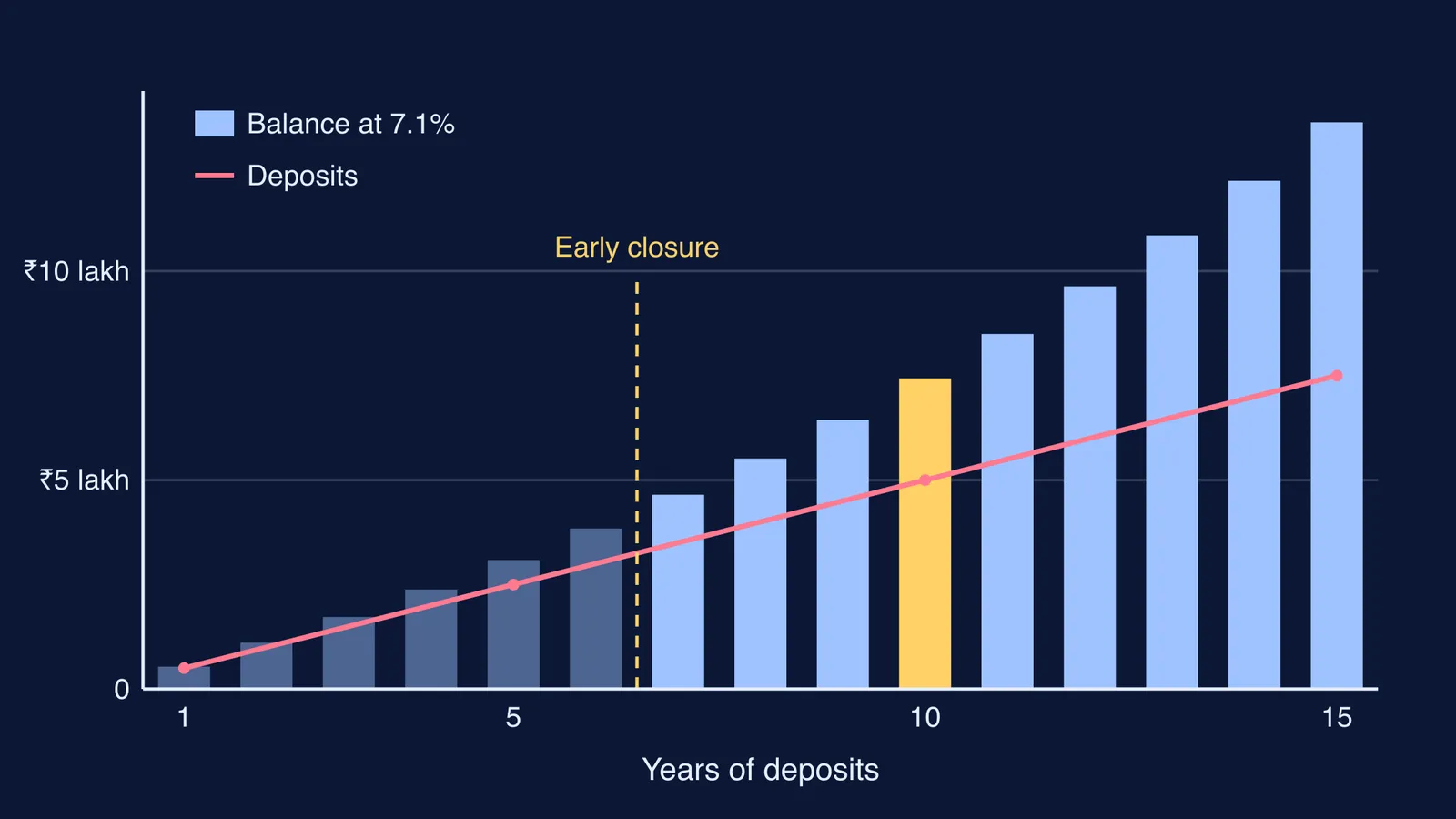
Say your child is 8 and college starts at 18. You open a PPF account in early April and deposit ₹50,000 by 5 April each year for 10 years: ₹5 lakh in all.
If the current 7.1% rate held throughout (it may not), the balance after 10 years would be about ₹7.43 lakh.
The account matures only after 15 years, so at 18 you would withdraw part or close it early.
Closing early cuts the rate by one percentage point for the whole time the account has run, under the scheme rules, to about 6.1%, leaving roughly ₹7.03 lakh: around ₹40,000 less.
We compounded these yearly; real figures depend on future rates. The lesson is timing: PPF fits best when opened early enough to mature near the goal.
A simple frame by time left:
Many years away: a steady base such as PPF, plus market-linked funds if you can live with ups and downs.
A few years away: shift money that is already enough into steadier options.
Fees due soon: deposits whose value does not swing.
Budget beyond tuition with our list of the hidden costs of college admission, and show your teen why fees rise with an inflation talk built on family memories.
What should you ask a financial adviser?
A SEBI-registered investment adviser is paid a fee by you rather than commission on products, according to SEBI's investor page. You can check a name or registration number on SEBI's list of registered investment advisers.
Take these questions with you:
Are you SEBI-registered, and how are you paid for this advice?
Which SEBI category is this product in, and what happens if it is merged?
What can I withdraw, and when, if fees come earlier than planned?
What does it cost to exit early?
How is each option taxed under this year's rules?
What happens to this plan if markets fall just before admission?
Money is half the plan. If your child gets stuck in maths or science along the way, Fermi's AI tutor works out what they already know and builds a plan for the session.