

On this page
The Sukanya Samriddhi Yojana is one of the most popular savings schemes for parents of a girl child in India. Designed to secure her future, the scheme offers attractive interest rates and tax benefits. But as your daughter grows older and her educational needs expand, you might wonder how to access those funds before the account reaches full maturity.
Fortunately, the government's official rules make provisions for her higher education, ensuring that the savings you have accumulated can be put to use precisely when she needs them most.
When can you withdraw from Sukanya Samriddhi for education?
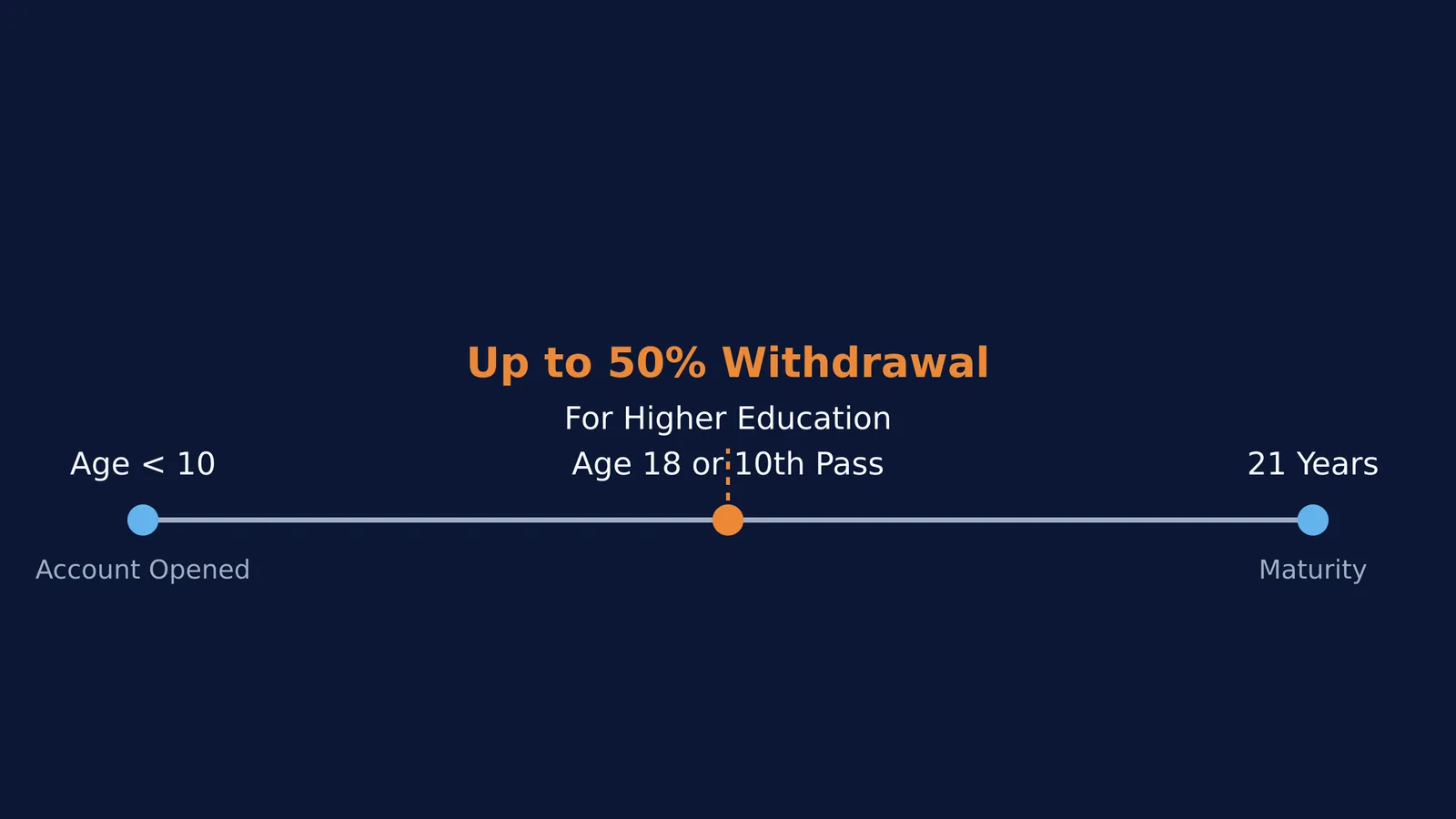
The Sukanya Samriddhi Account Scheme 2019 permits partial withdrawals to fund the account holder's higher education. You do not have to wait until the account fully matures at 21 years from the date of opening.
You can initiate a withdrawal once your daughter reaches the age of 18 or has passed her 10th standard exams, whichever comes first. This flexibility ensures that funds are available when she is likely to be enrolling in a pre-university course or a college degree. Many families find this particularly useful during the crucial transition from school to higher secondary education, where tuition and hostel expenses can spike unexpectedly.
How much can you withdraw for education?
You cannot withdraw the entire amount early. The official rules allow a maximum withdrawal of 50% of the balance that was available in the account at the end of the preceding financial year.
For example, if you are applying for a withdrawal in July 2026, the maximum limit will be 50% of the balance that stood in the account on 31 March 2026. If the account had ₹10 lakh on that date, you could theoretically withdraw up to ₹5 lakh. Furthermore, the withdrawal is restricted to the actual requirement of fees and other educational charges. You cannot withdraw the full 50% if the college fees are lower than that amount.
The money can be taken out either in a single lump sum or in installments. If you opt for installments, you are limited to one installment per year, for a maximum of five years. The total withdrawn across all installments must not exceed the 50% cap or the actual fee requirement. This gives parents the option to stagger the withdrawals alongside the annual fee schedule of a multi-year degree programme, rather than drawing out a lump sum that might sit idle.
What documents are required?
To process the withdrawal, you need to provide concrete evidence of the educational expenses. The official rules require you to submit an application form along with documentary proof. You will need:
A confirmed offer of admission to a recognised educational institution.
A fee slip or demand letter from the institution detailing the financial requirement.
Having these documents ready before you visit the post office or bank will save you time and ensure a smoother transaction. It is always a good idea to carry the original passbook and a valid identity proof of the account holder. Keep in mind that once your daughter turns 18, she is required to operate the account herself, meaning her signatures will be necessary on the withdrawal forms.
How should you plan for partial withdrawals?
If you are planning to use the funds for your daughter's upcoming college admission, follow this sequence based on the official scheme rules to avoid last-minute hurdles:
Estimate the shortfall: Calculate the first-year admission fees minus any existing liquid savings. This tells you exactly how much you need from the Sukanya Samriddhi account.
Check eligibility: Verify that she has passed Class 10 or turned 18. Keep her mark sheet or birth certificate handy as proof.
Choose lump sum vs installments: Withdraw only what the fee slip demands. If the course is a four-year degree, you can plan one withdrawal per year for up to five years, provided you stay within the overall 50% limit and the annual fee demands.
Gather documents: Secure the college admission offer and the fee demand slip before approaching the bank or post office. Make sure the fee demand letter clearly outlines all the charges (tuition, hostel, library) to justify the withdrawal amount.
Set up her study environment: A successful college transition isn't just about paying fees. Start setting up a good study space at home: a parent's checklist to ensure she has a quiet, dedicated area for her coursework.
Supporting her educational journey
Funding your daughter's education is only one part of the puzzle. Preparing for demanding university courses often requires a solid study routine and the right academic support. Navigating high expectations vs pressure: what research separates can be a difficult balance to strike as parents want the best for their children without overwhelming them.
If she is diving into university-level physics or chemistry, Fermi's AI tutor can work out what she already knows and build a plan for the session, so she sits down to a clear next step. Rather than simply giving her the answers, the tutor holds a line of reasoning across a session, notices where she is stuck, and decides whether to explain, ask or show. This teaches her to solve problems from first principles.
With the financial backing of your Sukanya Samriddhi savings and effective study habits, you can help your daughter step confidently into her higher education and beyond.


