On this page
Your child may already be asking an AI chatbot about homework, essays and doubts every day. Most parents only guess at what happens in those chats. If you spend about 15 minutes a day for one week trying the same tools, you get facts to replace the guesses, and the rules you set afterwards are fairer and easier to keep.
Should parents learn the AI tools their kids use?
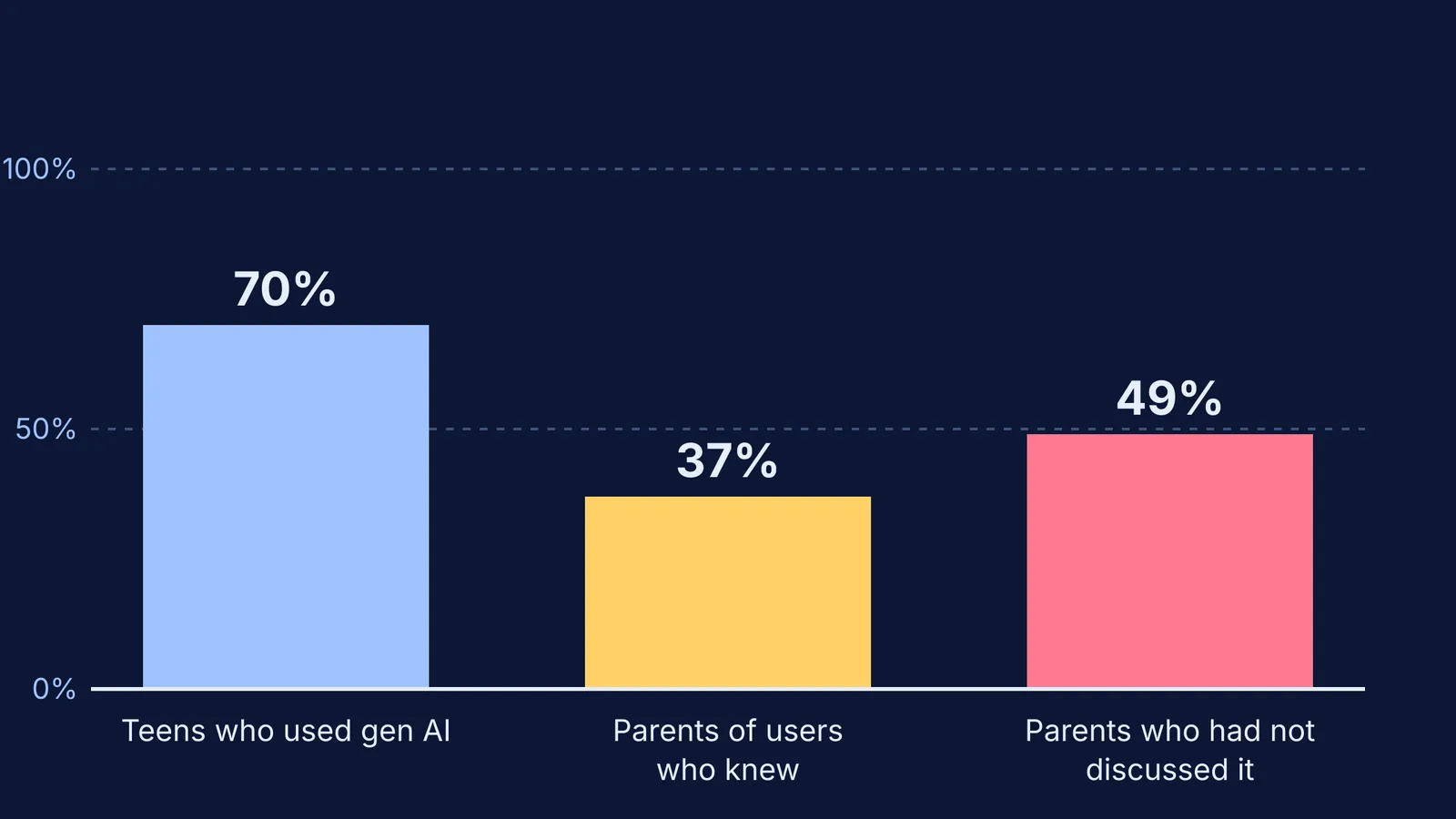
Yes, mainly because many parents don't know their teen is using AI at all. In the 2024 Common Sense Media survey of 1,045 US parents and their teens, seven in 10 teens had used at least one generative AI tool.
In the same survey, only 37% of parents whose teen had used generative AI thought their child had used it. Almost half of parents (49%) said they had not talked about generative AI with their child.
Use is growing quickly. A Pew Research Center survey of 1,391 US teens found that 26% used ChatGPT for schoolwork in 2024, up from 13% in 2023.
Both surveys are from the US, but you can check what happens in your own home. That is what the plan below is for.
What do you learn by trying the tool yourself?
Rules written from a distance tend to be "never" or "anything goes", and neither lasts. Once you have used the tool, you see three things:
How fast it hands over a full answer. One pasted question can return a finished solution, and your child gets the marks without doing the thinking.
How confidently it can be wrong. Ask it about something you know well and you will see the problem for yourself. Our guide to what to say when an AI tutor gives a wrong answer covers the conversation that follows.
The difference between being given answers and being taught. Some tools explain one step at a time and ask questions back. Others only print the result.
Teens draw some of these lines themselves. In the same Pew survey, 54% of teens said using ChatGPT to research new topics was acceptable. Only 18% said the same about using it to write essays. Start with that: your child probably already has a view on what counts as cheating.
What should parents do in the first week?
Spend about 15 minutes a day on this. Do it with your child where you can, and let them lead.
Day 1: Ask your child to give you a tour of the app they use most. Watch without commenting.
Day 2: Ask the tool about something you know well, such as your job, a family recipe or the rules of cricket. Note anything it gets wrong.
Day 3: Give it one question from your child's homework and compare its answer with the NCERT textbook or class notes. Our guide on using AI to understand your child's homework has prompts you can use.
Day 4: Type "Don't give me the answer. Ask me one question at a time." Notice how different the chat feels when it makes you think.
Day 5: Look at the settings, including the age rules, the chat history and what your child has shared. For classroom use, UNESCO's 2023 guidance asked governments to consider an age limit of 13.
Day 6: Write three or four rules together.
Day 7: Try the rules on a real homework evening and set a date to review them in a month.
On Day 4 you may find that some tools are built to teach rather than to answer. Fermi's AI tutor works through a problem with the student and checks their understanding as it goes, so your child does the thinking.
What rules make sense after the first week?
Good rules describe how to use the tool, not just whether to use it. Here are some to discuss:
Try first. Spend 10 minutes on a problem before asking AI.
Ask for steps, not answers. Use AI to explain the method, then do the working on your own.
Check against the book. For any fact going into homework or an exam answer, check it in the textbook.
Say when you used it. If a teacher allows AI, mention where it helped.
Keep private things private. Don't share photos, your address or school details in chats.
Our one-page family policy for AI chatbots turns rules like these into an agreement you can stick on the fridge.
What if your child knows far more about AI than you?
That is normal, and it helps. When your child teaches you, they explain their own habits out loud, which tells you more than checking their phone would.
If AI use comes with things that worry you, such as late nights, secrecy or a change in mood, talk to your child's class teacher or school counsellor. If you or your child needs someone to talk to, India's free Tele MANAS helpline is on 14416.
Pick a quiet evening this week and start with Day 1.