

On this page
Many Indian children grow up with a mother who works nights: a nurse on a ward, an agent on a call-centre floor, a factory or airport shift. The job fixes the hours. What a family controls is how the hours around them run: the same evening whoever is home, a short note passed from one adult to the next, and a morning slot that belongs to mother and child.
Does a mother's night shift affect a child?
The evidence suggests a modest link, not a large one. A study of 2,367 mothers of children aged 3 to 5 in the US Fragile Families survey found "suggestive evidence for modest associations" between maternal night-shift work and higher levels of aggressive and anxious or depressed behaviour in children, compared with mothers who were not working (Dunifon and colleagues, Developmental Psychology, 2013). The authors also point to earlier research showing that mothers on nights spend more time with their children overall, but are likely tired for much of it.
That is an association, not proof of harm. It gives you two things to work on: a predictable evening for the child, and protected sleep for the mother.
What routine helps a child when mother works night shift?
Regularity has the clearest evidence. In a UK study of 10,230 seven-year-olds, children with non-regular bedtimes had more behavioural difficulties, and children who moved to regular bedtimes improved (Kelly, Kelly and Sacker, Pediatrics, 2013).
The American Academy of Sleep Medicine recommends 9 to 12 hours of sleep per 24 hours for children aged 6 to 12, and 8 to 10 hours for teenagers aged 13 to 18 (Paruthi and colleagues, 2016).
So the household rule is simple: the evening runs the same way whichever adult is in charge. Fix three points, on shift nights and off nights alike:
Dinner at the same time.
One homework block with a start and an end.
The same lights-out time, worked back from the wake-up time.
For a full evening timetable, see a 30-minute homework routine for parents home late from work. If both parents rotate shifts, read keeping a steady study routine when parents work night shifts.
A worked example: one shift day for a Class 7 child
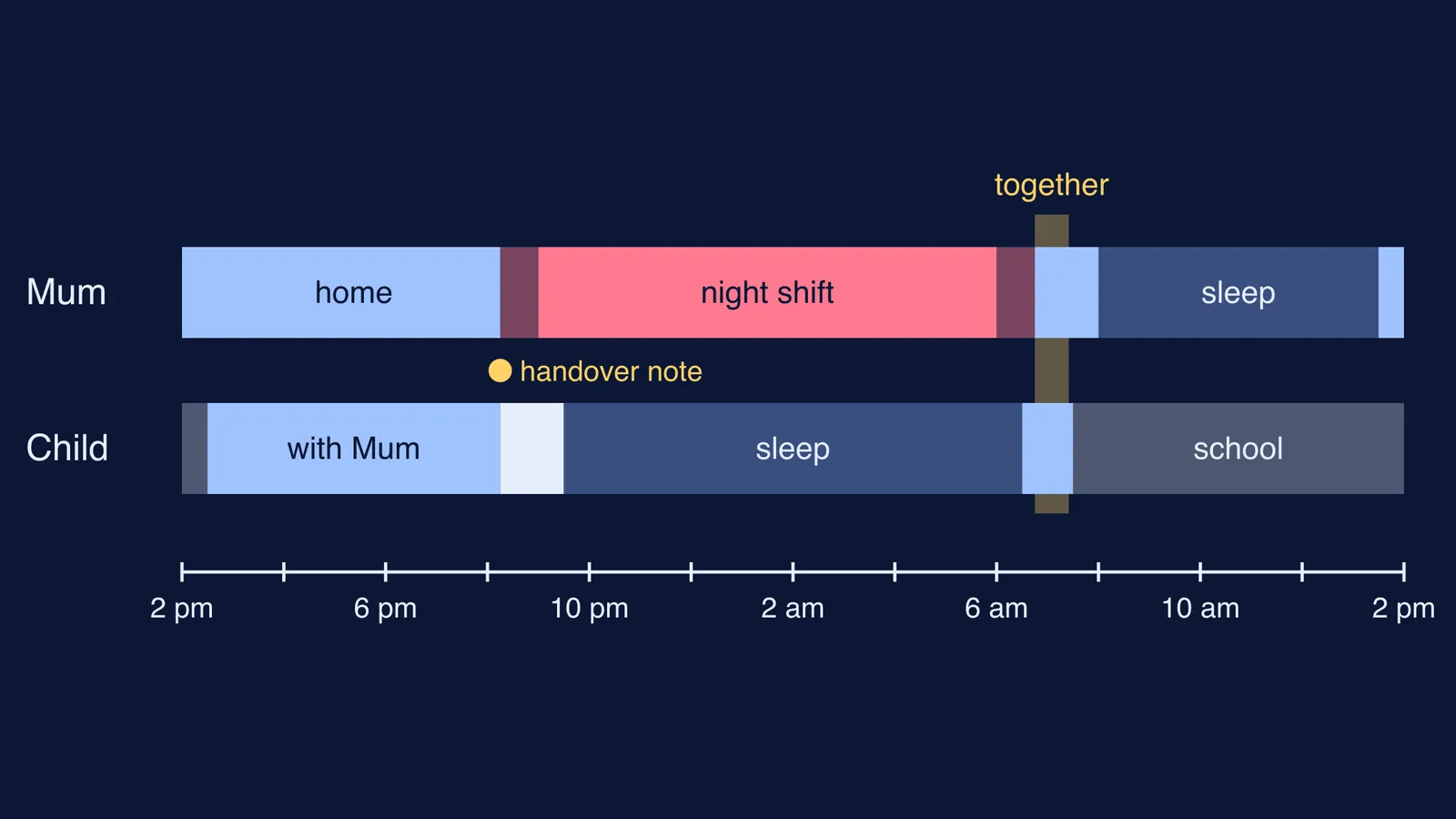
The mother works 9 pm to 6 am and is home by 6:45 am. The child wakes at 6:30 am and leaves for school at 7:30 am. The father or a grandparent covers the evening.
2:30 pm: child home from school; mother is up. Snack, then homework starts with her.
8:00 pm: mother writes the handover note and leaves at 8:15 pm.
8:30 pm: dinner with the evening adult, at the usual time.
9:00 pm: bag packed for tomorrow, screens off.
9:30 pm: lights out, giving 9 hours before the 6:30 am alarm.
6:45 am to 7:25 am: breakfast together. This is the connection time.
8:00 am to 1:30 pm: mother sleeps. Nobody wakes her except for an emergency.
What should a handover note include?
Keep it to one page or one WhatsApp message, written at the same time every shift day, so the evening adult never has to guess.
Homework due tomorrow, and which subject comes first tonight.
Anything the child found hard today, in one line.
Mood check: good day, flat day or upset, and why if known.
Tomorrow's needs: uniform, money, signed forms, a tiffin change.
One thing to ask about at bedtime.
What the mother will ask about at breakfast.
When a homework question stumps whoever is home, it can wait for breakfast. Or the child can take it to Fermi's AI tutor, which works out what they already know and decides whether to explain, ask or show, so the evening adult does not need to know Class 7 science.
How do you make mornings the connection time?
Shared meals are worth guarding. An umbrella review of 41 systematic reviews concluded that "greater family meal frequency protects children/adolescents against a poorer diet, obesity, risk behaviours, poorer mental health and wellbeing, and poorer academic outcomes" (Snuggs and Harvey, Nutrients, 2023). Many of the underlying studies are cross-sectional, so they show links rather than cause. A shared breakfast is still a family meal.
Clear the morning so the talking can happen: pack bags and iron uniforms the night before, using the checklist in making school mornings less rushed. Then keep breakfast for short, specific talk. Three lines that work:
"The note said maths was hard yesterday. Show me the one question that got stuck."
"What is one thing today you are looking forward to?"
"I am sleeping till 1:30. When you come home, tell me how the test went."
When should you get more help?
If the mother cannot sleep in the day, or feels low most of the time, see a doctor. If your child's worry, anger or sleep problems last for weeks, talk to the class teacher or school counsellor. For free mental-health support in India, call Tele MANAS on 14416 or 1-800-891-4416, any time of day (Tele MANAS).
Start with tonight's handover note and tomorrow's breakfast.


