

On this page
When you or your partner work non-standard hours, your family's daily timeline looks very different from the usual nine-to-five schedule. Managing homework, family dinners, and bedtimes on a rotating shift can sometimes feel like a chaotic relay race. However, having a parent working on a night shift does not mean your child has to sacrifice their academic consistency or well-being.
Research shows that it is the consistency of the routine, rather than which parent is home, that dictates how well a child sleeps and studies. By adjusting how you manage the handover between parents and separating the child’s routine from your own, you can ensure they wake up rested and ready for school.
How do night shifts affect children's sleep?
It is easy to assume that a parent’s irregular schedule directly throws off a child’s body clock, but the reality is more nuanced. A 2024 study on parental nonstandard work schedules found only a very modest direct reduction in children's weekday sleep, such as an approximate 4-minute drop per night for daughters (Nozaki, 2024, DOI: 10.2139/ssrn.6495138). The same study found that longer screen time (such as television viewing and video gaming) was actually the primary driver of shorter sleep for both boys and girls.
What truly impacts rest is whether the household rules slip when parents are tired or absent. In a large survey of families, researchers found that 90% of children obtained less sleep than recommended, but those with regularly enforced bedtimes and no technology in the bedroom maintained excellent sleep quality (Buxton et al., 2015, DOI: 10.1016/j.sleh.2014.12.002). Children need predictability to settle down; when the steps of the evening remain identical—even if the parent supervising them changes—their sleep is protected.
What is the impact on a child's academic routine?
Academic focus requires a calm environment and a clear sequence of tasks. When parents work erratic hours, the "prime time" for homework supervision often disappears. A longitudinal study spanning a child's first years found that maternal nonstandard work schedules tended to have negative cognitive effects, particularly impacting cognitive development at 24 months and expressive language at 36 months, which was largely tied to the type of alternative childcare used (Han, 2005, DOI: 10.1111/j.1467-8624.2005.00835.x).
For older students preparing for rigorous exams, self-study gets derailed if there is no parent available to guide them or answer doubts. A student might waste valuable time looking up how to begin naming carbon compounds in Class 10 rather than making progress. This is where modern tools can step in to fill the gap. Fermi's AI tutor can work out what you already know and build a plan for the session, so you sit down to a clear next step. The tutor holds a line of reasoning and teaches alongside the student, ensuring that learning continues steadily even while you are at work.
How to set a study routine when parents work night shifts?
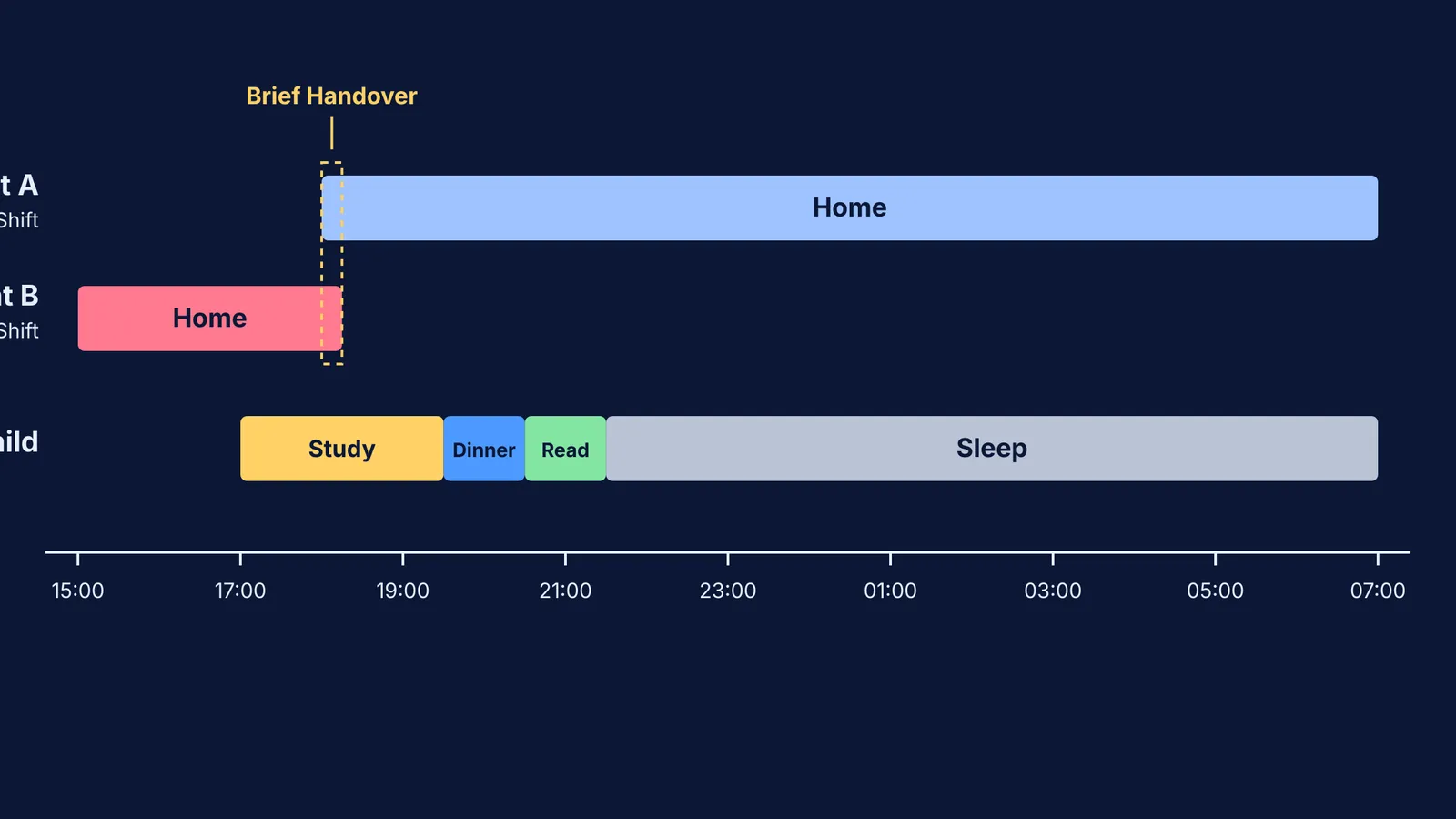
If your family uses a "tag-team" approach to cover childcare, here is how you can stabilize the evening:
Keep the routine, not the person. The sequence of events should be the anchor, not who is leading it. If the rule is to eat dinner at a set time, followed by a reading session, enforce that regardless of which parent is on duty.
Remove screens before bed. Since screen time is a stronger disruptor of sleep than a parent's work schedule, make the bedroom a tech-free zone.
Use a brief handover. When one parent arrives from a day shift and the other leaves for a night shift, use the short overlap to sync up on the child's academic plan.
Separate adult noise from child rest. If you return from a night shift in the early morning, ensure the child's morning routine to get ready for school is independent of your need to sleep.
When a student gets stuck—whether it is an algebra problem or a question about the free expansion of an ideal gas—having access to the Fermi Problem Library provides worked problems with a step-by-step solver that explains the reasoning. This prevents frustration from piling up while waiting for a parent to wake up or return from a shift, keeping the study routine on track.


