

On this page
You walk in at 7:30, your phone is still buzzing, and your child has a worksheet, a chapter to read and a test tomorrow. You do not need hours or a teaching degree to help. You need a short routine with a clear end, so your help is good help rather than long help.
Does helping more with homework actually help?
Not by itself. In a longitudinal study of 1,685 sixth-grade students, how often parents helped with homework was negatively associated with achievement growth, while help that students saw as supportive was linked with better achievement and help they saw as intrusive with worse (Moroni and colleagues, Journal of Educational Research, 2015).
A meta-analysis of 50 studies of middle-school students found that homework help was the only type of parental involvement not consistently linked with higher achievement (Hill and Tyson, Developmental Psychology, 2009). The strongest link was academic socialization: talking about why school matters and connecting it to the child's goals.
A research synthesis found a stronger association with achievement-related outcomes for parent rule-setting than for other homework involvement strategies (Patall, Cooper and Robinson, Review of Educational Research, 2008).
For a tired parent, that is good news: the research points to the quality of your help and clear rules, not more hours.
What does a 30-minute homework routine look like?
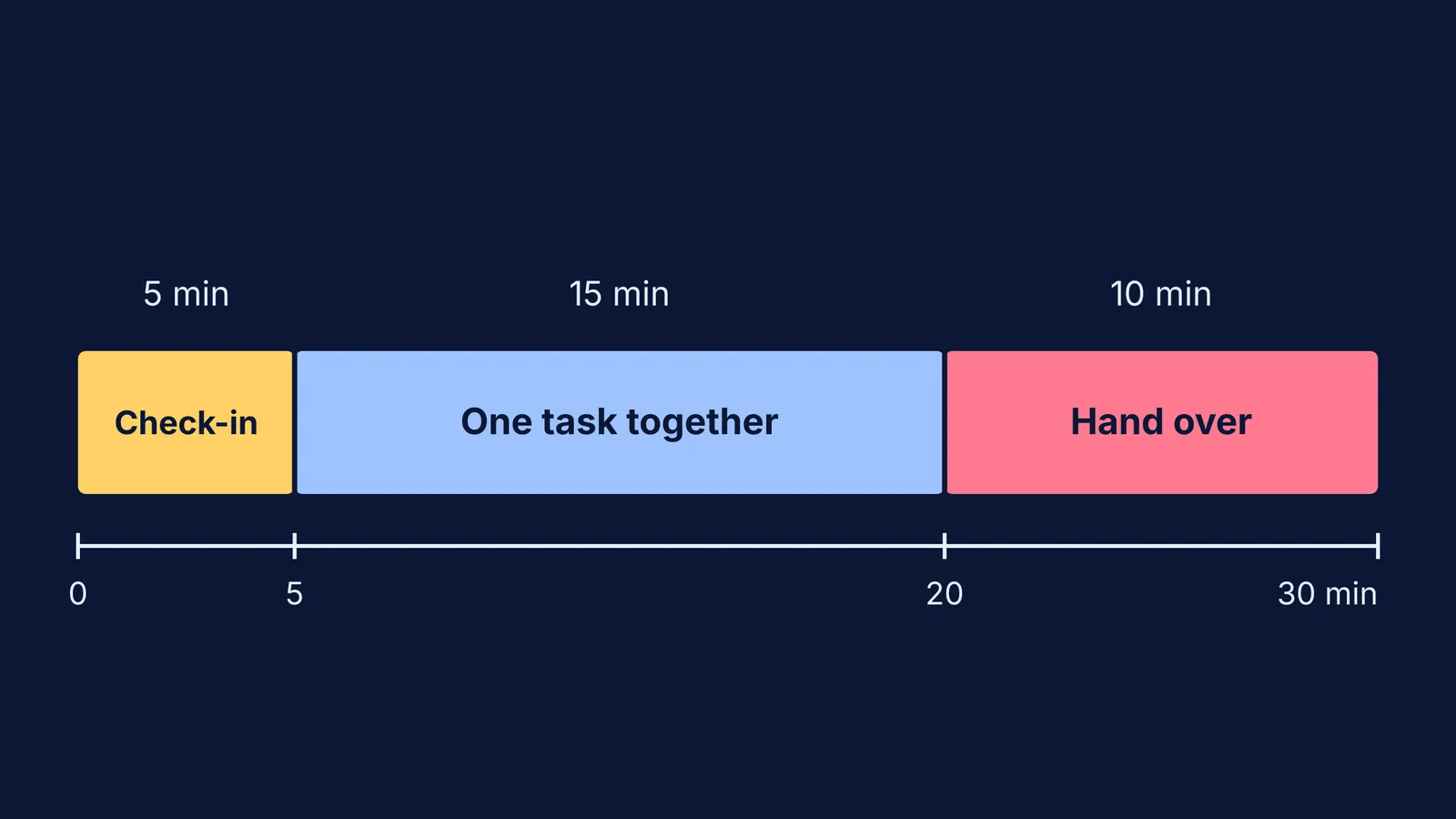
Set a timer. Keep the same start time and place on most evenings; that rule does part of the work for you.
Minutes 0 to 5: check-in. Phones face down. Your child shows you the diary or school app: what is due tomorrow and what feels hardest. You are listening, not inspecting.
Minutes 5 to 20: one focused task together. Pick the single hardest item, not the easiest. Your child does the work; you sit beside them and ask questions. When they get stuck, ask them to show you what they tried.
Minutes 20 to 30: hand over. Your child says out loud the order for the rest and when they expect to finish. You agree one time to check back, to see it is done, not to correct it. Then you leave the room.
For a Class 2 child, shorten the focused task and stay within earshot; if evenings end in tears, read why 6-to-8-year-olds throw homework tantrums. A Class 10 student may need only the check-in.
What should you say when helping with homework?
Supportive help sounds like questions. Intrusive help sounds like corrections and takeovers. Lines that work even after a long day:
Check-in: “What's due tomorrow, and which one are you worried about?”
Starting: “Read the question to me. What is it asking for?”
Stuck: “Show me what you tried. Where did it stop making sense?”
Wrong answer: “Walk me through this step. Does it follow from the line before?”
Hand over: “What will you do next, and by when? I'll come by at nine just to see it's done.”
Why it matters: “You said you want to design games. This is the kind of maths that goes into them.”
Avoid “Let me just do this one”, “This is easy” and comparisons with siblings. For maths, here is how to help a Class 8 child with maths without solving it for them.
What does this look like on a typical weeknight?
Take Meera, an illustrative example. She gets home from work at quarter to eight. Her son Arjun, in Class 7, has a fractions exercise, a science diagram and a Hindi reading.
7:50, check-in. Arjun says fractions are the hard one. He skipped a word problem near the end.
7:55, one task together. They work on that word problem only. Meera asks him to underline what is given and what is asked. He spots that “three-fourths of the remaining” means subtracting first.
8:10, hand over. Arjun plans: rest of fractions, then the diagram, Hindi before bed. Meera says she will look in at nine and goes to make dinner.
9:00, look in. She checks it is all done, names one specific thing she noticed (“You caught the ‘remaining’ trap yourself”), and leaves the marking to the teacher.
Meera did not teach fractions. She gave the evening a shape.
What if your child is still stuck after you leave?
Agree a stuck rule in advance: mark the question, try one different approach, then move on. You may not remember Class 9 chemistry, and that is fine. If the problem is a concept rather than a single question, the Fermi Concept Library has a lesson for every concept in physics, chemistry, biology and mathematics, so your child can go back to the idea instead of copying an answer.
If your hours make even this hard, compare after-school care options for working parents.
Tonight, try just the first five minutes: sit down, phones away, and ask which piece of homework feels hardest.


