

On this page
If your 7-year-old bursts into tears the moment a pencil touches paper, it is easy to assume they are being stubborn. But for children aged 6 to 8, homework resistance is rarely about defiance. It is a biological limit.
Their "mental whiteboard" — the working memory needed to hold instructions, retrieve facts, and plan an action simultaneously — is simply too small for long stretches of work. Understanding this constraint changes how you approach the after-school routine.
Why does my child throw tantrums during homework time?
When a child sits down to a 30-minute worksheet, adults see a task to finish. The child's brain sees an overwhelming flood of cognitive demands.
A study published in the *British Journal of Educational Psychology* found that early struggles with school tasks are strongly linked to deficits in working memory (Gathercole and Pickering, 2000). At age 7, working memory capacity is still developing. When a task requires them to hold multiple steps in mind — such as reading a word problem, remembering the maths rule, and deciding where to write the answer — their mental workspace overloads. The frustration that follows is a stress response to a system failure.
What does cognitive overload look like?
Working memory overload does not always look like confusion. In 6 to 8 year olds, it often looks like bad behaviour. Because they lack the vocabulary to explain that their brain feels too full, they express their frustration physically or emotionally. You might see:
Place-keeping errors: Skipping steps or forgetting what they were doing halfway through a sentence.
Instructional fade: Forgetting the first part of a command by the time they hear the third part.
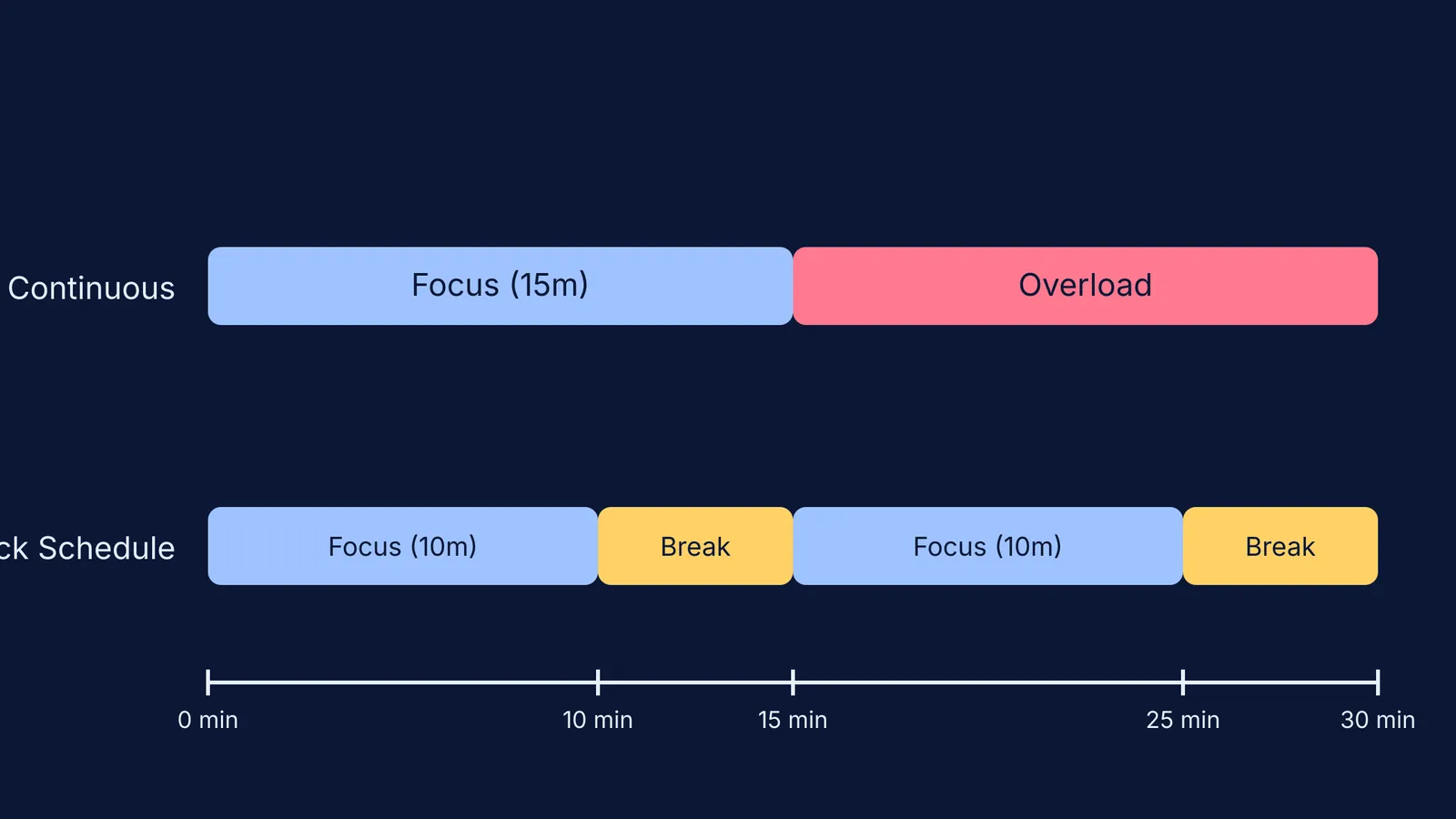
Task abandonment: Staring blankly, complaining they are tired, or refusing to continue after 15 minutes.
How can you stop the homework meltdowns?
You cannot stretch a young child's working memory by forcing them to sit still. Instead, you must shrink the task to fit the memory.
Break it down into shorter blocks A 6-year-old's sustained attention span maxes out around 12 to 18 minutes for adult-directed tasks (Brain Balance Centers). This means expecting a child to power through a 30-minute worksheet in one sitting is fighting against their natural neurological limits. Instead of asking them to finish everything at once, set a timer for 10 minutes. When the timer rings, they stop immediately, even if they are in the middle of a row or a sentence. This creates a predictable boundary and removes the anxiety of an endless task.
Build a calm reset routine After a 10-minute block, the brain needs to clear its whiteboard. A 5-minute physical reset — such as getting a drink of water, doing jumping jacks, or stretching — lowers stress hormones. This 15-minute rhythm allows them to complete more work without crossing into overload.
Why does choice of order matter?
When children feel overwhelmed, they seek control. Allowing them to choose the order of their work restores their agency and lowers starting friction. Ask them, "Do you want to start with spelling or maths?" or "Which three questions do you want to tackle first?"
If you have older children dealing with complex subjects, Fermi's AI tutor builds a plan for the session so they sit down to a clear next step. For young children, you play that role: break the work into manageable chunks before they sit down, so they know exactly what success looks like for the next 10 minutes.
If homework continues to be a battleground, read more about how parents can help children learn without adding pressure or learn when to help with homework and when to step back.


