On this page
Sitting at the kitchen table while your child stares blankly at a Class 8 mathematics problem is a familiar and stressful scene. The urge to take the pencil, take over the page, and show them exactly how to do it is strong. It feels supportive, it ends the immediate frustration, and it gets the homework finished faster so everyone can move on with their evening. But stepping in and solving the problem often backfires on long-term learning.
A 2015 study of 438 young students and their parents found that when math-anxious parents frequently helped with homework by explaining the steps, their children learned significantly less math over the school year. The direct help short-circuits the very cognitive friction that builds independent understanding: the struggle itself. If you dread the subject and want to avoid passing that along, you can read more about what research suggests in our article on parents' maths anxiety.
Why does giving the answer backfire?
When you solve a problem for your child, they are no longer doing mathematics; they are merely copying your steps. This shifts the cognitive load entirely away from the student.
Educational researchers distinguish between unhelpful, overwhelming frustration and "productive struggle"—the necessary effort a student expends to make sense of a mathematical concept that is just beyond their current reach. It is the mental equivalent of lifting weights to build muscle. A 2020 study in the *Journal for Research in Mathematics Education* explored this dynamic by looking at how parents view homework difficulty. The researchers found that parents who believe productive struggle is effective for learning intervene less frequently during homework sessions. By intentionally stepping back, they give their children the necessary space to grapple with the challenge, test hypotheses, make mistakes, and eventually build genuine problem-solving skills.
How do you prompt a stuck student?
Instead of providing a solution, your role is to act as a scaffold. You want to offer the smallest possible nudge to get them moving again.
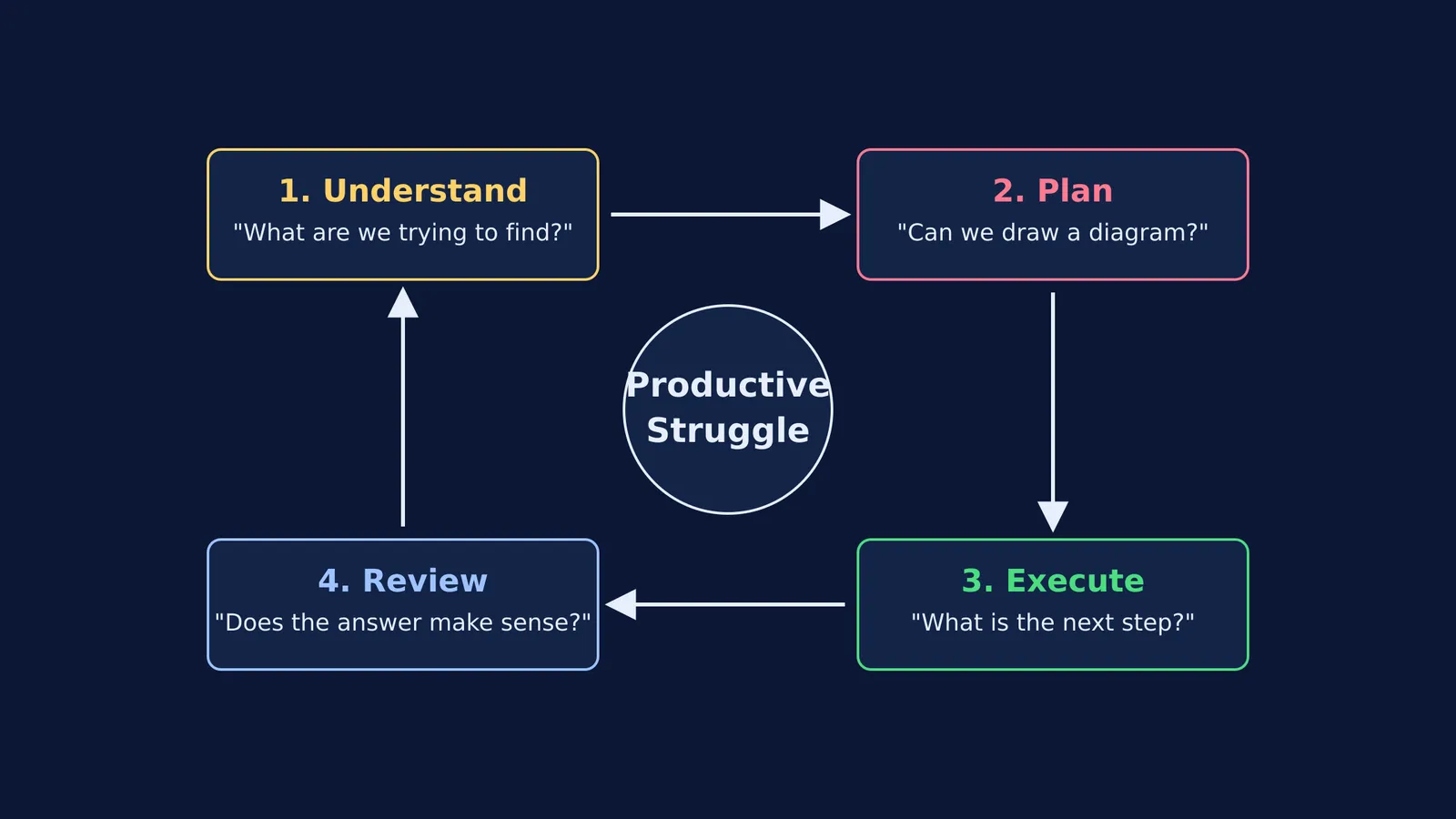
The best framework for this approach was written in 1945 by the mathematician George Pólya. In his classic book *How to Solve It*, Pólya outlined four systematic steps for tackling any mathematical problem. You can easily turn his steps into a script of simple prompts for tonight's homework:
Understand the problem: Ask, "What are we trying to find?" or "What information is already given?" If they cannot answer, ask them to read the question out loud one more time.
Devise a plan: Ask, "Can we draw a picture or diagram of this?" For geometry or word problems, sketching the scenario often breaks the mental block. If you need more specific examples, see our guide on helping your child with maths word problems.
Carry out the plan: Ask, "What is the next step?" If they get stuck, suggest trying a simpler version. If a problem uses confusing fractions or large decimals, swap them out for small whole numbers like 2 and 3 so the underlying logic becomes obvious.
Look back: Once they reach a result, do not just check the answer key. Ask, "Does this answer make sense based on what we started with?"
When you ask these questions, you must be prepared to wait. Silence at the table is often uncomfortable for parents, but it is usually just the sound of a child thinking. Do not rush to fill the quiet with more hints.
What if they are still completely stuck?
By Class 8, the curriculum shifts heavily into formal algebra, linear equations, and geometric proofs. The concepts become increasingly abstract, and sometimes a simple prompt is not enough to bridge the gap.
If your child needs more guided help to get unstuck, Fermi's AI tutor is designed to facilitate this exact kind of productive struggle. Because the tutor teaches rather than answers, it notices where a student is stuck and decides whether to explain, ask, or show. If a student is unsure how to start a complex algebra question, Fermi works out what the student knows and builds a plan for the session, keeping the focus on learning rather than just finishing the page. For physical or spatial questions that need visualising, the Fermi Simulation Lab provides interactive simulations for the ideas that are easier to see than to read.
Tonight, try a new approach to the homework routine. Keep the pencil in your child's hand, ask what they know so far, and let them do the heavy lifting.