

On this page
In many Indian homes, the daily care of children, homework included, falls mainly to the mother. India's Time Use Survey 2024 press note from MoSPI found that 41% of women aged 15 to 59 took part in caregiving for household members on a given day, against 21.4% of men. Women who gave such care spent about 140 minutes a day on it; men spent about 74. When both parents work, sharing homework is fairer. Done well, with one set of rules, it can also be better for your child.
Why does consistency matter more than who helps?
Children notice whether their parents act as a team. A meta-analysis by Daniela Teubert and Martin Pinquart combined 59 studies on coparenting, meaning how parents cooperate, agree, clash or pull the child into their disagreements. Coparenting was linked to children's psychological adjustment, and it predicted change in that adjustment over time. The effects were small, but they stayed significant after the researchers controlled for each parent's own parenting or for the quality of the marriage.
Homework is where small disagreements show up every evening. One parent lets the child rub out and rewrite; the other says leave it. A six-year-old will struggle to follow both.
Two more findings shape the split:
A study of 1,685 sixth-grade students by Moroni and colleagues found that how often parents helped with homework was linked to weaker growth in achievement, while help the students saw as supportive predicted better outcomes and help they saw as intrusive predicted worse.
A research synthesis by Patall, Cooper and Robinson found that training parents to be involved in homework led to higher homework completion and fewer homework problems among elementary school children, and that parents setting rules showed a stronger link with achievement than other kinds of involvement.
So taking turns does not mean twice the help. It means each parent helps less often and more calmly, under rules you both agreed.
Should you split homework by subject or by day?
Both work. Match it to your shifts and your child's age.
By day suits Class 1 to 3, when homework is short, and fixed work timings.
By subject suits older children, or a parent who is clearly stronger in maths or a language. It needs both parents home most evenings.
Hybrid: one parent owns each day, and the other is the go-to person for one subject, asked only when the owner wants help.
If you split by subject, agree to follow the school's method, even if you learnt it differently. Our guide to why your maths method differs from the school method explains how to check it with the teacher. If the parent on maths duty wants to refresh an idea first, the Fermi Concept Library has a lesson for each concept in mathematics.
What does a fair weekly rota look like?
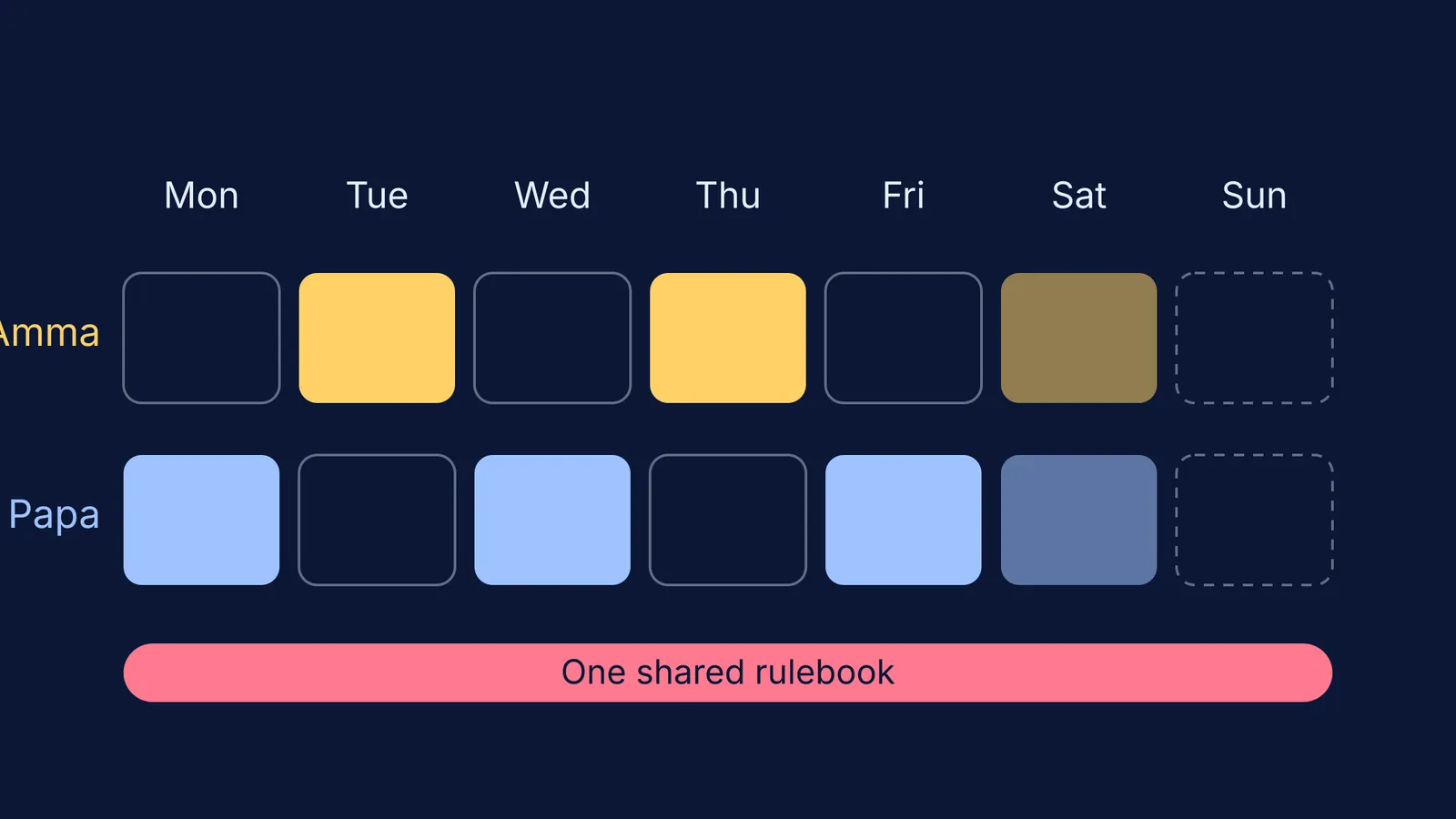
Here is a worked example for Meera, a Class 1 child. Her father works from home on Monday, Wednesday and Friday. Her mother finishes early on Tuesday and Thursday.
Monday, Wednesday, Friday: Papa owns homework, 6.30 to 6.50 pm.
Tuesday, Thursday: Amma owns homework, same time, same table.
Saturday: both parents, 15 minutes. Look through the school diary and notebooks together and agree one thing to change next week.
Sunday: no homework time. Meera packs her bag for Monday with Papa, since he owns Monday.
Owning a day means you sit with the child, sign the diary and give the instructions that evening. The other parent can bring water and praise effort, but stays out of the instructions. For a short evening structure to run inside each slot, see this 30-minute homework routine for working parents.
How do you avoid giving your child mixed instructions?
Write a one-page rulebook together and stick it near the study table. Settle these once:
Where and when homework happens, and what happens to screens.
What to do when stuck: try once more, then ask; the parent gives a hint, not the answer.
Rubbing out: allowed, or cross out neatly with one line.
Mistakes: point to the line, and the child fixes it.
Methods: always the school's method.
Praise: for effort and checking, not just for finishing.
Then hand over in two minutes, by message or at dinner. A handover can be as short as: 'Maths page 14 done. She got stuck on counting back, so I showed her the number line. Diary says bring a leaf for EVS tomorrow.'
If you disagree with how the other parent handled something, do not correct them in front of your child. Say: 'Let us talk about it after she sleeps.' Then change the rulebook together.
What if one parent is away or on night shifts?
The absent parent can still own a small, fixed slot: a five-minute video call to hear the reading, or the Saturday review. Grandparents and other helpers follow the same rulebook. For more on stepping in without taking over, read how fathers can help with homework.
Start this week: agree the rulebook on Sunday, try the rota for two weeks, and adjust it at the Saturday review.


