

On this page
You sit down with your child to help with maths homework. You see a multiplication or addition problem and immediately show them how to stack the numbers and "carry the one." They look at you in frustration and say, "That is not how my teacher does it!"
This homework standoff happens in living rooms every evening. If your maths method differs from the school method, you are not alone. As curricula have evolved, the way schools teach basic arithmetic and algebra has shifted from memorising rules to building a deep understanding of numbers.
Why is my maths method different from the school method?
The core difference between the way most adults learned maths and the way it is taught today is the shift from procedural fluency to conceptual understanding.
Older parent methods usually rely on standard algorithms. These are efficient, step-by-step procedures designed to get the correct answer quickly, such as long division or cross-multiplying. However, they often hide the actual logic of the numbers.
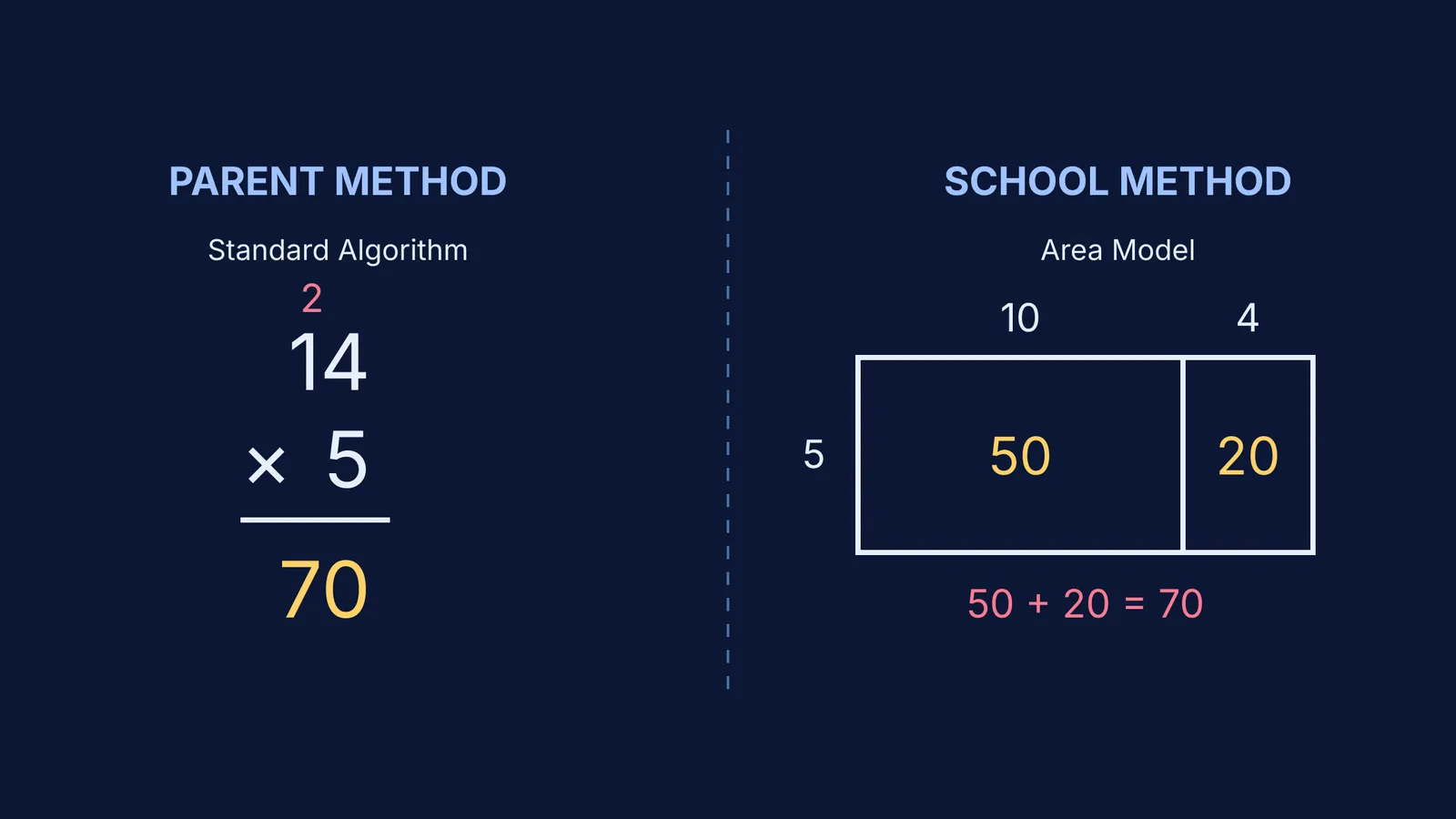
Modern school methods focus on showing why the maths works. Teachers use visual models, such as number lines and area models, or strategies like "decomposing" numbers into tens and units. For example, instead of immediately stacking 14 × 5 vertically, a teacher might draw a rectangle split into 10 and 4, showing that (10 × 5) + (4 × 5) equals 70. This builds a foundation of number sense that becomes critical when students reach advanced algebra.
The risk of the "rescue" approach
When a child is stuck, a parent's instinct is to rescue them by demonstrating the familiar, faster way. However, research shows that introducing a conflicting method during a moment of frustration can do more harm than good.
A 2015 study by researchers at the University of Chicago found that when math-anxious parents frequently help with homework, their children actually learn significantly less math and develop higher math anxiety. The researchers concluded that the conflicting methods and the parents' own stress create a double burden for the child, who internalises the belief that maths is inherently confusing.
Furthermore, a 2023 meta-analysis published in *Frontiers in Psychology* examined how different types of parental involvement affect mathematics achievement across more than 16,000 students. The study found that "intrusive" involvement—such as taking over the problem or strictly controlling the method—is negatively linked to a child's achievement.
How to help when methods clash?
If you do not recognise the method on the worksheet, the goal is to shift from being a teacher to being a coach. You do not need to know the mathematical steps; you only need to help your child navigate their own confusion.
Here is a supportive framework to use instead of taking over:
Ask, do not tell: Say, "Can you show me the exact point where this stopped making sense?" or "What did your teacher draw on the board today?"
Value their visuals: If they are drawing boxes or number lines, encourage it. These are not signs that they are behind; they are tools for organising thought.
Check the reasoning: If they are completely stuck, the Fermi Problem Library has worked problems with a step-by-step solver that explains the reasoning rather than printing an answer. This helps students reconstruct the school's logic.
Use AI as a bridge: If your child is struggling to remember the concept entirely, Fermi's AI tutor can help. It works out what the student knows and builds a plan for the session, asking questions rather than simply handing over a different method.
Should they learn multiple methods?
Eventually, understanding multiple ways to solve a problem builds cognitive flexibility. A student who can solve a problem using an area model, a number line, and a standard algorithm has a much deeper grasp of mathematics than a student who only knows one rule.
However, timing matters. When a child is first learning a new concept in primary or middle school, introducing a second, conflicting method at the kitchen table often overwhelms their working memory. It is better to let them master the school's conceptual method first. Once they have built that solid foundation, they will naturally see how the standard, faster algorithms connect to the visual models they already understand.
If homework routinely causes tears or takes hours to complete, it is a signal to contact the school. It is always better to write a note to the teacher saying, "We spent 20 minutes on this but got stuck," rather than forcing a child to learn a different method just to finish the page. Instead of forcing a new algorithm, you can build their number sense outside of homework hours by pointing out maths in daily life or exploring maths while cooking for younger children. By keeping the pressure low, you can help them navigate the school's methods with confidence.


