

On this page
When a teenager looks at a page of algebra, the most common question they ask is, "When will I ever use this?" It is a fair question. School mathematics can feel abstract, disconnected from the problems a 15-year-old faces every day. Yet, mathematical thinking is the foundation of managing money, understanding technology, and even cooking dinner.
Without a practical anchor, students can lose motivation. When you show a teenager how mathematical concepts solve problems they care about, the subject shifts from a chore to a tool. Here are three everyday areas where you can point out the maths hidden in plain sight.
How is maths used in phone plans and data?
For most teenagers, a smartphone is their primary connection to the world. According to a 2023 Pew Research Center study, 46% of teens say they use the internet "almost constantly". This constant use consumes a massive amount of data, especially through high-definition video streaming and image-heavy social media applications.
Managing a family data plan is an excellent everyday exercise in percentages, rates and basic algebra. If a family plan shares 50 GB of data a month, and a teenager has used 12 GB by the tenth day of a 30-day billing cycle, they are consuming data at a rate of 1.2 GB per day.
By setting up a simple linear equation, 12 + 1.2x = 50, they can calculate exactly how many days they have left before hitting the limit. You can also use this scenario to practice percentages: if they have used 12 GB out of an allocated 20 GB personal limit, they have consumed 60% of their allowance. This kind of calculation teaches them to forecast their usage and adjust their habits before they run out of data.
Why does compound interest matter for student loans?
Financial literacy is one of the most critical applications of mathematics, yet it remains poorly understood by young people. A June 2024 report on the OECD PISA 2022 financial literacy assessment found that only 11% of 15-year-old students understood how compound interest works.
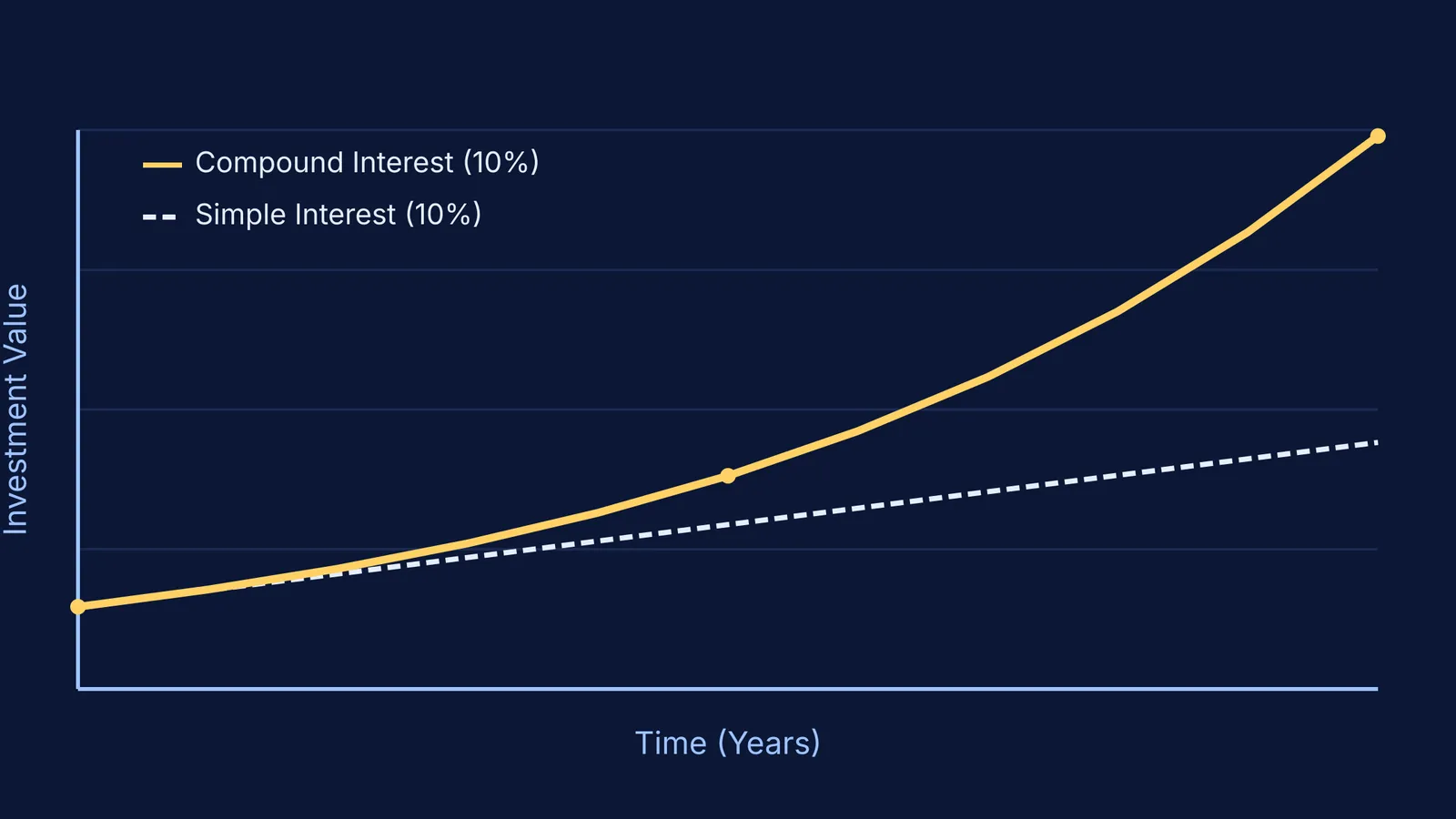
Understanding exponential growth is essential for anyone who will take out a student loan, buy a car, or open a savings account. While simple interest grows in a straight line, compound interest grows exponentially because you earn or owe interest on the previously accumulated interest.
If you invest ₹10,000 at a 10% annual compound interest rate, you earn ₹1,000 in the first year. In the second year, you do not just earn another ₹1,000; you earn 10% on the new total of ₹11,000. Over twenty years, the difference between simple and compound interest is staggering. Showing them the curve of compound interest makes the power of exponents visible, proving why starting to save early is so beneficial.
When a student is stuck on the equations behind exponential growth or needs help seeing how the algebraic steps fit together, Fermi's AI tutor can work out what they already know and build a plan for the session, teaching through the problem rather than just printing an answer. This approach helps students master the underlying logic they need for Quadratic word problems in Class 10 and beyond.
How is maths used in cooking?
Cooking is applied mathematics. Every time you scale a recipe up or down to feed a different number of people, you are using fractions, ratios, and proportions.
Imagine a pancake recipe that serves four people, requiring 2¼ cups of flour. If your teenager wants to make enough for six people, they must find the scaling factor—which is 6 divided by 4, or 1.5—and multiply the ingredients. Converting 2¼ to an improper fraction (9/4) and multiplying it by 3/2 gives 27/8, or 3⅜ cups of flour.
Ratios are equally important for balancing flavours. A classic vinaigrette dressing uses a strict ratio of 3 parts oil to 1 part vinegar. Whether making a tablespoon for a single salad or a litre for a party, keeping that 3:1 ratio consistent is what guarantees the dressing tastes correct. Looking at data and ratios critically is a skill that translates into everything from balancing kitchen chemistry to drawing a John Tukey and the box plot for statistics.
A practical script for parents
It is easy to tell a teenager that maths is important, but showing them how to use it works much better. Here is a simple framework for bringing mathematics into daily conversations without turning it into a stressful lecture:
Ask for their help with a real financial decision: "I am trying to figure out which streaming subscription is cheaper over the year if we factor in the introductory discount. Can you run the numbers for me?"
Hand over the recipe responsibility: "We have six guests tonight instead of our usual four. Can you rewrite the ingredient list so we have enough food?"
Visualise the future together: "Let's look at a compound interest calculator online to see what happens if you save ₹500 a month until you are twenty-five."
When teenagers see that algebra can save them money, maths becomes a useful life skill—try calculating your family's data usage together this weekend.


