

On this page
Why does a father's involvement in homework matter?
In many homes, homework oversight defaults to mothers. Yet when fathers step into academic support, their involvement produces measurable advantages. In a meta-analysis encompassing 66 studies in Urban Education, William H. Jeynes demonstrated that paternal involvement has a statistically significant positive effect size of usually just under 0.2 standard deviations across academic achievement. This relationship held steady across elementary and secondary grades, and for both boys and girls.
Crucially, subtle engagement mattered far more than surveillance. Communicating high expectations, taking an interest in daily coursework, and maintaining an encouraging home climate correlated more strongly with academic success than policing completed notebook pages. When a father actively values learning, children perceive education as a household priority. Deciding when to help with homework and when to step back begins by recognizing that your presence serves as encouragement rather than supervision.
How can fathers help with daily assignments without taking over?
A common stumbling block for fathers is the temptation to fix mistakes or direct every step. Education research shows that this intrusive style often backfires. In a study of middle school students in The Journal of Educational Research, Sandra Moroni and colleagues found that the frequency of parental homework help was negatively associated with student achievement once prior grades were controlled. However, the quality of help changed the outcome entirely: help perceived as supportive and autonomy-granting was positively linked to achievement, whereas intrusive, controlling help predicted lower competence and poorer marks.
To adopt an autonomy-supportive approach, treat your role like an on-call consultant:
Set up the environment: ensure a quiet surface with necessary supplies and zero screen distractions before study begins.
Let your child choose their workflow: ask whether they prefer tackling a difficult topic first or warming up with an easier task.
Wait for an invitation: allow them to grapple with challenging material for several minutes before offering input.
Emphasize reasoning over answers: praise persistent problem-solving strategies rather than effortless completion.
What makes weekend projects and shared reading effective?
Homework support extends well beyond textbook worksheets. Informal routines outside the school week build the mental scaffolding required for independent study. In early literacy, research published in First Language by Elisabeth Duursma found that fathers have a distinct interaction style during shared reading. While mothers often focus on immediate details like naming objects, fathers use significantly more non-immediate talk—asking "bridge" questions that connect the story to real-world experiences, family events, and practical concepts. This cognitively demanding conversation prompts children to use richer vocabulary and practice abstract reasoning.
For older students, weekend projects offer an ideal venue to practice active learning without grading pressure. You might measure cooling rates of liquid to explore heat transfer or build simple structures to test mechanical loads.
When assignments involve advanced STEM coursework where you no longer remember the specific formulas, focus on helping with maths you have forgotten by exploring reliable resources together. The Fermi Concept Library maps every concept in physics, chemistry, biology, mathematics and computing, each with its own lesson and its place in the map. For multi-step numerical exercises, the Fermi Problem Library provides worked problems with a step-by-step solver that explains the reasoning rather than printing an answer, allowing parent and child to dissect the logic side by side.
Why should fathers attend parent-teacher meetings?
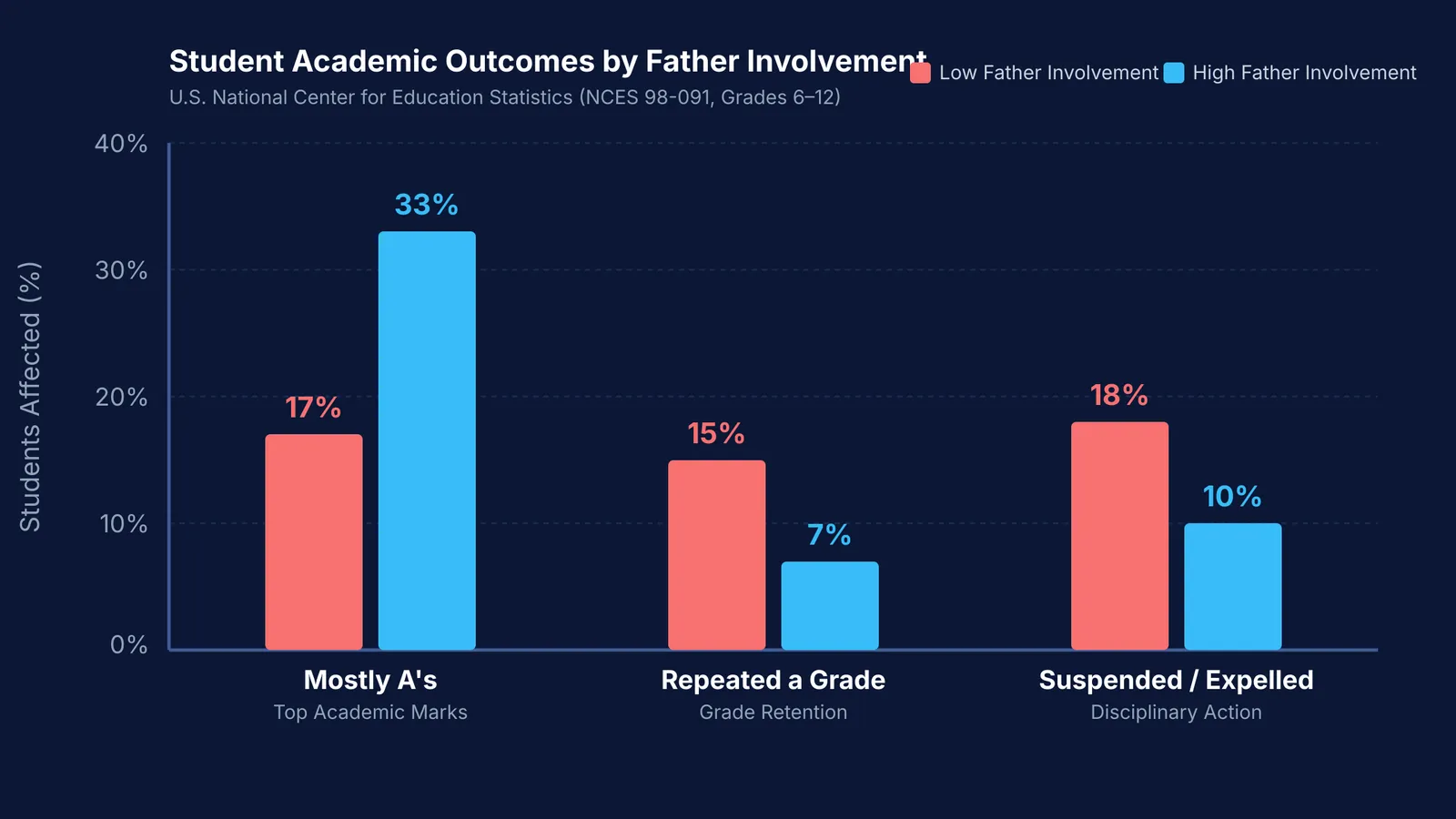
One of the most consequential ways a father can support academic progress happens inside the school building. A landmark report from the U.S. National Center for Education Statistics (NCES 98-091) by Christine Winquist Nord, DeeAnn Brimhall, and Jerry West analyzed survey data on parental engagement. In two-parent households, only 39% of fathers attended parent-teacher conferences compared to 68% of mothers, and only 27% participated in three or more school activities compared to 56% of mothers.
Yet the academic payoff of paternal presence was profound. Children whose fathers demonstrated high school involvement were nearly twice as likely to earn mostly A's—33% compared to 17% among students whose fathers had low involvement. Furthermore, students with highly involved fathers were less than half as likely to repeat a grade (7% compared to 15%) and significantly less likely to face suspension or expulsion (10% compared to 18%). Attending meetings demonstrates that learning is a shared family responsibility. Preparing specific parent-teacher meeting questions that lead to real follow-up ensures these discussions result in concrete support.
What should you say when your child gets stuck?
When your child hits an impasse and asks you to solve it, resist giving the final answer. Use a three-step Socratic prompt routine to keep ownership of the problem with them:
The Restatement Prompt: "Can you read the problem aloud and tell me what it is asking for in your own words?" This separates vocabulary confusion from conceptual gaps.
The Anchor Prompt: "Where in your textbook chapter or class notes did you see a similar example?" This trains your child to seek existing models rather than waiting for an external solution.
The Hypothesis Prompt: "What is one possible first step we could write down, even if we are not sure it will work?" This normalizes drafting and reduces the fear of making a mistake.
Sharing homework support does not require mastering every secondary school syllabus. By establishing consistent study hours, asking open-ended questions, and participating directly in school dialogues, fathers help build resilient, self-directed learners.


