

On this page
Many parents will recognise this pattern. Your teenager gets home at 4, sleeps from about 4:15 until 6:15, wakes up groggy, starts studying after dinner and is still at the desk at midnight. The 6 am alarm means they come home exhausted and nap again. It's not laziness, it's a loop, and you can start breaking it in about a week.
Is an after-school nap bad for night sleep?
Not always. It depends on how long the nap is and how late it ends. A 2024 study in the journal Sleep tracked 153 secondary-school students in Singapore, average age 16.6, with wrist activity monitors and sleep diaries. They napped about 2.3 times a week. The average nap lasted 82 minutes and started around 3 pm.
On school days, napping an hour longer than usual meant about 29 fewer minutes of sleep that night. On weekends it was the timing that mattered: for each hour later a teenager woke from a nap, they went to bed about 16 minutes later. The authors concluded that naps may harm the same night's sleep "only if they are long and occur late."
Waking up earlier than usual also made students more likely to nap that day. So a long nap can be a patch for a short night, and the patch then shortens the next night.
How long should an after-school nap be?
Short. In a 2006 study by Amber Brooks and Leon Lack, 24 healthy young adults had their night's sleep cut to about 5 hours. They then took a 3 pm nap of 0, 5, 10, 20 or 30 minutes in a sleep laboratory. The 10-minute nap improved alertness and performance straight away, and some of the benefits lasted up to 155 minutes. The 20-minute nap helped too, but the gains took about 35 minutes to appear. After the 30-minute nap they were groggy at first, a state called sleep inertia. The researchers judged 10 minutes the most effective of the lengths they tested.
Those volunteers were adults, so treat this as a guide.
How much sleep does a school child need?
The American Academy of Sleep Medicine consensus recommends 9 to 12 hours per 24 hours for children aged 6 to 12, and 8 to 10 hours for teenagers aged 13 to 18.
For our example teenager, 12 am to 6 am is 6 hours, plus a 2-hour nap makes 8. That only just reaches the teenage range, and only by borrowing the afternoon. The plan below ends with 7 hours 45 minutes at night plus a 20-minute nap, and frees the evening for study. A younger child needs more, so aim for an earlier bedtime.
How do you shift the routine back over a week?
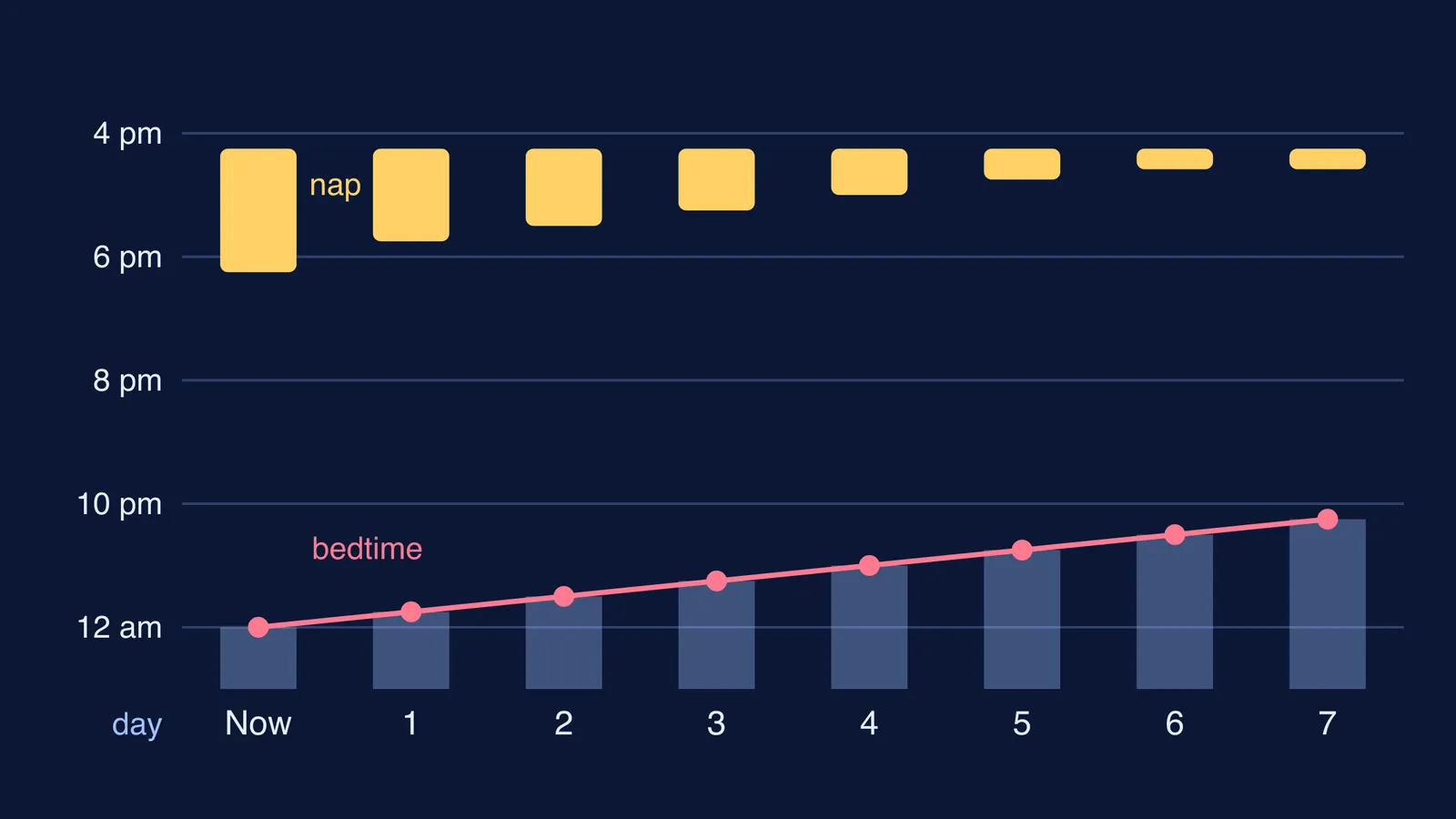
Before the 2014 school year, Timothy Morgenthaler, then president of the AASM, advised parents to ease bedtime back "at least 15 minutes earlier each night" and to wake children 15 minutes earlier too, even on weekends. Our example teenager already wakes at 6 am, so this plan keeps wake-up fixed at 6 am every day, Sunday included, and moves only bedtime. The nap starts at 4:15 pm and gets shorter as bedtime moves earlier:
Day 1: nap 90 minutes, bed 11:45 pm
Day 2: nap 75 minutes, bed 11:30 pm
Day 3: nap 60 minutes, bed 11:15 pm
Day 4: nap 45 minutes, bed 11:00 pm
Day 5: nap 30 minutes, bed 10:45 pm
Day 6: nap 20 minutes, bed 10:30 pm
Day 7: nap 20 minutes, bed 10:15 pm
By the end of the week, hard study moves to roughly 5 to 8 pm, after the nap. If the shorter evening feels tight, Fermi's AI tutor can work out what your child already knows and build a plan for the session, so they sit down to a clear next step instead of rereading notes until midnight.
Morning light helps the body clock follow along. In a 2020 study of 37 teenagers with late bedtimes and short school-night sleep, 2.5 hours of bright light on Saturday and Sunday mornings moved their body clocks about an hour earlier, more than dim light did. Open the curtains as soon as your child wakes.
What to say, so it doesn't sound like a punishment: "You're not in trouble. Let's try one week where the nap gets shorter and bedtime moves 15 minutes a day. You choose what goes in the 5-to-8 study slot."
Expect some resistance: here is why teenagers feel sleepy later at night and how to shift a teen's bedtime earlier for school. Before swapping late nights for very early mornings, read whether a teenager should wake up at 4 am to study.
When should you look beyond the routine?
See your paediatrician if your child is still exhausted after two weeks of enough night sleep, snores loudly, falls asleep in class or seems low most days. Sleepiness can have medical causes that a timetable won't fix. If stress or low mood is behind the late nights, the free, 24x7 Tele MANAS helpline, 14416, offers support in around 20 languages.
Start tonight with one change: set an alarm for the after-school nap.


