

On this page
Teenagers are biologically wired to be night owls, but early school start times force them into an exhausting schedule. If your teen is regularly staying up past midnight and struggling to wake up at 6:00 AM, it is not just stubbornness—it is biology.
Here is what is happening and how you can gently reset their internal clock.
Why do teenagers naturally stay up so late?
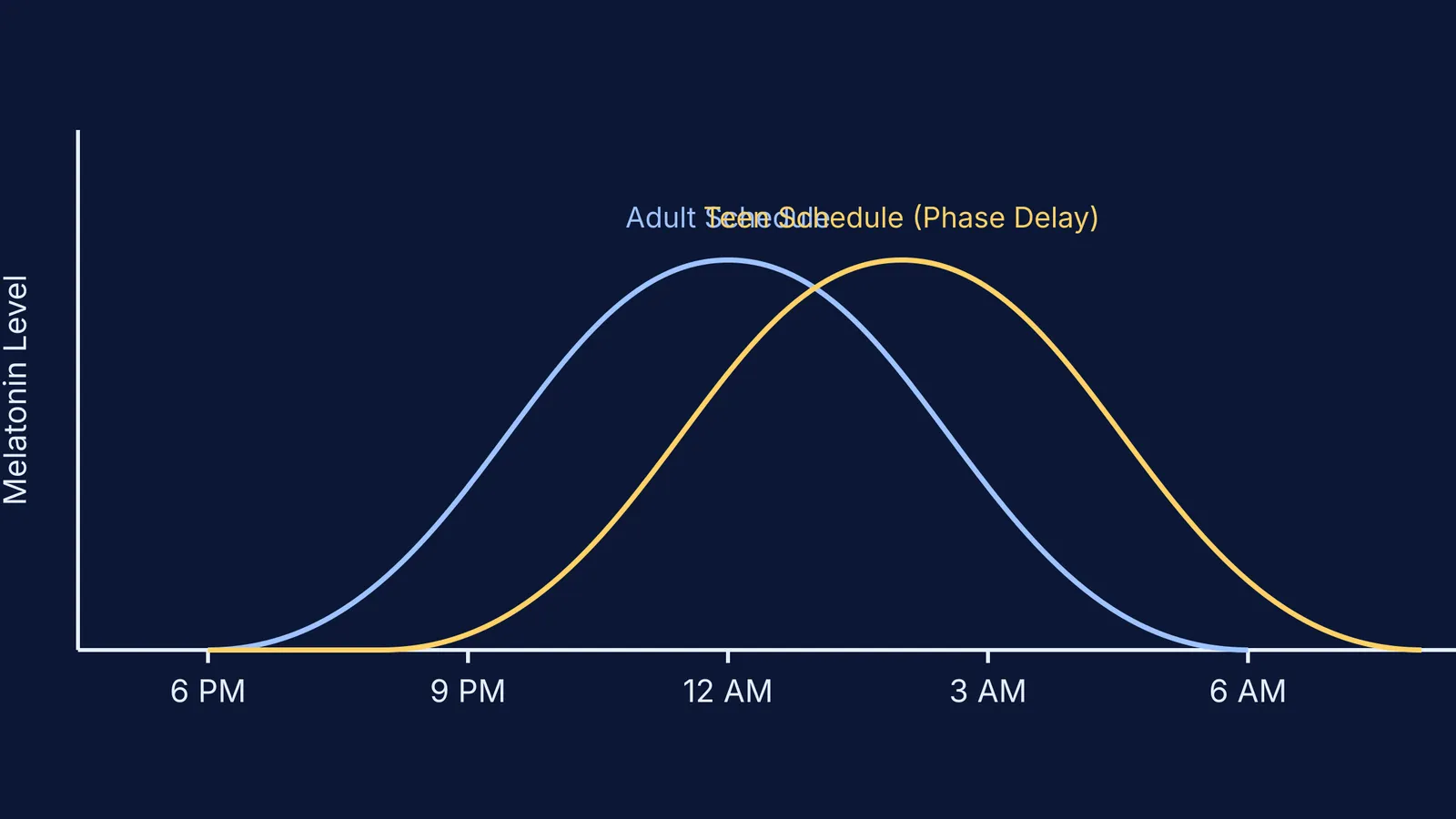
During adolescence, a teenager's internal biological clock undergoes a shift known as a circadian rhythm phase delay. According to the Sleep Foundation, a teen's body begins producing melatonin—the hormone that signals it is time to sleep—much later in the evening than a child's or an adult's body does (Sleep Foundation). Because of this delayed melatonin release, most teens do not naturally feel sleepy until 11:00 PM or midnight.
Coupled with a slower buildup of "sleep drive" (the pressure to sleep that accumulates throughout the day), teens can easily stay awake long after the rest of the household has gone to bed. While an adult might feel their eyelids drooping by 10:00 PM, a high school student is often wide awake and mentally active at the same hour. This biological delay makes the classic parental advice of simply "going to bed earlier" frustrating and ineffective, because the teen is genuinely unable to fall asleep.
What happens when sleep is cut short?
The CDC recommends that teens aged 13 to 17 get 8 to 10 hours of sleep per 24 hours on a regular basis (CDC). However, when a biological drive to stay up until midnight collides with a 6:00 AM school alarm, teens are chronically shortchanged.
A lack of adequate sleep does more than make mornings difficult. The CDC notes that insufficient sleep reduces attention and memory, making daily learning much harder (CDC). Students who do not get enough rest struggle to process complex subjects like physics and maths, and they are more prone to making simple errors in exams. Furthermore, sleep deprivation increases the risk of mood swings, stress, and poor physical health.
How to reset the sleep clock without arguments?
Forcing a sudden shift—like demanding lights out at 9:30 PM when they usually sleep at midnight—rarely works because their bodies simply are not ready to sleep. Instead, habits take time to build. Much like the study of habits of study by William James noted, small, repeated actions are the best way to shape our routines.
Use this gradual plan to shift their sleep schedule without turning every evening into a battle:
Move in small increments: Shift bedtime earlier by a small amount every few days. This gives their internal clock a chance to adjust naturally to the new expectation.
Enforce the 30-minute digital sunset: The CDC recommends turning off electronic devices at least 30 minutes before bedtime (CDC). The blue light from smartphone and tablet screens directly suppresses whatever melatonin their bodies are trying to produce.
Anchor the morning wake-up: Keep the wake-up time consistent, even on weekends. Exposure to bright natural light first thing in the morning acts as a powerful signal to reset the circadian rhythm to an earlier start time.
Partner with them: Just as a trial that helped parents explain why maths and science matter showed, guiding teenagers is more successful when parents provide steady, patient support rather than strict top-down policing. Explain the biology to them so they understand the goal is feeling better, not just following a rule.
How can we make earlier study time work?
Shifting sleep earlier means homework that used to happen at midnight now has to happen in the late afternoon or early evening. To make this new schedule stick, the study time itself has to be effective and engaging. When a student is exhausted from school, simply staring at a textbook is a recipe for procrastination.
If late afternoons are spent staring at a confusing assignment without knowing where to start, Fermi's AI tutor can help. A student brings a topic, a course, a problem set or a scanned assignment. Fermi works out what they already know, builds a plan for the session, and teaches through it — writing on a board, drawing the figure, running the simulation, and checking understanding as it goes.
For dense topics that are hard to process after a long school day, active tools work significantly better than passive reading. The Fermi Problem Library has worked problems with a step-by-step solver that explains the reasoning rather than printing an answer, keeping the student actively engaged in the process. If a scientific concept is difficult to grasp from a textbook, the Fermi Simulation Lab provides interactive simulations for the ideas that are easier to see than to read.
With a gradual adjustment plan, strict limits on evening blue light, and active tools for their new evening study hours, your teen can get the sleep they need. Try the Fermi Problem Library to make their next study session more effective.


